Those watching the West Virginia Mountaineers take on the Kentucky Wildcats may have caught a glimpse of Almost Heaven during commercial breaks.
The state Division of Tourism debuted a new ad during the NCAA men’s basketball tournament game, taking advantage of the Mountaineer’s primetime Sweet 16 game to showcase the Mountain State.
“This ad was originally supposed to be launched in April, but we took this incredible opportunity to put it into the Sweet 16, Mountaineers against Kentucky,” said Tourism Commissioner Amy Goodwin. “A lot of folks are going to be watching across the nation, particularly in our market, which includes Pennsylvania, Ohio, the D.C. area and Maryland. It made good sense for us to showcase our new commercial in our market.”
The ad will air on CBS affiliates across West Virginia and in cities like Pittsburgh, Cleveland, Columbus, Cincinnati, Richmond, Charlotte, Greensboro, Baltimore and Washington, D.C.
Goodwin said the ad is part of a larger spring advertising campaign designed to entice spring break and summer travelers to travel West Virginia.
“We’re excited about it,” Goodwin said. “It’s shot in West Virginia with real West Virginians doing real things. The message of the commercial is there are a lot of things to do in West Virginia and your children will love it, your family will love it. The message is West Virginia has a lot to offer for families. We’re really close. We’re really close to you and there are lots of things you can do.”
Ratings for this year’s men’s basketball tournament have increased over last year’s. According to CBS Sports, third-round coverage registered the highest-ever overnight ratings, up 14 percent over last year. Broadcastingcable.com shows a steady increase in the number of viewers the popular tournament attracts. If the trend continues, more than 10 million people could watch the Mountaineers play Kentucky for a spot in the Elite Eight.
“Obviously with the amount of people watching not only West Virginia but also Kentucky, this is a great opportunity to hit those folks in our key markets and our key demographics,” Goodwin said.
Contact writer Whitney Burdette at 304-348-7939 or whitney.burdette@dailymailwv.com. Follow her at www.Twitter.com/wburdette_DM.
Long before the age of Internet lists and online travel magazines, people came to Asheville and Western North Carolina for the intrinsic natural beauty — diverse wildlife, clean air, lush forests, clear waters, ancient mountains and one of the world’s oldest rivers, the French Broad.
The beauty of our environment is what many say makes this place so special. But are we protecting what we have? What initiatives are underway to help ensure that the region remains a respite and a haven for generations to come?
Water
And we’ll all float on: RiverLink’s annual water parade, Anything That Floats, is a chance for participants to create colorful floats and costumes — and enjoy the French Broad. Photo courtesy of RiverLink
Rivers have been key to the development and survival of many cities, but getting people to understand their importance hasn’t always been easy. The story of the French Broad is one of transformation and survival. KarenCragnolin, executive director of RiverLink, describes the evolution of Asheville’s waterfront — from a thriving business and community center wiped out by a flood in 1916 to a semi-deserted warehouse district and polluted waterway in the mid-20th century. Today though, the waterfront is home to the bustling River Arts District, which draws both visitors and residents to popular restaurants and studio tours.
Cragnolin credits the river’s economic and environmental renewal to the writings of local activist Wilma Dykeman in the 1950s and the continued work of residents, activists and groups like RiverLink, which launched in 1989. Cragnolin says RiverLink’s work to restore the environmental and recreational health of the river is ongoing. “We realized this was a 60-year project,” she adds.
Today, almost halfway into the grand vision, several projects have taken shape on the river. Part of the revival has included cleanups and pollution controls that improved water quality and increased public access through green spaces like Carrier Park, French Broad River Park and the 1.2 miles of greenway along the banks of the river and throughout the RAD. In September 2014, the city received a $14.6 million grant for its RAD improvement plan, which will go toward building the 2.2-mile Wilma Dykeman Riverway, developed in partnership with RiverLink. When completed, the new section will link 17 miles of trails along the French Broad and Swannanoa rivers. A visitor or resident could “get on a greenway at Broadway and go all the way to the arboretum without having to get on a road,” Cragnolin says.
But the future health of the French Broad will hinge on much more than outdoor recreation. A serious concern, Cragnolin emphasizes, is the need to figure out how — if at all — our water will be shared with other parts of WNC and the state, as population pressures, climate change and other factors lead to water shortages. She notes that local water suppliers like the city of Asheville already have agreements with neighboring municipalities, towns and counties for interbasin transfers — agreements to take water from one area and provide for another that doesn’t have enough for its populace.
Water sharing will be “a huge issue in the future,” Cragnolin says, adding that, “We haven’t established the rules on how we share it.” Current legislation allows N.C.’s governor to call for interbasin transfers as an emergency measure, and Cragnolin notes that such transfers have already occurred for areas of the French Broad when Henderson County transferred water to Polk County.
“How do we decide, as a watershed entity, who gets our water? Do we want anyone to get it?” Cragnolin asks. “We’ve got to figure this out.”
Air
The Clean Smokestacks Act required emissions from coal-fired power plants — including at Duke Energy’s Asheville site — to be significantly reduced. Photo by Max Cooper
The Canary Coalition formed in 1999 specifically to address deteriorating air quality in the mountains. At that time, “it was becoming very clear that this region was subject to some of the worst air pollution in the country,” says Avram Friedman, executive director of the Sylva-based nonprofit.
Research by the National Park Service, which began tracking air pollution in the 1980s, demonstrated how bad things were, he recalls. “We weren’t fully aware of the extent of which coal was a part of air pollution,” Friedman says.
The mountains were acting as a net, catching and holding coal-based pollution from neighboring states as well as from within. Vehicular traffic also added to the problem, with ground-level ozone posing the biggest challenge: It drifts upward at night and settles at altitudes between 2,000 and 6,000 feet above sea level — the elevation ranges in the Appalachians. Inhaled ozone can lead to lung inflammation, and Friedman says this effect was evident in some of WNC’s youngest residents.
“There was this terrible asthma epidemic [in the late 1990s], especially among children,” he explains. “One in three children were suffering from asthma in WNC. It was the largest cause of school absenteeism, and [a] huge health and economic issue.”
The Canary Coalition gathered support across the region and pushed state legislators to establish the Clean Smokestacks Act in 2002. The act required significant emissions reductions from coal-fired power plants — 77 percent for nitrogen oxide emissions by 2009 and 73 percent for sulfur dioxide emissions by 2013.
“We got calls from the Jackson County Chamber of Commerce, the medical community, the local newspaper, the travel and tourism bureau. They all endorsed our efforts,” Friedman says.
Following the adoption of the act and the implementation of pollution controls, air quality improved in the region and in some ways exceeded the hopes of the bill, says Ashley Featherstone, permitting program manager with WNC Regional Air Quality Agency. “We’ve seen improvements here in Buncombe County and across the state,” Featherstone says. She cites a 90 percent reduction in sulfur dioxide emissions at Duke Energy’s Asheville plant since pollution-control scrubbers were installed in 2005-2006.
That said, there’s still more to be done, Friedman notes. The coalition has recently lobbied the General Assembly to pass legislation that would incorporate an inverted rate structure into utility billing, giving residents and businesses an incentive to use less energy.
Inverted rates are based on a tier system where customers who use more energy are charged higher rates, and customers who use less energy are charged lower rates, Friedman explains. Currently, electricity has a set rate no matter how much is used.
The Canary Coalition says this measure would both lower energy costs and potentially reduce energy use — cutting emissions from power plants and further improving air quality. The proposed legislation also calls for the creation of an energy efficiency “bank” — an independent agency that manages the finances of utility bills and issues low-interest loans for energy-efficienct projects. Repayment of loans would be integrated into the monthly utility bill, Friedman explains.
Friedman adds that other states have begun using inverted rates, including New Mexico and Colorado. One benefit would be “massive reductions in consumption [because] this is a major shift in energy policy and the economics of energy,” Friedman says.
To date, the bill has now been introduced three times, without success, but Friedman remains optimistic. “In the 2013 session we had a total of 15 legislators who sponsored or co-sponsored the bill,” he says. “Our goal is to increase that number in [the current] session.”
Earth
Views for days: Conservation efforts have protected spaces like Bearwallow Mountain, but there are still places “where development should never have occurred and the land was ruined,” says Carolina Mountian Land Conservancy executive director Kieran Roe. Photo courtesy of CMLC
Land conservancy has long been a huge part of economic and environmental sustainability as well.
In 1966, a group of recreation buffs and hikers sought to protect the balds at Roan Mountain, an area beloved for its sweeping mountain views and unique natural habitat. That group, originally known as the Roan Mountain Preservation Committee, grew to become the Southern Appalachian Highlands Conservancy, which works to preserve the high country in Mitchell and Avery counties — an area SAHC director Carl Silverstein notes is “astonishingly beautiful.”
More recently, in 1994, the Carolina Mountain Land Conservancy was born from a survey commissioned by Henderson County’s League of Women Voters to assess the county’s natural areas. “It was made apparent that some of those special places were in danger of being lost — if they hadn’t been lost already,” says Kieran Roe, CMLC’s executive director. The nonprofit primarily focuses on Henderson County and surrounding areas, including Hickory Nut Gorge.
Combined, these two groups have protected more than 100,000 acres in the region through conservation easements, purchases and transfers to state and federal parks.
But Silverstein points out that conservation isn’t just about preventing development — it’s about saving WNC’s most special places. Eligible lands have to hit certain criteria, he explains — including government guidelines that evaluate an area’s rare plants, streams, forest cover and views.
Once an area has been identified, both state and federal park officials work with the conservancies in efforts to extend park boundaries and protect viewsheds. In many cases, a local trust will hold the land until the government agency can afford to buy it at a reduced rate. This transfer/assist method has accounted for vast extensions of protected land in Hickory Nut Gorge, at Chimney Rock Park, along the Appalachian Trail and in the Great Smoky Mountains National Park.
For SAHC, this method has been used for 46 percent of the land the organization has placed into conservation. In the case of easements facilitated by CMLC, Roe says part of the popularity is that land held for generations gets to stay in the family. “People like it,” Roe says. “They get to keep their land, but they’re assured that it will always remain relatively undeveloped.”
The easements are enforced into perpetuity and come with very significant tax incentives, leading many landowners to actively seek out the trusts, Roe adds. “When the Great Recession hit, people were going bankrupt who owned large tracts of land they borrowed money on. We were being approached by landowners who had no other option, saying, ‘Will you buy my land?’” Roe says.
Roe mentions that former U.S. Rep. Charles Taylor — for many years the single largest private landowner in Transylvania county — is working with CMLC to place 8,000 acres into a conservation easement. The tract boasts high-quality water, rare plants and animals and intact forests — and will likely become North Carolina’s newest state forest.
Silverstein adds that conservation easements are also used to protect farmland. With only 2 percent of the land in WNC considered prime for agriculture and many farms disappearing, easements allow farmers to maintain ownership and decrease cost burdens due to tax incentives — all while continuing to work the land.
He adds that Buncombe County — “a hero among counties in the state” — provides some funding that leverages easement purchases and “helps get these transactions done.”
“Our colleagues in other counties look at us with envy,” Silverstein says. “It’s a real model for public-private partnership.”
In the heart of the city
At the end of the day, almost all conservation issues come down to public policy — and in recent years, a lot has happened at the local level. In 2007, the city of Asheville created the Sustainability Advisory Committee of Energy and Environment, hiring a full-time employee to oversee the work.
“In 2008, we started benchmarking the city’s performance based on greenhouse gas emissions,” says Kerby Smithson, interim sustainability manager for the city. “[We’ve] made a lot of improvements on our fleet vehicles, as far as using alternative fuels, [and our] streetlights, which we’re replacing with LED lights that last much longer and use half as much energy, as well as having zero uplight [light pollution].”
The city has also focused on employee responsibility in its facilities — reminding staff to turn off lights and computers, for example. Those same facilities are also slowly switching to a highly automated heating-and-cooling system that could be run by one person from a laptop — allowing that person to turn off the systems when buildings are unoccupied and also keep temperatures within a 10-degree range when occupied.
The city is also reaching out to residents as part of what Smith- son terms “community-facing sustainability initiatives.” Some examples include the introduction of the blue recycling bins in 2012 as a single-stream system that eliminated the need to separate the material. City staff is also analyzing ways to reduce solid waste, possibly in the form of a “pay-as-you-throw” initiative.
One unmitigated success, he says, is the city’s carbon footprint. “[The city] council mandated an annual 4 percent carbon footprint reduction in 2011 [up from 2 percent in 2008], and we’ve been meeting that every year,” Smithson says. Energy spending across city facilities, he adds, has decreased by $400,000 since 2012.
So how are we doing?
Despite all of this, there remains much work to be done.
For land trusts, money and time are always a concern. By the time enough money is raised to buy a tract, it may have been sold to a developer. And cuts in state funding have been difficult to surmount, says Silverstein, forcing increased reliance on private funding.
Roe adds that the effects of the recent real estate boom and sub- sequent market crash also influence conservation efforts. “People were buying land and doing developments and subdividing property because it was the way to make a fast buck, [but] no one intended to stay there,” he says. As an example, he points to the failed Seven Falls luxury development in Henderson County, “where development should never have occurred and the land was ruined.”
Still, community awareness of the advantages of sustainability and preservation — especially in the economic sense — have helped put Asheville and the region on the map, Roe says. “Businesses are moving here for the quality of life,” he explains. “They want to be in a place where the employees have access to the wonderful outdoor amenities we have around here.”
The recent brewery boom, he points out, is the perfect example as that industry relies on natural resources — in this case, clean water — in order to even function. “It’s no coincidence that Sierra Nevada is located right on the French Broad,” Roe says. “People in the region are coming to realize that natural resources are not an impediment to our economic boom — they’re the assets upon which our future economic development will be based.”
And those natural resources draw people here, to stay or to visit, and make the area one of a kind. Cragnolin adds that the mountains have always had a unique sense of presence. If anything will keep the region viable, she says, it will be embracing that: “Celebrate who you are and what you are. Don’t try to be somewhere else; it just won’t work.”
Syracuse, N.Y. — Syracuse basketball players will be spectators at this weekend’s Sweet 16 at the Carrier Dome. Some might try to attend the games. Some might watch on TV. Others won’t check in at all.
But a few Orange players are invested in the outcome. They have filled out brackets. Or they are interested college basketball viewers.
Those Syracuse players have a distinct favorite for this weekend’s teams in the Carrier Dome. During a break Wednesday at the Golisano Children’s Hospital, where the players waited for young patients to arrive for a visit, SU players made that preference known:
North Carolina State.
“N.C. State really looks good to me. I think they’ll win the region. I feel like their highest high is bigger than most teams’ highest high,” SU guard Michael Gbinije said. “But they also have the lowest low. They surprised me at Villanova. They looked good. They have size. Trevor Lacey is good. They’ve got a decent bench.”
“Honestly, the East Regional, it’s not like anybody thought it would be,” SU guard Trevor Cooney said. “I think N.C. State’s rolling right now. They’re playing well. They’ve got a lot of different pieces. If they get it going, I think they could win it.”
Cooney equivocated: “But Louisville always makes a run in the tournament, no matter what seed they are. Oklahoma’s a good team.”
But in the end, he settled on his original choice: “I’m picking N.C. State.”
SU guard/forward Mike Sutton said he’s leading his NCAA Tournament bracket and boasted of his mastery over Cooney: “I’m beating Trevor, I know that,” he said. Sutton said he initially picked Kentucky to win the national championship.
“But I’m starting to have doubts,” Sutton said. “I like Arizona a lot. That’s my team right now.”
Gbinije boldly foresees an Arizona-N.C. State national championship clash, with Arizona emerging as the title team.
Why all the love for the Wolfpack?
Cooney laughed: “They’re the last team we played.”
INDIANAPOLIS (AP) – Indiana Gov. Mike Pence vigorously defended the state religious objections bill that he signed into law Thursday as businesses and organizations including the NCAA pressed concerns that it could open the door to legalizing discrimination against gay people.
The state became the first to enact such a change this year among about a dozen where such proposals have been introduced. Arkansas’ governor said Thursday he supported a similar bill that’s advancing in that state’s Legislature.
Pence, a Republican mulling a possible 2016 presidential campaign, signed the bill privately in his office with at least a couple dozen supporters on hand. He later met with reporters and refuted arguments from opponents that law would threaten civil rights laws by saying that hasn’t happened under the federal religious freedom law Congress passed in 1993 and similar laws in 19 other states.
“There has been a lot of misunderstanding about this bill,” Pence said. “This bill is not about discrimination, and if I thought it legalized discrimination in any way I would’ve vetoed it.”
Those arguments didn’t satisfy opponents who worry the law, which will take effect in July, presents Indiana as unwelcoming and could give legal cover to businesses that don’t want to provide services to gays and lesbians.
National gay-rights consider the Indiana bill among the most sweeping of similar state proposals introduced as conservatives brace for a possible U.S. Supreme Court ruling legalizing same-sex marriage nationwide.
The Washington-based Human Rights Campaign said Indiana lawmakers “have sent a dangerous and discriminatory message.”
“They’ve basically said, as long as your religion tells you to, it’s OK to discriminate against people despite what the law says,” said Sarah Warbelow, the group’s legal director.
The Indianapolis-based NCAA, which is holding its men’s basketball Final Four in the city next weekend, said in a statement it was concerned about the legislation and was examining how it might affect future events and its workforce.
“We will work diligently to assure student-athletes competing in, and visitors attending, next week’s Men’s Final Four in Indianapolis are not impacted negatively by this bill,” NCAA President Mark Emmert said in the statement. “Moving forward, we intend to closely examine the implications of this bill and how it might affect future events as well as our workforce.”
Soon after Pence signed the bill, Salesforce.com founder and CEO Marc Benioff announced on Twitter that he was canceling all programs that require its customers or employees “to travel to Indiana to face discrimination.”
The San Francisco-based company bought Indianapolis-based marketing software company ExactTarget for $2.5 billion in 2013 and has kept hundreds of employees in the city. A company spokeswoman declined to elaborate on Benioff’s statement.
Conservative groups backing the bill have said it merely seeks to prevent the government from compelling people to provide such things as catering or photography for same-sex weddings or other activities they find objectionable on religious grounds.
Indiana Right to Life President and CEO Mike Fichter praised the new law, saying it would give abortion opponents legal recourse if they are pressured to support the procedure. The organization circulated an online petition to thank Pence for signing the bill.
At least two groups – the Christian Church (Disciples of Christ) and gamers’ convention organizer Gen Con – have said they would reconsider plans to events in Indianapolis because of the legislation.
Pence pointed out that President Barack Obama voted in favor of a similar state law while he was an Illinois legislator. But when Pence was asked whether he would support matching Illinois by adding sexual orientation to the state’s civil rights law, he responded: “That’s not on my agenda. I won’t be pursuing that.”
Copyright 2015 The Associated Press. All rights reserved. This material may not be published, broadcast, rewritten or redistributed.
Myrtle Beach City Council will wait two weeks before tackling a proposed resolution that opposes seismic testing and offshore drilling along South Carolina’s coast.
Councilman Mike Lowder suggested council postpone the discussion early Tuesday afternoon during council’s workshop, saying there would not be enough time to debate the issue before the 2 p.m. council meeting. The workshop began at 9 a.m.
At the 2 p.m. meeting, Mayor John Rhodes said the city did not plan to take public comment on offshore drilling and instead suggested those for and against the issue have a separate meeting. Each side would be given 30 minutes to present their argument and City Council would then make a decision.
The Conservation Voters of South Carolina had organized a group of about 30 people to speak against offshore drilling Tuesday during the 2 p.m. meeting in Myrtle Beach.
“The resolution itself doesn’t really do anything,” said Alan Hancock, campaigns director with Conservation Voters. “It’s up to the state and federal government, of course. But it sends a message.”
Council members on Tuesday were split on whether to offer a resolution opposing the testing.
The federal Bureau of Ocean and Energy Management is now taking comment on what should be included in environmental studies to decide whether areas in the Atlantic are opened to oil and gas development later this decade.
Lowder, Councilman Michael Chestnut and Councilman Wayne Gray said they wanted more information about what would be done before they could make a decision on whether they support the testing and drilling.
“I have no idea what seismic testing is,” Gray said. “I don’t know how it works. … I would like to entertain the discussion but I would like to have someone come in here and tell us more about it.”
Councilman Philip Render also said he wasn’t sure about all of the details of testing.
“At first blush, I have real concerns,” he said. “But at this point I don’t feel I have full command of the facts.”
Councilwoman Susan Grissom Means said she was ready to approve the resolution Tuesday, stating the city’s opposition to seismic testing and offshore drilling. Rhodes has said he would oppose either oil or natural gas drilling.
Councilman Randal Wallace said he was “100 percent in support of exploration.”
“There’s a lot of misinformation going around – even in that resolution,” he said. “I plan to fight to death [in favor of drilling].”
Surfside Beach also was expected to discuss taking a position on drilling during its meeting Tuesday night.
Grand Strand area municipalities that have not stated a position on offshore drilling include North Myrtle Beach, Pawleys Island, Georgetown, Horry County, and Georgetown County. Officials in Atlantic Beach could not be reached for comment.
Hancock said his group plans to come back to town to discuss their position against drilling. Wallace said he hopes to put together a group of experts to share the benefits of drilling at that time as well.
“But 30 minutes each isn’t a lot of time,” he said. “It’s a complicated issue and it deserves more than an hour of discussion.”
U.S. Rep. Tom Rice, R-Myrtle Beach, has said he favors oil exploration.
“I don’t know how you can make an intelligent decision about what you’re going to do if you don’t know what’s there,” Rice said.
But he wonders if offshore drilling is practical with prices low and drilling operations on land being closed down. He says states should have a say in where offshore drilling is allowed.
“I have always put a condition on my assent that it not be near tourism areas,” Rice said.
Gov. Nikki Haley also supports offshore drilling and is a member of the Outer Continental Shelf Governors Coalition, which has a mission statement that says it works to “influence a sensible path forward for the development of America’s offshore energy resources.”
Drilling proponents say it can help reduce dependence on foreign energy and create jobs and revenue.
Charleston City Council also was expected to discuss opposing offshore drilling. If it does, the city would become the largest in the state opposing offshore drilling.
At press time, seven coastal communities in South Carolina and 12 in North Carolina are on record against drilling.
Opponents of offshore drilling worry that spills could damage fisheries and the important coastal tourism industry. Supporters say drilling can be done safely and will mean jobs.
The New York Times Travel Show always proves to be an entertaining and efficient way to sift through the morass of clutter generated by the travel industry. This past January, I made it a point to attend some of the seminars offered, including two that were presented by the father-daughter duo, Arthur and Pauline Frommer. Yes, the same Frommers who have carved a niche as the go-to sources for the best of the best travel guides.
Like most bloggers, I try to keep my finger on the pulse of industry trends — particularly when it involves the next great travel destination. Luckily, Arthur and Pauline did the work for me and all I had to do was take notes! Here’s a list of the Frommers’ top destination picks for 2015:
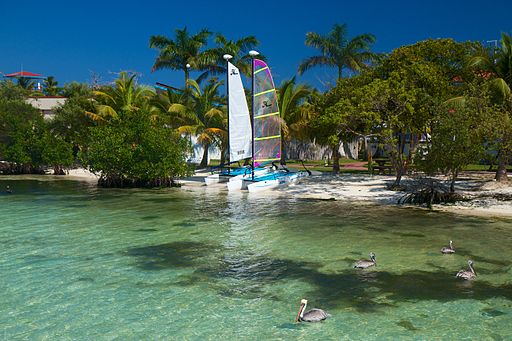
Photo: Belize; By Dave ten Broek from Calgary, Canada [CC BY 2.0 (http://creativecommons.org/licenses/by/2.0) or CC BY 2.0 (http://creativecommons.org/licenses/by/2.0)], via Wikimedia Commons
• Belize – This tropical oasis has all of the trappings of Costa Rica plus family friendly cultural attractions, including Mayan Temples and underwater caves lined with ancient skulls
• Belgium – With the U.S. dollar gaining strength, it’s an opportune time to visit Europe and Belgium, in particular. There are many celebrations and anniversaries happening this year, including the 125th anniversary of Van Gogh’s death, as well as the 200th anniversary of the Battle of Waterloo
• South Dakota – While the 100th anniversary of the building of Mount Rushmore isn’t until 2016, if you’re thinking of taking a trip to the home of the Badlands, you’ll beat crazy crowds if you visit in 2015
• Tanzania – Africa’s tourism market has seen a rapid decline since the Ebola crisis has created mass hysteria among Westerners. The virus is contained in only a small region in West Africa — far from Tanzania. The African government is offering super low travel packages to offset the slump. Some travel companies are offering all-inclusive safari vacations with airfare for as little as $1,200
• Asheville, NC – This is a hip and trendy destination that has gone from gritty to great after being revitalized. Accent on the Smoky Mountains and charming B+Bs
Photo: Chaco; by National Park Service (United States) [Public domain], via Wikimedia Commons
• Chaco National Historic Park – Located in New Mexico, the Frommers urge folks to visit ruins of the ancient Pueblo people in this park before fracking destabilizes the archaelogy
• Pompidou Center – Located in Malaga, Spain, this area has also been transformed from an industrial district to a thing of beauty and culture
• Argentina – If you’re looking for a cheap unforgettable vacation, visit Patagonia this year. The currency has been cut in half for US travelers
• Austria – The hills are alive with the sound of music! And there will be plenty to see, do and celebrate around the 50th anniversary of the Sound of Music
• Yellowstone Park – Lots of geothermal activity expected this year, along with the usual breathtaking vistas, flora and fauna
• Washington D.C. – 2015 marks the 150th anniversary of the Civil War and the assassination of President Abraham Lincoln
• Cruise with Cunard – Cunard, a top luxury cruise liner, celebrates its 175th anniversary with special onboard lectures and performances
• London – Long live the Queen! Queen Elizabeth reigns supreme this year as the longest reigning monarch in history — and there will be plenty of special events and promotions to celebrate. Oh and the Tube expands operation to 24/7, so you can get around underground with no traffic.
• Vietnam – Dong Van Karst Plateau geo-park for unforgettably spectacular mountain scenery.
Happy Travels!
Chris Lopinto is the president and co-founder of ExpertFlyer.com, a service that helps travelers get out of the “Middle Seat” by providing in-depth flight info and alerts when Awards and Upgrades are available.
left
0
New Duke Energy logo.
http://photos.prnewswire.com/prnfull/20130322/CL81938LOGO
http://visit-nc.com/wp-content/plugins/RSSPoster_PRO/cache/b02b3_CL81938LOGO
http://photos.prnewswire.com/prnthumb/20130322/CL81938LOGO
http://photos.prnewswire.com/prnh/20130322/CL81938LOGO
http://photos.prnewswire.com/prnvar/20130322/CL81938LOGO
and http://photos.prnewswire.com/prnh/20130322/CL81938LOGO –>
left
0
New Duke Energy logo.
http://photos.prnewswire.com/prnfull/20130322/CL81938LOGO
http://visit-nc.com/wp-content/plugins/RSSPoster_PRO/cache/b02b3_CL81938LOGO
http://photos.prnewswire.com/prnthumb/20130322/CL81938LOGO
http://photos.prnewswire.com/prnh/20130322/CL81938LOGO
http://photos.prnewswire.com/prnvar/20130322/CL81938LOGO
and http://visit-nc.com/wp-content/plugins/RSSPoster_PRO/cache/b02b3_CL81938LOGO –>
CHARLOTTE, N.C., March 26, 2015 /PRNewswire/ — Fifteen organizations in North Carolina, South Carolina and Virginia are the first to receive $1 million in grants from the Water Resources Fund to improve local water quality.
The fund is a $10 million, multi-year commitment from Duke Energy to help local nonprofits continue to protect and improve the environment, including the waterways our communities appreciate and use year round across the Carolinas and neighboring states.
“Safeguarding clean water and connecting people with nature are cornerstones of our mission,” said Katherine Baer, director of conservation for Triangle Land Conservancy. “Thanks to the generous support of the Duke Energy Water Resources Fund, we will further protect the Stony Creek watershed and prepare Brumley Forest Nature Preserve for its opening to the public in 2016.”
Water Resources Fund grant recipients and projects
Anderson County (S.C.) Timmerman Access Project — $99,509 to provide a handicapped-accessible kayak launch and shoreline access route at the Timmerman Access along the Saluda River Blue Trail.
City of Danville Parks and Recreation (Va.) Riverwalk-Sandy River Project— $100,000 to create a riverwalk that includes a paved trail, a bridge and a boardwalk and will serve as an extension of Danville’s greenway with westward access along the Dan River.
City of Spartanburg (S.C.) Butterfly Foundation Trail Project— $100,000 to return the Greenville Branch Creek to its natural setting and to provide greater awareness of plant and wildlife natural to the habitat.
Cleveland Soil and Water Conservation District (N.C.) Sandy Run Farm Stewardship Project — $65,400 to fence cattle out of 10,000 linear feet of streams and creeks.
Foothills Conservancy of North Carolina, Inc., South Mountains Headwaters: Catawba Basin Watershed Protection Project—$100,000 to protect more than 2,000 acres of water supply watershed lands adjoining the South Mountains State Park at the confluence of the Henry Fork and Jacob Fork rivers.
Macon County Soil Water Conservation District (N.C.) Cartoogechaye Creek Canoe Launch and Stream Access Project— $29,257 to install two canoe launches and a public stream access on Macon County’s recently developed Parker Meadows Recreation Facility.
Mountain Valleys Resource Conservation Development (N.C.) Catawba Streambank Stabilization and Trail at Old Fort Park Project— $36,500 to support a stream restoration project, which will stabilize eroding stream banks and offer a handicapped-accessible angler trail along a hatchery-supported trout stream.
Nash Community College (NCC) Water Quality Institute (N.C.) NCC Water Quality Institute Project— $99,850 to improve water quality and conservation in the Neuse and Tar-Pamlico river basins through research, public outreach, K-14 education and workforce development.
Sturgeon City of Jacksonville (N.C.) Sturgeon City Waterway and Wetland Education Program — $35,000 to expand an effective, land-based education program for youth and adults to nearby waterways, with educational waterway kiosks and other hands-on educational methods along the way.
The Conservation Fund (Va.) Preserving Headwaters State Forest Project — $100,000 to protect critical acreage that contains headwaters of the French Broad River in the Headwaters State Forest.
Triangle J Council of Governments (N.C.) Triangle Regional Drought Communications for Reliable Water Supplies Project — $76,700 to improve drought response in the Triangle Region through a regional water shortage communication framework and online water supply portal.
Triangle Land Conservancy (N.C.) Brumley Forest Riparian Restoration Project — $58,975 to improve water quality, aquatic education and public access to the Brumley Nature Preserve by reforesting stream buffers, building and improving trails and more.
Valle Crucis Community Park (N.C.) Dutch Creek Stream Restoration and Education Initiative Project —$77,150 to restore a degraded reach of Dutch Creek through natural channel design methods and to educate the local community about stream ecology.
Wake County (N.C.) Robertson’s Mill Pond Preserve Project — $100,000 to support the opening of the first Wake County-maintained nature preserve at Robertson’s Mill Pond, the county’s only blackwater swamp and bald cypress habitat.
Winyah Rivers Foundation (S.C.) Coastal SC Wetlands Partnership Project— $100,000 to protect coastal wetland habitats, associated uplands and water quality along the Black River.
“The Water Resources Fund is an investment in healthier waterways and a better quality of life for communities,” said Stick Williams, president of the Duke Energy Foundation. “Our hope is that these programs will help preserve the beauty of our region’s waterways for years to come.”
Investment decisions were carefully reviewed by the Water Resources Fund committee, an independent body that includes five environmental experts and two Duke Energy employees. Selected projects are chosen on several criteria, including whether the project is science-based and research-supported. The application process is managed by the North Carolina Community Foundation.
“The Butterfly Creek Park Project will provide a fun learning experience about our water resources while simultaneously encouraging physical activity,” said Ed Memmott, Spartanburg city manager. “The funding from the Duke Energy Water Resources Fund helps us transform what was a hidden and forgotten urban creek into a tremendous asset and continues the very positive momentum in Spartanburg. We are very grateful to receive this grant.”
Duke Energy anticipates two grant announcements per year for the duration of the commitment. Applications for the next Water Resources Fund grant cycle are due May 15, 2015. An information session will also be available to interested organizations April 1. Please visit www.nccommunityfoundation.org for more information on how to apply and register for the session.
About the Duke Energy Foundation The Duke Energy Foundation actively works to improve the quality of life in its communities, lending expertise in the form of leadership and philanthropic support to charitable organizations. Duke Energy has long been committed to building and supporting the communities in which its customers and employees live and work.
About Duke Energy Duke Energy is the largest electric power holding company in the United States with approximately $121 billion in total assets. Its regulated utility operations serve approximately 7.3 million electric customers located in six states in the Southeast and Midwest. Its commercial power and international energy business segments own and operate diverse power generation assets in North America and Latin America, including a growing portfolio of renewable energy assets in the United States.
Headquartered in Charlotte, N.C., Duke Energy is a Fortune 250 company traded on the New York Stock Exchange under the symbol DUK. More information about the company is available at duke-energy.com.
The small community of Kenly is mourning the loss of a beloved neighbor, and his death on Monday is shining a light on the importance of slowing down in DOT work zones.
left
0
ATT Inc. logo.
http://photos.prnewswire.com/prnfull/20120612/DA23287LOGO
http://visit-nc.com/wp-content/plugins/RSSPoster_PRO/cache/df3af_DA23287LOGO
http://photos.prnewswire.com/prnthumb/20120612/DA23287LOGO
http://photos.prnewswire.com/prnh/20120612/DA23287LOGO
http://photos.prnewswire.com/prnvar/20120612/DA23287LOGO
and http://photos.prnewswire.com/prnh/20120612/DA23287LOGO –>
left
0
ATT Inc. logo.
http://photos.prnewswire.com/prnfull/20120612/DA23287LOGO
http://visit-nc.com/wp-content/plugins/RSSPoster_PRO/cache/df3af_DA23287LOGO
http://photos.prnewswire.com/prnthumb/20120612/DA23287LOGO
http://photos.prnewswire.com/prnh/20120612/DA23287LOGO
http://photos.prnewswire.com/prnvar/20120612/DA23287LOGO
and http://visit-nc.com/wp-content/plugins/RSSPoster_PRO/cache/df3af_DA23287LOGO –>
HOUSTON, March 26, 2015 /PRNewswire/ — ATT* invested nearly $1.4 billion in its best-in-class wireless and wired networks in Houston between 2012 through 2014, driving a wide range of upgrades to enhance reliability, coverage, speed and performance for residents and business customers.
As part of its Project Velocity IP (VIP), an investment plan focused on network enhancement and expansion, ATT in 2014 made 62 wireless network upgrades in the Houston area, including 21 new cell sites and 41 new wireless high-speed Internet connections. Additionally, ATT expanded the reach of its network, providing access to ATT U-verse® High Speed Internet, ATT U-verse video and ATT U-verse voice services to nearly 62,000 new customer locations.
“We are committed to making sure that Houston residents have access to the fastest, most reliable infrastructure in order to stay well connected,” said Kerrick Henny, ATT Vice President of External Affairs. “Mobile and high-speed access are a must for economic development. We will continue to work toward and support the adoption of smart public policies in Texas that will allow us to deliver the innovative, high-performance products and services that Houstonians deserve.”
Notable Houston network enhancements in 2014 included:
Minute Maid Park LTE Overlay
George Bush Intercontinental Airport (IAH) Terminal B expansion
Memorial Herman Hospital LTE Overlay
“ATT realizes that Houston residents and businesses need ready access to the right tools and services to stay connected, whether it’s through smartphones or other forms of technology,” said Jeffrey L. Boney, Founder and CEO, Texas Business Alliance. “These latest investments, as well as ATT’s continued investment here, show how dedicated this company is to ensuring our Houston economy continues to grow and prosper.”
ATT provides the nation’s most reliable 4G LTE network today, covering more than 300 million Americans with 4G LTE service.** ATT’s network also has the nation’s strongest LTE signal.***
ATT was recently recognized by FORTUNE magazine as the Most Admired Telecommunications Company in the world in 2015. Additionally, FORTUNE ranked ATT #47 among all companies in all industries in its list of the Top 50 Most Admired companies in the world.FORTUNE’s Most Admired Companies lists are among the most highly respected indicators of corporate performance and reputation.
ATT U-verse is delivered over ATT’s advanced IP network and includes ATT U-verse High Speed Internet, ATT U-verse TV, and ATT U-verse Voice.**** ATT U-verse TV customers enjoy Total Home DVR®, apps for entertainment on the go, and integrated features. ATT recently received three Women’s Choice Awards® as “America’s Most Recommended Brand Among Women for Broadband, Television and Phone Service Provider.” Frost Sullivan recognized ATT for its leadership in high-speed Internet services with the 2015 North American Competitive Strategy and Innovation Leadership of the Year Award for Broadband, ATT U-verse TV with the 2015 North American Company of the Year for Multichannel Video for its growth, innovation, and leadership, and the 2015 North American Company of the Year for Consumer Communication Services.
ATT announced a major initiative in 2014 to expand the availability of U-verse with ATT GigaPowerSM in up to 25 markets nationwide. Hundreds of thousands of customer locations across parts of Austin, Dallas, Fort Worth, Kansas City, Raleigh-Durham and Winston-Salem are able to sign-up for ultra-fast speeds up to 1 gigabit per second. ATT has since announced it will deliver the ATT GigaPower network to an additional 11 markets: Atlanta; Charlotte and Greensboro, N.C.; Chicago; Cupertino, Calif.; Houston; Jacksonville, Fla.; Nashville, Tenn.; St. Louis and San Antonio.
ATT operates an extensive Wi-Fi network including more than 34,000 ATT Wi-Fi Hot Spots at popular restaurants, hotels, bookstores and retailers, and provides access to more 1 million Hot Spots globally through roaming agreements. Most ATT smartphone customers and U-verse customers get access to our entire national Wi-Fi network at no additional cost, and Wi-Fi usage doesn’t count against customers’ monthly wireless data plans.*****
If the ATT-DirecTV merger is approved by regulators, the combined companies will have an opportunity to redefine the video entertainment industry by delivering content to consumers across multiple screens – mobile devices, TVs, laptops, the backseat displays of connected cars, and even airplanes. ATT has also committed to expand and enhance its deployment of both wireline and fixed wireless high-speed Internet to cover at least 15 million customer locations across 48 states – most of them in underserved rural areas.
For more information about ATT’s coverage in Houston or anywhere in the United States, consumers can visit the ATT Coverage Viewer. For updates on the ATT wireless network, please visit the ATT network news page.
* ATT products and services are provided or offered by subsidiaries and affiliates of ATT Inc. under the ATT brand and not by ATT Inc. **Reliability claim based on analysis of independent third party data re nationwide carriers’ 4G LTE. LTE is a trademark of ETSI. 4G LTE not available everywhere. ***Claim based ONLY on avg LTE signal strength for national carriers **** Geographic and service restrictions apply to ATT U-verse services. Call or go to www.att.com/u-verse to see if you qualify. *****A Wi-Fi enabled device required. Other restrictions apply. See attwifi.com for details and locations. To define a market, we rely on the Core Based Statistical Areas (CBSA), as established by the United States Office of Management and Budget. Minor differences, if any, between annual totals reflect annual updating of market boundaries in our record systems.
Cautionary Language Concerning Forward-Looking Statements Information set forth in this news release contains financial estimates and other forward- looking statements that are subject to risks and uncertainties, and actual results may differ materially. A discussion of factors that may affect future results is contained in ATT’s filings with the Securities and Exchange Commission. ATT disclaims any obligation to update or revise statements contained in this news release based on new information or otherwise.
About ATT
ATT Inc. (NYSE: T) helps millions of people and businesses around the globe stay connected through leading wireless, high-speed Internet, voice and cloud-based services. We’re helping people mobilize their worlds with state-of-the-art communications, entertainment services and amazing innovations like connected cars and devices for homes, offices and points in between. Our U.S. wireless network offers customers the nation’s strongest LTE signal and the nation’s most reliable 4G LTE network. We offer the best global wireless coverage*. We’re improving how our customers stay entertained and informed with ATT U-verse® TV and High Speed Internet services. And businesses worldwide are serving their customers better with ATT’s mobility and highly secure cloud solutions.
*Global coverage claim based on offering voice and LTE data roaming in more countries than any other U.S. based carrier, and offering the most wireless smartphones and tablets that work in the most countries.







 Facebook
 Twitter
 Pinterest


 Facebook
 Twitter
 Pinterest


