RESEARCH TRIANGLE PARK, N.C.–(BUSINESS WIRE)–Lenovo and theNational
Academy Foundation (NAF) today announced the five winning student
groups of the Lenovo Scholar Network mobile app development contest. The
Lenovo Scholar Network, in its first official program year, is designed
to enrich high school students with an intensive application development
curriculum to enable the next generation of developers and
entrepreneurs. As part of their coursework over the 2014 – 2015 academic
year, science, technology, engineering and math (STEM) students were
given Lenovo PCs and tablets and tasked with designing and developing a
mobile app and business plan to take the app to market.
More than 20 apps were submitted from the 10 NAF academies selected to
participate in the Lenovo Scholar Network Mobile App Competition. From
the group, the five student groups selected as this year’s winners are:
DeeringDollar from Phillip O. Berry Academy of Informational
Technology – Charlotte, NC
DeeringDollar is an app built for students in a classroom setting
to foster a token economy society, using a reward system in the
form of virtual dollars for good deeds conducted in the classroom.
Flashy Cards from Cimarron-Memorial High School Academy of
Information Technology – Las Vegas, NV
Flashy Cards is a learning tool for students who seek a more
engaging way to study. The app serves as virtual flash cards in
the form of a game, where points are given or deducted based on
the user’s response.
Savant from Pathways Academy of Technology Design – Hartford, CT
Savant eliminates the inconvenience of carrying heavy textbooks by
serving as an online portal for students. Through Savant, students
can participate in group class discussions, read assigned books
and materials, complete assignments and receive push notifications
for upcoming deadlines.
Sukario Kids from Phillip O. Berry Academy of Informational
Technology – Charlotte, NC
Sukario Kids is a subsidiary app for Sukario, an on-the-go blood
analyzer and recorder app for diabetics. The app was created to
serve as a communication tool between school nurses and parents,
where parents can monitor their children’s health throughout the
school day via an automated text message sent through the
application by the school nurse.
WHS Bowling from Washington High School of IT – Milwaukee, WI
WHS Bowling is a game that also serves as a platform to promote
positive messages and behaviors for teenagers. While bowling
through the app with the flick of a finger, a motivational or
encouraging message will appear to enforce positive behavior and
discourage bullying.
The five winning student groups are invited to present their app and
business plan at NAF’s annual NAF
Next conference for professional development in the education space,
taking place on July 20, 2015, in Anaheim, California. The Lenovo
Scholar Network Fan Favorite, a student group selected by public vote,
will also be announced at the conference. To vote, visit www.lenovoscholars.com.
The Lenovo Scholar Network program was established in July 2014
following a successful pilot program in 2012. Lenovo provided the 10
participating NAF academies with Lenovo ThinkPad laptops and YOGA
tablets to aid the students in the development, coding and testing of
their mobile application, and students used the Massachusetts Institute
of Technology (MIT) App Inventor, a web-based tool for creating Android
apps, to build and test their apps on Lenovo devices.
Quotes:
“It is critical we tackle the STEM skills gap of today’s young
generation as everyday technology users become more dependent on apps
and devices to enhance their personal and professional lives,” said
Jason Mooneyham, vice president of Public Sector, Lenovo. “Through the
Lenovo Scholar Network program, we enable students with rigorous yet
rewarding coursework in mobile app development to enrich their critical
thinking, team building and analytical skills that are required for the
next generation of innovators and entrepreneurs.
“We are so proud of all 400 students who participated in the Lenovo
Scholar Network project and the 20 teams who entered their mobile apps
in the competition,” said JD Hoye, president, National Academy
Foundation. “The apps are the end product of their hard work and
dedication, and serve as a tangible example that the NAF academy
experience is preparing students to become the innovators of tomorrow’s
workforce.”
About Lenovo
Lenovo (SEHK:0992) (Pink Sheets: LNVGY) is a $39 billion global Fortune
500 company and a leader in providing innovative consumer, commercial,
and enterprise technology. Our portfolio of high-quality, secure
products and services covers PCs (including the legendary Think and
multimode YOGA brands), workstations, servers, storage, smart TVs and a
family of mobile products like smartphones (including the Motorola
brand), tablets and apps. Join us on LinkedIn,
follow us on Facebook
or Twitter (@Lenovo)
or visit us at www.lenovo.com.
About The National Academy Foundation
The National Academy Foundation (NAF) is an acclaimed network of
career-themed academies that open doors for underserved high school
students to viable careers. For more than 30 years, NAF has refined a
proven model that provides young people access to industry-specific
curricula, work-based learning experiences, and relationships with
business professionals. NAF academies focus on one of five career
themes: finance, hospitality tourism, information technology,
engineering, and health sciences. Over 5,000 business professionals
volunteer in classrooms, act as mentors, engage NAF students in paid
internships, and serve on local advisory boards. During the 2014-15
school year nearly 82,000 students attended 667 NAF academies across 38
states, including D.C. and the U.S. Virgin Islands. In 2014, NAF
academies reported 97% of seniors graduated.
c 2014, WLOS ABC 13 | Portions are Copyright 2014 Associated Press. All rights reserved. This material may not be published, broadcast, rewritten, or distributed.
WLOS News 13 provides local news, weather forecasts, traffic updates, notices of events and items of interest in the community, sports and entertainment programming for Asheville, NC and nearby towns and communities in Western North Carolina and the Upstate of South Carolina, including the counties of Buncombe, Henderson, Rutherford, Haywood, Polk, Transylvania, McDowell, Mitchell, Madison, Yancey, Jackson, Swain, Macon, Graham, Spartanburg, Greenville, Anderson, Union, Pickens, Oconee, Laurens, Greenwood, Abbeville and also Biltmore Forest, Woodfin, Leicester, Black Mountain, Montreat, Arden, Weaverville, Hendersonville, Etowah, Flat Rock, Mills River, Waynesville, Maggie Valley, Canton, Clyde, Franklin, Cullowhee, Sylva, Cherokee, Marion, Old Fort, Forest City, Lake Lure, Bat Cave, Spindale, Spruce Pine, Bakersville, Burnsville, Tryon, Columbus, Marshall, Mars Hill, Brevard, Bryson City, Cashiers, Greer, Landrum, Clemson, Gaffney, and Easley.
RALEIGH, N.C., May 13, 2015 /PRNewswire/ — The production company behind the heart-pumping new simulation experience at North Carolina’s Airborne Special Operations Museum is Raleigh’sBREAKIRON AnimationDesign, LLC. BREAKIRON’s team created a high-definition adventure that puts riders in the boots of soldiers during major actions in World War II, Korea, Vietnam, Afghanistan and Iraq. The new ride, Experience the Legend, debuts Saturday, May 16, after a short 1 p.m. ceremony. Rides will be complimentary for the rest of the day.
What does it take to depict the prestigious 101st Screaming Eagles, 187th Rakkasans, 82nd All-Americans, a Ranger regiment, and Special Forces on a screen nearly two stories tall? It takes detailed historical accuracy across five eras and geographies, plus cutting-edge software that renders high-quality animation in less than a tenth of the usual time.
ASOM Pritzker Simulator Trailer 2015 Produced by BREAKIRON AnimationDesign, LLC.
It was a dedication to historical accuracy that sent Paul Galloway, executive director of the museum foundation, on the hunt for the chateau near where the Screaming Eagles gliders landed in Normandy on D-Day. He chose to depict a glider experience because many Americans don’t realize that the Airborne went in on gliders that day. It’s all part of his aim of educating while the ride also entertains. For Korea, he scripted a jump from a C-119 boxcar into the actual drop zone where the 187th jumped in Munsan-ni in 1951. And for the Vietnam piece, he made sure visitors are with the 82nd Airborne and an element of the 17th Cavalry as their Huey helicopter flies the nap of the Earth—a flight path at extremely low altitude—until they face off against the enemy in a landing zone. In Afghanistan, three of the Ranger’s advanced light strike vehicles exit a Chinook helicopter and travel a road in southwest Kandahar. And for Iraq, riders will find themselves with a Special Forces team, plus a K-9, on the Euphrates River passing Saddam Hussein’s palace.
“We share the true exploits of Airborne and Special Ops soldiers. We don’t make anything up,” Galloway explains. “This is an opportunity to walk in their boots and see what they do. Not only are the young and old alike going to have fun, they’re going to learn without knowing it, because it’s all historically accurate.”
Galloway worked on the script for nearly five years. “We called in artillery experts and helicopter pilots, and we worked with representatives from the 82nd Airborne Division and the United States Army Special Operations Command. If we were going to call for fire, for example, I wanted to know exactly how that would sound.”
For Charlie Breakiron, the project’s patriotic mission motivated him to deploy a brand-new, highly advanced rendering solution. “We made some serious strides on the bleeding edge of technology,” Breakiron says. “We needed to build out five different environments, five sets of soldiers, and five sets of vehicles, all of it highly detailed and historically exact. That could have easily taken a year. We cut the time in half.”
In technological terms, he explains, “We chose a GPU rendering solution instead of rendering on the CPU. We rendered on the video card itself, allowing for higher quality and much faster renders.” A GPU is a graphics processing unit; a CPU is a computer’s processing unit.
“With GPU rendering, we could render a frame of CG animation in 28 seconds, for example, versus 11 minutes. For a project that has 14,400 frames, the difference is months. Instead, we produced all five military eras in one month using only two machines.
“Our 3D was all Autodesk – Softimage, Maya, 3ds MAX, and Mudbox. Mootzoid’s emFluid 5 allowed us to do realistic combustion explosives. We propagated rocks and trees with 3DQuaker’s Forester and rendered with Redshift. We used some gaming techniques, but we did it as a cinematic. It’s taken on the look of modern-day FPS games. That was our benchmark.
“The breadth and scope of this project made for an excellent challenge. We’re absolutely ready for more.”
Adds Galloway, “Working with Breakiron has been great. We talked to many firms. Some were outrageously expensive. What put Charlie over the top were his willingness to work within our budget, his location not far from us, in Raleigh, and his experience in the field, including a multitude of awards. It’s been very enjoyable to work with him.”
BREAKIRON AnimationDesign, LLC, is a high-end, full-service animation, visual effects and 3D graphics company that has produced work for medical applications, advertising, television, film, and the military. Among their honors are prestigious Telly Awards for 3D animation and the Addys. Owner Charlie Breakiron has created visual effects work for the film and broadcast industries, including productions such as Union Bound, The Janus Project trailer, Barnyard, Answering the Call, and Titan A.E. For further information, visit http://www.breakiron.com/.
The Airborne Special Operations Museum Foundation supports the museum with marketing, advertising and financial support for its programs and exhibits. Opening the doors on August 16th, 2000, the 60th anniversary of the original United States Army’s Test Platoon’s first parachute jump, the museum offers free admission, a main exhibit gallery, a temporary gallery, a four-story tall theater, a video theater and a motion simulator ride. It is located in historic downtown Fayetteville. For more information, visit http://www.asomf.org/.
NEW YORK, May 14, 2015 /PRNewswire/ — Bluerock Residential Growth REIT, Inc. (NYSE MKT: BRG) (“BRG” or the “Company”) announced today that it will acquire a two-phase 473-unit Class A apartment community in Charlotte, NC, known as the Ashton Reserve Apartments in two stages. Located in the upscale Northlake submarket, this luxury community sits in close proximity to Charlotte’s Uptown Central Business District and University Research Park.
Built in two phases in 2013 and 2015, Ashton Reserve features high-end one, two and three bedroom layouts. Ashton I consists of 322 existing units that average 993 square feet and with an effective in-place rent of $1,250 per month. Ashton II consists of 151 units, of which 71 have been delivered and 43 leased, that average 1,019 square feet.
BRG sourced the transaction through an existing operating partner, which had purchased Ashton with a capital provider in 2013. BRG has entered a purchase agreement for Ashton I and is replacing the capital provider at their original basis for Ashton I, and stepping into their contract at the closing of Ashton I to purchase Ashton II, enabling BRG to benefit from favorable pricing relative to the market. As a result, BRG is purchasing Ashton I at a cap rate of 6.0%, versus local market cap rates of approximately 5.25% – 5.50%, and Ashton II at a cap rate of 5.8%.
Ashton Reserve offers some of the most desirable and highest-end in-unit features available in the Northlake submarket. All units have nine foot ceilings and are equipped with a stainless steel appliance package that includes full-sized refrigerators, granite countertops, undermount sinks with high-end gooseneck faucets, and full size washer/dryers. Community amenities include lush landscaping, two clubhouses, fitness facilities, a swimming pool with oversized deck and grilling stations, as well as a business center and a private media center.
The Charlotte, NC market is currently sustaining strong population growth among the rental-oriented 20 year-old to 34 year-old demographic, and management believes that Ashton Reserve is well situated to take advantage of that growth. The Northlake submarket in which the project is located is approximately eight miles from Uptown Charlotte and is anchored by the one million square foot Northlake Mall, a premier retail destination for the affluent communities in the North Charlotte metropolitan area. The property is in close proximity to Lake Norman as well as to regional employers, major travel routes and the Charlotte-Douglas International Airport.
“This transaction speaks very much to the strength of our deal sourcing capability as well as our ability to facilitate complex transactions and execute on them, quickly.” said Ramin Kamfar, Chairman and CEO of BRG. “We are acquiring a high-end and highly-marketable asset at a very favorable cost basis.”
The company expects to close Ashton I during the current quarter, and Ashton II when stabilized, which the Company expects to be in the third quarter.
BRG plans to acquire Ashton I and Ashton II, respectively, for $44.75 million or $140,700 per unit, and up to $21.8 million or $144,500 per unit, with final pricing for Ashton II based on in-place financial performance. The Company expects to make equity investments of approximately $14 million and $7 million for Ashton I and Ashton II, respectively. BRG will assume the existing loan on Ashton I of $31.19 million and intends to secure new senior mortgage financing of approximately $15 million when it acquires Ashton II.
About Bluerock Residential Growth REIT, Inc. Bluerock Residential Growth REIT, Inc. (NYSE MKT: BRG) is a real estate investment trust. The Company focuses on acquiring a diversified portfolio of Class A institutional-quality apartment properties in demographically attractive growth markets to appeal to the renter by choice category. The Company’s objective is to generate value through off-market/relationship-based transactions and, at the asset level, through improvements to operations and properties. BRG generally invests with strategic regional partners, including some of the best-regarded private owner-operators in the United States, enabling the Company to operate as a local sharpshooter in each of its markets and to enhance its off-market sourcing capabilities. BRG has elected to be taxed as a real estate investment trust (REIT) for U.S. federal income tax purposes. For more information, please visit our website at: www.bluerockresidential.com.
Forward Looking Statements This press release contains forward-looking statements within the meaning of the Private Securities Litigation Reform Act of 1995 and other federal securities laws. Forward looking statements are statements that are not historical, including statements regarding management’s intentions, beliefs, expectations, representations, plans or predictions of the future, and are typically identified by such words as “believe,” “expect,” “anticipate,” “intend,” “estimate,” “may,” “will,” “should” and “could.” Because such statements include risks, uncertainties and contingencies, actual results may differ materially from those expressed or implied by such forward looking statements. These forward-looking statements are based on BRG’s present expectations, but these statements are not guaranteed to occur. Furthermore, BRG disclaims any obligation to publicly update or revise any forward-looking statement to reflect changes in underlying assumptions or factors, of new information, data or methods, future events or other changes. Investors should not place undue reliance upon forward-looking statements. For further discussion of the factors that could affect outcomes, please refer to the risk factors set forth in Item 1A of BRG’s Annual Report on Form 10-K filed by BRG with the U.S. Securities and Exchange Commission (“SEC”) on March 4, 2015, and subsequent filings by BRG with the SEC. We claim the safe harbor protection for forward looking statements contained in the Private Securities Litigation Reform Act of 1995.
To many Western North Carolina residents, the region’s parks and recreational areas represent a chance to experience our state’s natural beauty and preserve its rich history. But what’s often overlooked is these attractions’ key role in bolstering local economies.
WINDING ROAD: Quantifying tourism on the Blue Ridge Parkway can be difficult, due to its length and use by both locals and visitors.
A recent report from the National Park Service highlights the way North Carolina’s protected areas benefit adjacent communities. Using statistics compiled by economists with the U.S. Geological Survey and the National Park Service, the report documents annual visits to national sites within the state and the resulting economic effects on “gateway communities,” defined as those within a 60-mile radius of such parks and monuments.
According to the report, titled “2014 National Park Visitor Spending Effects,” North Carolina ranked third nationally, behind only Alaska and California. The more than 16.7 million visitors to North Carolina’s national park sites last year spent roughly $1.1 billion during their stays.
Nationally, notes Maggie Tyler of the Park Service’s Southeast Regional Office. “We saw a 7 percent increase in park visitation from 2013 to 2014.”
The reasons for the increase vary from region to region, says Tyler, citing North Carolina’s diverse physical landscape and strategic location as keys to the state’s popularity with tourists. “We have two great dichotomies: the mountains and the beach. Not many states can offer both those things,” she points out, “or offer both within a reasonable driving distance. Families can drive across the state and experience incredibly iconic parks from end to end, plus a lot of history along the way.”
Those visitors, the report notes, helped create 18,500 jobs last year, pouring about $1.5 billion into the state’s economy. Much of that spending went toward things like lodging, restaurants and gas, creating a “ripple effect” in local economies (often in rural or disadvantaged areas) that are geared toward accommodating tourists’ needs.
“Those are the people we grocery-shop with,” Tyler explains. “They fix our cars, and they’re the ones that the tourists rely on. It’s an important connection that allows everyone to contribute to the public lands we’re using.”
These public assets’ growing popularity, however, means local communities may face challenges if they want to preserve those significant economic benefits.
Topping the list of the WNC attractions is the Blue Ridge Parkway, whose more than 13.9 million visitors spent some $863 million last year and supported an estimated 14,020 jobs. The Smokies, meanwhile, drew more than 10 million visitors, generating around $806 million in revenue; and the Carl Sandburg Home’s over 82,000 visitors generated $4 million in total visitor spending while supporting 75 jobs.
And those benefits, notes Tyler, are pretty consistent. “As we’ve done these studies year after year, we continue to see that every time American taxpayers invest money in the public park system, there’s a great return into the economy,” she says. “This year’s numbers show that for every dollar invested by taxpayers into the National Park Service, over $10 comes back into the U.S. economy.”
The Park Service tracks both direct spending by visitors and “indirect” or “induced” spending by the businesses serving them. Together, these categories, including the associated income and job growth, constitute the “total economic effect of visitor spending in a local economy,” the report explains.
A formula developed by the Park Service identifies different types of visitors and where in the local economy their money is being spent, based on figures and metrics provided by each park’s officials. But quantifying the impact of more ambiguous sites like the Blue Ridge Parkway can be problematic.
“These units,” the report notes, “have some of the highest number of visits while posing the most difficult problems for estimating visits, spending and impacts.” One big challenge is differentiating between local and nonlocal visitors; in addition, however, “Better data on parkway spending patterns and trip characteristics is needed.”
North Carolina’s state parks face similar issues. “We have not had the resources in recent years to do a timely economic analysis on how park visitation relates to local economic revenue,” says Charlie Peek, public information officer for the N.C. Division of Parks Recreation, though he speculates that the results would be similar to what the National Park Service found.
According to a report issued by the N.C. Department of Environment and Natural Resources earlier this year, state parks and recreation areas attracted a record 15.6 million visitors in 2014. That constitutes a “healthy” 10 percent increase from the previous year, says Peek, adding that 2015 could see even higher totals.
And though the most popular state parks are in the state’s eastern and Piedmont regions, WNC destinations such as Mount Mitchell, Chimney Rock, South Mountains and Stone Mountain state parks all saw substantial increases in visitors last year, and the Southern Appalachians’ growing popularity as a tourist destination will most likely spill over to adjacent natural attractions.
Collateral damage
But while the increase in both foot and vehicle traffic may be good news economically, it could harm the very landscapes and ecosystems that are attracting all those tourists.
“We have a dual mission,” notes Tyler. “To protect and preserve these delicate environments, while at the same time allowing for public enjoyment.”
Maintaining that balance, she explains, calls for constant monitoring and re-evaluation, and it may require restricting the number of daily visitors to a particular site, or instituting “quota camping” during certain seasons to accommodate vegetative and wildlife cycles.
Peek agrees, saying that “Increased visitation certainly intensifies the challenge of balancing recreation with protection of the natural resources. … Practically every state park has areas that are particularly sensitive in terms of rare species and delicate habitats. Careful planning can address that.”
But the answer, he maintains, lies not in restricting visitation but in “thoughtful expansion of the parks, the parks system and persistent efforts for conservation in general, with the help of land trusts and conservation organizations.”
Tyler, too, stresses the importance of collaboration. “There are hundreds of different community groups and organizations that get out there and do the work that we just don’t have the time or resources to do,” she says. “They become an extension of the Park Service in educating the public on how to be good stewards of the resources.”
Education, says Peek, may be the most effective tool for preserving the integrity of parklands. Citing things like exhibit halls and educational hikes led by park rangers, he says, “We’ve found that the more visitors know about the sensitive natural resources in a state park, the more they’ll try to help us in protecting those resources.”
The National Park Service also places a premium on educational efforts. “We work very hard to educate the public about their visit,” notes Tyler. “As visitation increases, we constantly monitor and re-evaluate our land management decisions.” And public acceptance of the resulting changes “depends on how well we communicate to them what we’re doing and why we’re doing it.”
Preserving profits
Meanwhile, Asheville continues to show up on list after list of top destinations to visit or move to, making it likely that both national and state parks in the region will continue to draw more visitors. And for some WNC communities, this will mean continued opportunities to profit from preserving these unique landscapes.
What can residents do to support those efforts?
NEW HEIGHTS: State parks and recreation areas like Mount Mitchell saw a 10 percent increase in visitor traffic last year, according to the N.C. Division of Parks Recreation.
“Having the public support the state to expand funds to preserve protected land tracts,” says Angela Shepherd, communications director for the Southern Appalachian Highlands Conservancy, “is a giveback to the community in a way that preserves the lands, which draws tourism and brings money into the hotels and local businesses. It’s a win-win situation.”
“When we look to preserve land,” she explains, “we do look at whether those places are viewable from the Appalachian Trail or Mount Mitchell State Park, and other iconic landmarks in the area. If a development came into those areas, it’s going to impact visitation to those places. We’re not anti-development, but rather developing in the right places in the right way.”
Angie Chandler, executive director of the Blue Ridge National Heritage Area, also urges residents to “communicate to your community and businesses and national leaders about how important the parks and their resources are — not only to our quality of life but to businesses who want to be in a place with things to do, with the arts, and with our distinct cultural heritage.”
Beginning in August of 2016, the National Park Service will stage events across the country to celebrate the agency’s 100th birthday. Several other federal agencies, as well as state and city parks, will team up to help commemorate the Park Service’s creation in 1916. For details on what will be happening in your area, go to findyourpark.com.
A wad of money from Charlotte strolls over to Asheville. After taking a quick look around, it parks itself in the center of downtown, then puffs up and bursts apart, sending greenbacks fluttering everywhere.
Some of that money lands in restaurants; some goes to experiences like guided tours and outdoor excursions. A few bills drift over to a local retail outlet, exchanged for a coffee mug or hand-woven bag.
The owners of those businesses then take their share of the money down to the grocery store to buy food. They also use it to pay their employees, who might buy food, a new coat or even a TV. The beneficiaries of all those transactions do the same, and around and around it goes.
From a conventional economic perspective, that is tourism in a nutshell: money coming from outside the city and spreading itself around. Asheville is the “product,” tourists are the customers, and other areas are also jockeying for those dollars.
“These are our competitors,” says Bob Patel, leaning over a sheet of tourism statistics for nearby destinations. “Asheville is competing with other cities.”
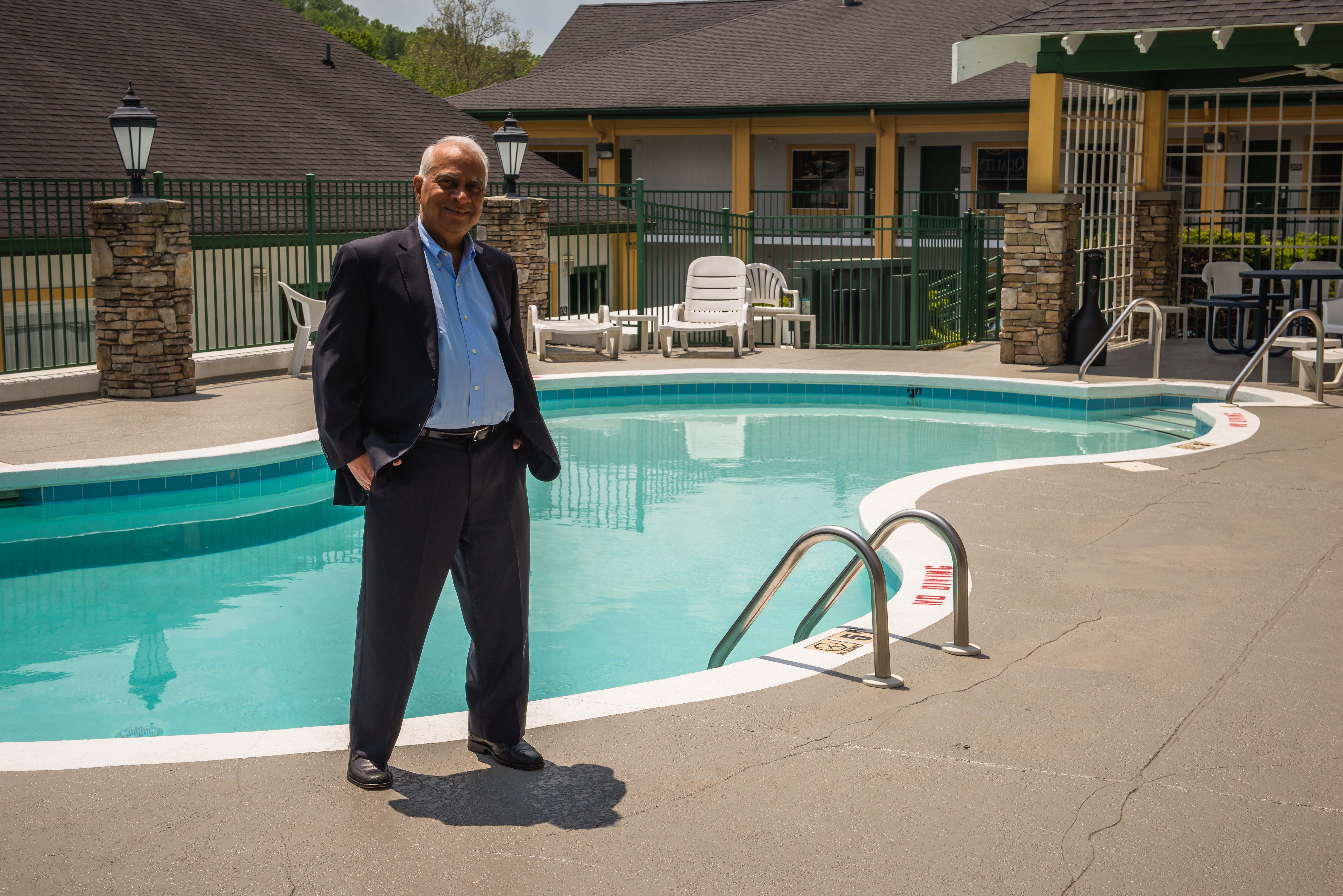
“Asheville is competing with other cities; we’re trying to steal the other city’s lunch,” declares Bob Patel. Photo by Pat Barcas
Originally from India, Patel now chairs the Buncombe County Tourism Development Authority’s board; he also owns four hotels in Asheville. He acquired the first one in 1982, before downtown revitalization. He’d previously owned a hotel in Pensacola, Florida, and before that, he worked as a structural engineer.
Patel points to Charleston’s entry on the sheet in front of him, saying his goal is to beat them. And according to the data he’s assembled, we’re close, trailing slightly in hotel room occupancy rate and actually ahead in the average price of those rooms.
The way he sees it, each visitor coming here represents money leaving some other city’s economy and slipping into Asheville’s, and vice versa.
“So we’re trying to steal the other city’s lunch here,” says Patel. “A pie is only so big.”
To him, the more tourists the better. So from that perspective, the fact that there are five hotels under construction around town and at least seven more being considered should be good news for all. More lodging, the thinking goes, equals more tourists, which equals more money — assuming, that is, that those hotel rooms are occupied.
But Tom Tveidt, an independent economic analyst and former director of research for the Asheville Area Chamber of Commerce, says it’s hard to predict how this round of substantial investment will fare.
“A concern whenever there’s a big burst in any industry is, ‘How sustainable is this?’” he notes, adding, “Obviously, no one knows.”
And downtown business owner Franzi Charen, who’s also the director of the Asheville Grown Business Alliance, worries that the increased demand for goods and services stemming from those additional bodies on the street might attract more corporate chains that could drive out local indie businesses.
Interdependence
Asheville currently has about 7,200 hotel and motel rooms that are subject to the 4 percent occupancy tax levied on room sales. And if all of those current hotel projects came to fruition (which is by no means guaranteed), it would add at least 1,115 more, boosting the total number by 15 to 20 percent, notes Patel. Demand, meanwhile, is increasing by about 4 percent per year. So if all of them popped up out of the ground fully formed today and demand continued to grow at the same rate, it could take four or five years for the scales to re-balance.
Effective marketing, however, could potentially speed things up, and that’s where the Convention and Visitors Bureau comes in. While hotels, restaurants and other services advertise themselves individually, the bureau promotes Asheville as a whole.
Marla Tambellini, the organization’s deputy director and vice president of marketing, says Asheville has a brand, and her organization is charged with crafting and promoting that brand. To do this, the bureau, an arm of the Chamber of Commerce, uses various tools, including marketing strategies, a geographic focus, a primary target audience (experiential travelers ages 25-54), media and communications strategies, extensive data analysis, and actively pursuing conferences and business conventions.
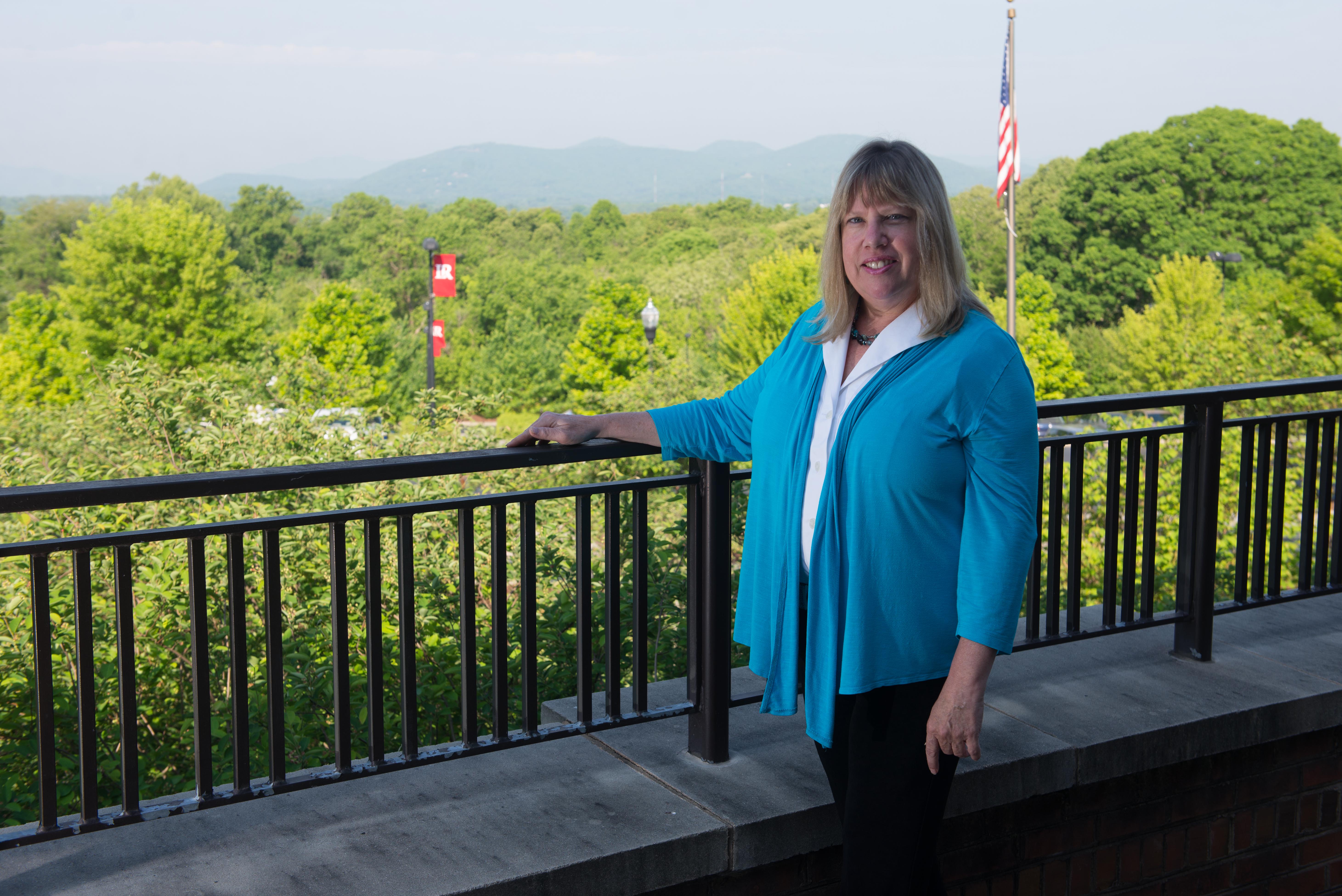
“There are weekends where it’s very difficult to find a room in Asheville,” notes Marla Tambellini. Photo by Pat Barcas
The bureau’s marketing strategy for 2014-15 plays up the range of experiences available here, rather than focusing on any single one.
“What we’ve found is it’s really the collection of our assets that’s appealing to people,” Tambellini explains. “It’s the mountains, it’s food, it’s music, it’s Biltmore.”
Downtown Asheville, she notes, has gradually become a significant part of that array as well, as local restaurants and other businesses have flourished to the point that some now qualify as attractions themselves.
And it’s a symbiotic relationship, notes Charen.
“We probably have 90 percent walk-by traffic,” she says. “They just pop their heads in and they buy something. We’re very dependent on the tourism industry. We don’t try to build our business or gear it that way, but because of our location downtown, because downtown is such a tourist attraction, it’s what ends up happening.”
In 2012, for example, 3.1 million overnight visitors to Buncombe County spent an average of $129 per person per day, more than half of it on food and beverages or retail shopping, according to an economic impact analysis by Tourism Economics, a global consulting firm.
Still, Charen fears that too many visitors might end up undermining the very culture that drew them here to begin with. But she believes that such measures as incentives and subsidies for independent businesses, and limits on things like store size, could help prevent this. Charen also questions the wisdom of investing too much in an industry that’s prone to significant peaks and valleys.
Franzi Charen: Too many visitors might end up undermining the very culture that drew them here to begin. Photo by Daniel Hall
Self-sufficient
Tveidt, though, says the local tourism industry isn’t really all that unstable. Recalling the concern in the wake of 9/11 that tourism would drop off, he says, “The irony of it is, we actually did better after 9/11, because people were afraid to get on planes. This is a drive market.”
In addition, he maintains, the city’s investment in the tourism industry is not all that significant: It’s the hotel investors who are taking the risk. Asheville’s appeal, notes Tveidt, isn’t based on some big theme park or natural wonder that the city needs to sink money into. The things that draw visitors here are either inherent, such as the mountains and the heritage, or develop on their own in the natural course of things, as Asheville’s culture and local businesses have.
“It’s kind of self-sufficient, and it’s a lot of small businesses,” he says. “So it’s dynamic, and it’s able to change direction pretty easily.”
Besides, the money used to market and develop tourism comes directly out of tourism revenue, in the form of the occupancy tax. And the state legislation that enacted the tax spells out how that money can be spent: Three-quarters is used for marketing, and the rest goes to the Tourism Product Development Fund.
Businesses can apply for grants and loans from this fund for projects that have the potential to attract more overnight visitors to the area. Highland Brewing Co., RiverLink and the Asheville Art Museum have all received grants for projects that are set to break ground this year. Between 2010 and 2013, the U.S. Cellular Center received a series of grants totaling over $4 million to renovate the convention space in the former Asheville Civic Center. The Riverfront Destination Development Project, meanwhile, was awarded $1.8 million.
“It’s one of the few industries where the things they do for their customers benefit the residents as well,” says Tveidt. “Obviously, they want clean streets, they want safe streets, they want lots of nice restaurants, they want diverse entertainment. … They’re not doing it for us, but we can profit from it as well.”
Darwinian evolution
Tourism, Tveidt maintains, creates a dynamic economy that can quickly respond to market conditions: A trendy new restaurant may open even as two others are closing.
Charen agrees. Like an ecosystem rich in biodiversity and intricate species relationships, an economy fed by tourism creates a business environment that’s always improving itself through trial and error, encouraging creative entrepreneurs to take chances.
“When you have a lot of businesses opening and a lot of businesses closing, you really home in on what works,” says Charen. “There’s a lot of people trying stuff: You’re trying a little hot dog stand, I’m trying a burger thing, and somebody else is trying a butcher shop. And maybe only the butcher shop works.”
Entrepreneurs can take risks and discover niche markets — and if they fail they can try again until they hit the sweet spot, as Charen did herself.
“This is my fourth business,” she reveals, gesturing around her Lexington Avenue boutique, Hip Replacements. “I had two that essentially, on paper, failed and two that, on paper, succeeded. But Asheville was kind enough to me to be able to keep trying.
“For me, it wasn’t necessarily such a bad thing — 20/20 hindsight — that two businesses closed. It helped me nurture my skills to, in the end, come out with two successful businesses.”
And thanks to that same dynamic, Hip Replacements, she says, would be nearly unrecognizable to someone who knew it 20 years ago, having evolved along with its environment and customer base.
Kim Murray, co-owner of The Lobster Trap, notes that hotels aren’t the only local establishments anticipating growth in tourism. In response to high demand last year (at one point, people had to wait up to four hours for a table), Murray decided to add 22 seats to her restaurant.
Fellow downtown restaurateur Peter Pollay, co-owner of Posana, has also expanded his seating by 20 percent.
Other establishments, such as the Corner Kitchen, Rocky’s Hot Chicken Shack and Bouchon, are opening entirely new venues, says Jane Anderson, executive director of the nonprofit Asheville Independent Restaurants.
Where’s the money?
Between 2009 and 2012, the tourism industry created over 280 jobs per year, and as of the latter year, one in seven jobs in Buncombe County was in that sector, according to the Tourism Economics report.
There is a catch, however: “It’s not a well-paying industry, for the most part,” says Tveidt. “It’s a lot of low-skilled service workers. You’ll find that if you compare this area to other similar-sized or larger communities, our wages are never that strong, and it’s primarily due to the mix of industries. And one of those big industries is tourism, so that’s always going to be a bit of a drag.”
Just Economics, another local nonprofit, advocates for a sustainable economy in Western North Carolina and has a certification program for employers that pay a living wage.
“Does tourism typically breed low-pay jobs? Yes,” says Executive Director Vicki Meath. “Does it have to? No.”
Of the 350 living-wage-certified businesses in Buncombe County, notes Meath, none are hotels. But that doesn’t necessarily mean that no local hotel pays a living wage: It could just be that they haven’t sought certification.
According to the Convention and Visitors Bureau’s monthly indexes, nearly every pertinent metric is on the rise. Hotel occupancy, airport passengers, revenue per available room, publicity reach — it’s all going up.
About the only numbers that have dropped are those related to traditional, guided tourist experiences and services. Fewer people have come through the Asheville and Pack Square Park visitor centers or booked group tours. Requests for travel guides, meanwhile, have taken the biggest hit, declining by about 25 percent.
Asheville’s online presence is showing the fastest growth, with more than 200 percent greater online publicity value this fiscal year, and 400 percent growth in estimated reach, based on the cost of comparable paid advertising and the nature of the information. It’s a different market now, says Tambellini: Tourists are starting to favor casual exploration over the traditional brochure-and-tour-guide experience.
The goal, she notes, is to stay at over 60 percent hotel room occupancy. Over the past year, the city averaged about 70 percent, the indexes show, with a high of 86 percent in October and a low of 54 percent in February.
Tambellini expects those numbers to drop once the new hotels are built, but she sees such declines as just one part of a larger cycle. Bring one pie to a party and they eat the whole thing. Bring two pies the next year, and maybe they eat one whole pie and half of the other one. But it’s apparent that this party has pie to spare, so the following year more people show up, both pies are eaten and the cycle repeats. In other words, even if the occupancy rate drops, total visitation should continue to rise until the market stabilizes again.
“There are weekends where it’s very difficult to find a room in Asheville,” Tambellini points out, “particularly once you get into the summer months and October. So that scenario becomes very favorable for hotel growth.”
Charen, however, imagines all these new hotel rooms filled with tourists, some of whom like it here so much that they decide to buy a second home in Asheville. And soon enough, they begin to yearn for things familiar from their hometown — perhaps a Starbucks around the corner or a Gap down the street — and the ball gets rolling.
Tension builds as the newcomers try to impose their vision of what Asheville should and shouldn’t be, while some locals resist. Maybe the culture remains strong and doesn’t change. Or maybe it does.
“If I was purely interested in profit, as a business,” says Charen, “I would say these hotels that are popping up downtown are great, because they’re going to bring in more people. But I’m more concerned with what Asheville’s going to look like 20 years down the road.”
If you’re looking to open a business in North Carolina, you may want to consider Morehead City.
Morehead City was recently ranked as number five in the top ten places to open a small business in North Carolina by NerdWallet, a financial advice company that helps people comparison shop in different areas.
Mandy Vick is a good example of that. She moved from Raleigh to open Wine and Design in Morehead City back in January. She says, “We love the downtown feel here working right on the waterfront. All of the businesses are just super supportive. We’ve got great restaurants and tons of thing for families to do.”
Wine and design provides painting parties for a wide variety of groups. In less than 5-months, the business has hosted about 225 events so far.
The Carteret County Chamber of Commerce is continuing to work to grow the area and bring in more visitors so there is long term incentive for businesses to set up shop.
Vick is glad she did, even opening the doors in winter. “We were very busy in the off season, which was very comforting because we knew we could be a success in the summer, but February was my busiest months, so I think the town was excited to have us here.”
In 2013, Carteret County brought in nearly $303-million in tourism money. The 2014 figures will be out in August.
You can learn more about Wine and Design in Morehead City by clicking on the related link.
left
0
Infinisource iSolved Network logo
http://photos.prnewswire.com/prnfull/20140908/143813
http://visit-nc.com/wp-content/plugins/RSSPoster_PRO/cache/00c66_143813
http://photos.prnewswire.com/prnthumb/20140908/143813
http://photos.prnewswire.com/prnh/20140908/143813
http://photos.prnewswire.com/prnvar/20140908/143813
and http://photos.prnewswire.com/prnh/20140908/143813 –>
left
0
Infinisource iSolved Network logo
http://photos.prnewswire.com/prnfull/20140908/143813
http://visit-nc.com/wp-content/plugins/RSSPoster_PRO/cache/00c66_143813
http://photos.prnewswire.com/prnthumb/20140908/143813
http://photos.prnewswire.com/prnh/20140908/143813
http://photos.prnewswire.com/prnvar/20140908/143813
and http://visit-nc.com/wp-content/plugins/RSSPoster_PRO/cache/00c66_143813 –>
CHARLOTTE, N.C., May 14, 2015 /PRNewswire/ — As one of the events on the Professional Golf Association Tour, the Wells Fargo Championship will be held on May 14-15, 2015, at the Quail Hollow Club in Charlotte, NC. PGA players such as Phil Mickelson, Rory McIlroy, Adam Scott and Billy Hurley III will be testing their skills on the Green Mile, holes 16, 17 and 18, known as some of the toughest holes on the PGA Tour.
Hurley attended the US Naval Academy and played in the Walker Cup and Palmer Cup. After actively serving in the US Navy until 2009, he returned to competitive golf. In 2011, he was the first Naval Academy graduate to become a PGA Tour member. As a supporter of charities and causes, Hurley is the first SEAL Legacy Foundation Ambassador. Underwritten by the iSolved Network, headquartered in Charlotte, Hurley will represent the Foundation during the 2015 PGA season.
The iSolved Network is an exclusive community of elite service providers who deliver human capital management (HCM) solutions to their clients through iSolved technology. iSolved is a single source that provides a comprehensive approach to payroll, human resources, time tracking and benefits enrollment. The iSolved platform is the cloud-based flagship product of Infinisource, a leading HCM technology company.
About SEAL Legacy Foundation
The SEAL Legacy Foundation is dedicated to supporting the United States Navy SEAL community. As operational deployments across the world continue to increase, the SEALs and their families need support now more than ever. These SEALs, their spouses and their children all make daily sacrifices to defend our nation. The Foundation focuses support on education, funeral, health wellness, living and quality of life expenses for the SEALs and their families. For more information about the SEAL Legacy Foundation, please visit www.SEALLegacy.org. SLF may also be followed via www.Twitter.com/SEALLegacy.
About the iSolved Network
The iSolved Network is an ecosystem for elite, high-growth payroll service providers who use the cloud-based iSolved human capital management technology to deliver a complete set of workforce solutions to small and medium sized businesses. Launched in the summer of 2014, the iSolved Network has experienced rapid growth and now has nearly one million employees committed to the technology. The iSolved solution delivers a comprehensive approach to workforce management, offering payroll, human resources, time and labor tracking, as well as benefit enrollment from within the same solution. For more information on the iSolved Network, or to locate a Certified Network Partner in your region visit www.infinisource.com/network
–>
and imageUrl: http://visit-nc.com/wp-content/plugins/RSSPoster_PRO/cache/e57a1_216112 –>
–>
and imageUrl: http://visit-nc.com/wp-content/plugins/RSSPoster_PRO/cache/68621_216111 –>
TripAdvisor Logo. (PRNewsFoto/TripAdvisor)
Cheryl Boone Isaacs addressed 235 graduates of the University of North Carolina School of the Arts in Winston-Salem on May 9. Facebook Twitter Pinterest
Cheryl Boone Isaacs, center, received an honorary doctorate of the arts from Robert L. “Rob” King III, chairman of the Board of Trustees, and Lindsay Bierman, Chancellor of the University of North Carolina School of the Arts. Facebook Twitter Pinterest
left
0
Cheryl Boone Isaacs addressed 235 graduates of the University of North Carolina School of the Arts in Winston-Salem on May 9.
https://photos.prnewswire.com/prnfull/20150514/216112
https://photos.prnewswire.com/prn/20150514/216112
https://photos.prnewswire.com/prnthumb/20150514/216112
http://visit-nc.com/wp-content/plugins/RSSPoster_PRO/cache/e57a1_216112
http://visit-nc.com/wp-content/plugins/RSSPoster_PRO/cache/e57a1_216112
and http://visit-nc.com/wp-content/plugins/RSSPoster_PRO/cache/e57a1_216112 –>
left
0
Cheryl Boone Isaacs addressed 235 graduates of the University of North Carolina School of the Arts in Winston-Salem on May 9.
https://photos.prnewswire.com/prnfull/20150514/216112
https://photos.prnewswire.com/prn/20150514/216112
https://photos.prnewswire.com/prnthumb/20150514/216112
http://visit-nc.com/wp-content/plugins/RSSPoster_PRO/cache/e57a1_216112
http://visit-nc.com/wp-content/plugins/RSSPoster_PRO/cache/e57a1_216112
and http://visit-nc.com/wp-content/plugins/RSSPoster_PRO/cache/e57a1_216112 –>
left
0
Cheryl Boone Isaacs, center, received an honorary doctorate of the arts from Robert L. “Rob” King III, chairman of the Board of Trustees, and Lindsay Bierman, Chancellor of the University of North Carolina School of the Arts.
https://photos.prnewswire.com/prnfull/20150514/216111
https://photos.prnewswire.com/prn/20150514/216111
https://photos.prnewswire.com/prnthumb/20150514/216111
http://visit-nc.com/wp-content/plugins/RSSPoster_PRO/cache/68621_216111
http://visit-nc.com/wp-content/plugins/RSSPoster_PRO/cache/68621_216111
and http://visit-nc.com/wp-content/plugins/RSSPoster_PRO/cache/68621_216111 –>
left
0
Cheryl Boone Isaacs, center, received an honorary doctorate of the arts from Robert L. “Rob” King III, chairman of the Board of Trustees, and Lindsay Bierman, Chancellor of the University of North Carolina School of the Arts.
https://photos.prnewswire.com/prnfull/20150514/216111
https://photos.prnewswire.com/prn/20150514/216111
https://photos.prnewswire.com/prnthumb/20150514/216111
http://visit-nc.com/wp-content/plugins/RSSPoster_PRO/cache/68621_216111
http://visit-nc.com/wp-content/plugins/RSSPoster_PRO/cache/68621_216111
and http://visit-nc.com/wp-content/plugins/RSSPoster_PRO/cache/68621_216111 –>
WINSTON-SALEM, N.C., May 14, 2015 /PRNewswire-USNewswire/ — Artists are responsible for protecting freedom of expression, Cheryl Boone Isaacs, president of the Academy of Motion Picture Arts and Sciences (AMPAS), told graduates of the University of North Carolina School of the Arts (UNCSA) during her commencement address on May 9 at the Stevens Center in downtown Winston-Salem.
“As the world becomes smaller and more globally connected, you as artists have a responsibility to protect freedom of expression and ensure that no one’s voice is silenced by threats, violence or prejudice, and that different opinions can be shared without fear of personal or professional attack,” she said.
Boone Isaacs is serving her second term as president of the 7,000-member Academy, presenter of the Oscars.
“Every year at the Oscars we honor the courage of filmmakers who cross borders and test boundaries, who give voice to challenging ideas and alternative points of view, and who encourage us to see the world and those around us in new ways,” she said. “As you embark on the next phase of your careers in the arts, I hope you will carry that torch, tell the truth about the world as you perceive it and change the narrative.”
Boone Isaacs told 235 recipients of bachelor of fine arts, bachelor of music, master of fine arts and master of music degrees they should remain faithful to their aspirations: “I want you all to follow your passion. There may be detours … but just keep moving forward. Stay focused on your goals and dreams. Happiness is a goal of life.”
She noted that “there will be times when your passion has to take a back seat to the need to earn money. A career in the arts does not guarantee financial stability, but if you’re smart about finding ways to monetize the work you love, the rewards will be immense.”
As head of CBI Enterprises, Inc., Boone Isaacs has consulted on marketing efforts on such films as THE CALL, THE ARTIST, THE KING’S SPEECH, PRECIOUS: BASED on the NOVEL “PUSH” BY SAPPHIRE, SPIDER-MAN 2 and TUPAC: RESURRECTION. Previously, she oversaw marketing for New Line Cinema’s box office hits including AUSTIN POWERS: THE SPY WHO SHAGGED ME and RUSH HOUR; and for Paramount Pictures she orchestrated publicity campaigns for the Best Picture winners FORREST GUMP and BRAVEHEART.
“As a marketing and public relations executive both at major studios and independent companies, I have had to learn to maneuver both sides of the show business equation – the show side and the business side,” she said. “As creative artists nowadays, it’s incumbent on you to understand the business of the arts.”
Boone Isaacs told the graduates their conservatory education will serve them well. “It’s hard to see it now, but your time here will fundamentally shape the way you look at the world, solve problems and challenges, and build a sustainable future,” she said.
Technological advancements offer countless opportunities to this generation of graduates, she said, but technology has not altered “the human love of storytelling – whether it is music, painting, literature, dance or film.”
She also asked the graduates to “give back to the community through the nonprofit sector. There are so many youngsters who never get the chance to experience the arts. I urge you to support arts education for the underserved.”
In closing, Boone Isaacs advised graduates to “bring the light of humanity and inspiration that you found here at UNC School of the Arts to the world around you.”
Presiding over his first UNCSA commencement, Chancellor Lindsay Bierman spoke of mixed emotions. “I’ve loved seeing your work in our shops and studios, and on our stages and screens. But I’m personally very, very sad to see you go,” he said. “Wherever you go from here, I want you to know this: I will always admire your creativity, respect your individuality, and applaud your extraordinary talents. The past two semesters together have made me one of your biggest lifelong fans.”
Wearing custom-designed academic regalia created by UNCSA costume design faculty and students, Bierman asked graduates to recall the moment they informed their parents of their career choice. “Parents, let’s be honest. Some of you took the news pretty hard at first,” he said. “You might have hoped for finance, or engineering.
“But you knew, in your heart, that your child has a rare ability and passion that must be cultivated and nurtured and protected. That success is defined by doing what you love, and loving what you do. That your child’s unique gift, discipline, and focus would be highly valued and developed at a conservatory. That being true to oneself, and following one’s calling, can lead to the richest and most rewarding life of all.”
Honorary doctorates were presented during the ceremony to Boone Isaacs and to Dean Emeritus John Sneden, who led the School of Design and Production from 1970 to 2003 and established the first graduate program at the School of the Arts.
Celebrating its 50th anniversary, the University of North Carolina School of the Arts is America’s first state-supported arts school, a unique stand-alone public university of arts conservatories. With a high school component, UNCSA is a degree-granting institution that trains young people of talent in music, dance, drama, filmmaking, and design and production. Established by the N.C. General Assembly in 1963, the School of the Arts opened in Winston-Salem (“The City of Arts and Innovation”) in 1965 and became part of the University of North Carolina system when it was formed in 1972. For more information, visit www.uncsa.edu.







 Facebook
 Twitter
 Pinterest


 Facebook
 Twitter
 Pinterest

