NC: Dale Earnhardt Jr.’s Restaurant Now Open at RDU

March 25–MORRISVILLE — Dale Earnhardt Jr.’s Whisky River restaurant has opened in Terminal 2 at Raleigh-Durham International Airport, bringing with it a permanent live music stage.

The restaurant’s menu mirrors the ones at Whisky River in Uptown Charlotte and at Charlotte Douglas International Airport, including BBQ brisket, a burger topped with roasted pork and “dirty” tots made with pulled pork, chipotle queso, green onion and Earnhardt’s own BBQ sauce.

And as at Charlotte’s airport, the Whisky River at RDU has a small stage for what the restaurant says will be regular performances.

The original Whisky River at the EpiCentre in downtown Charlotte opened in 2008, followed by the airport location in 2015. Earnhardt’s partner in both airport restaurants is HMSHost, which already operates most of the eateries in both terminals at RDU.

Earnhardt, 43, retired from NASCAR racing last fall, ending a career that began when he was 17 and earned him NASCAR’s Most Popular Driver Award 15 years in a row.

Whisky River opened Saturday near Gate D14 at the south end of Terminal 2, a part of the airport that has grown busier as airlines have expanded at RDU. It’s near a new Popeyes Louisiana Kitchen and the airport’s fifth Starbucks, which became the first retail to open at the end of Concourse D last fall.

The restaurant is part of an overhaul of retail at RDU that includes 15 new shops opening this year, including a Vineyard Vines, a TripAdvisor travel store and a duty free shop. A new shop called Root and Branch, which will sell North Carolina products, is a joint venture between a Las Vegas-based retailer and two local ones: Deco Raleigh and Wilmington’s Edge of Urge.

Some of the new shops and restaurants are replacing old ones, but others are moving in to new spaces that have been hidden behind blank walls at the airport until now.


Richard Stradling: 919-829-4739, @RStradling

___ (c)2018 The News Observer (Raleigh, N.C.) Visit The News Observer (Raleigh, N.C.) at www.newsobserver.com Distributed by Tribune Content Agency, LLC.

Tagged with:

Saving Princeville

Lindsey Naylor, left, a graduate student in landscape architecture, talks with residents of Princeville, North Carolina, about ways to promote a sustainable and prosperous future for the town.

The Princeville, North Carolina, residents gathered at a county administration building last month didn’t need a reminder that their town faces a challenging future as it struggles to recover from the devastation wrought by Hurricane Matthew in 2016.

But nature underscored the point anyway.

On the first day of a five-day workshop aimed at exploring ways of making the low-lying town more resilient in the event of flooding from the nearby Tar River, Hurricane Harvey made landfall on the Texas Gulf Coast. The intended keynote speaker, Administrator Brock Long of the Federal Emergency Management Agency, sent word that he was staying in Washington, D.C., to lead FEMA’s response to the powerful storm.

Designers and planners adapted their ideas based on feedback from the community.

As the conference was wrapping up on Aug. 29, Hurricane Irma — one of the strongest storms ever recorded in the Atlantic — began its destructive march toward the Caribbean.

“We didn’t plan to hold the workshop between two major hurricanes,” says Andrew Fox, a landscape architecture professor at NC State and one of the organizers of the conference. “The irony wasn’t lost on anyone in the room. But it hardened everyone’s resolve that we need to focus on these issues. These are real events, real people, real lives.”

Undaunted

Resolve is the one thing Princeville isn’t lacking. The historic town, founded by freed African-Americans in the closing days of the Civil War, has weathered more than a few storms in the past 150 years, including the 1887 lynching of a Princeville man by white residents of neighboring Tarboro.

Settled in a floodplain on a bend in the Tar River, Princeville flooded so frequently in its first 80 years that the Army Corps of Engineers built a 2.5-mile dike along the river’s south bank in 1967 to protect the town.

LSU landscape architecture professor Austin Allen makes a suggestion during a planning session.

Mayor Ray Matthewson greeted the project with relief and optimism, predicting that the town would “blossom like a rose.”

“It’s fear of the river that has held us back,” he told the Associated Press.

But the river wasn’t done with Princeville. After back-to-back storms in 1999, the town was all but wiped out as the Tar River overflowed the levee, covering homes, schools and businesses with 20 feet of water for 10 days.

Battered but undaunted, the town’s 2,000 residents rebuilt. President Bill Clinton ordered Army engineers to conduct a study aimed at finding ways to protect the town from future floods, “to the extent practicable.” The lengthy report was finalized last April, just six months before Hurricane Matthew barreled across eastern North Carolina, leaving Princeville, once more, underwater.

Even if the report’s recommendations are implemented — enhancing and extending the levee at a cost of $21 million — it will take more than an engineering solution to save Princeville.

Perilous Future

Like many rural communities, the town has seen an exodus of younger residents in recent years to the state’s urban centers such as the Triangle and Triad. That’s fed a cycle of economic and population decline as perilous to its future as any storm.

“The demographics are very challenging,” Fox says. “Because the town has a high percentage of residents over the age of 65, we need buy-in from multiple generations. We need to look at recovery as a long-term effort. It isn’t going to happen in a year or two.”

The design team keeps up a demanding pace during the five-day workshop.

If setting Princeville on a path to growth and prosperity seems like a daunting task, there is no shortage of experts willing to lend their time and skills to the effort. Last month’s workshop, held in the auditorium at the Edgecombe County administration building in Tarboro, brought together university scholars and researchers, state and federal emergency management professionals, land use planners and public officials.

Participants included representatives of the Environmental Protection Agency, National Parks Service, Army Corps of Engineers and FEMA, as well as a host of state agencies, including Emergency Management, Cultural and Natural Resources, Public Safety and the governor’s office.

NC State sent students and professors from the departments of architecture, landscape architecture, and agricultural and resource economics, and from North Carolina Sea Grant. They were joined by researchers from Louisiana State University, East Carolina University and the University of North Carolina at Chapel Hill.

Rolling Up Their Sleeves

“It was exhilarating,” Fox says. “Designers love to roll up their sleeves and just get to work. So it was great having the resources in the room to answer questions about technical issues like environmental policy and land use regulations.”

Members of the community give their input.

The workshop’s principal organizer, Gavin Smith, is director of the U.S. Department of Homeland Security’s Coastal Resilience Center of Excellence and a professor of city and regional planning at Carolina. Smith, whose family home in Houston was destroyed by Hurricane Ike in 2008, says he wanted more than just technical expertise on display at the workshop.

“It’s important to have technical experts, but I also wanted people who could empathize with the people in the community and involve them in the process,” he says. “I didn’t want us to come in and act like we had all the answers.”

In fact, every evening the planning group invited residents into the auditorium to review their ideas and plans and make suggestions. The following morning, the experts would go back to the drawing board, literally, to refine their plans based on the residents’ feedback.

Send Help

Mayor Pro Tem Linda Joyner says she was surprised and delighted by the way the designers involved the community. “After the flood my continual prayer was, ‘God, send help. Send us people who genuinely have the same heart for Princeville that I have.’”

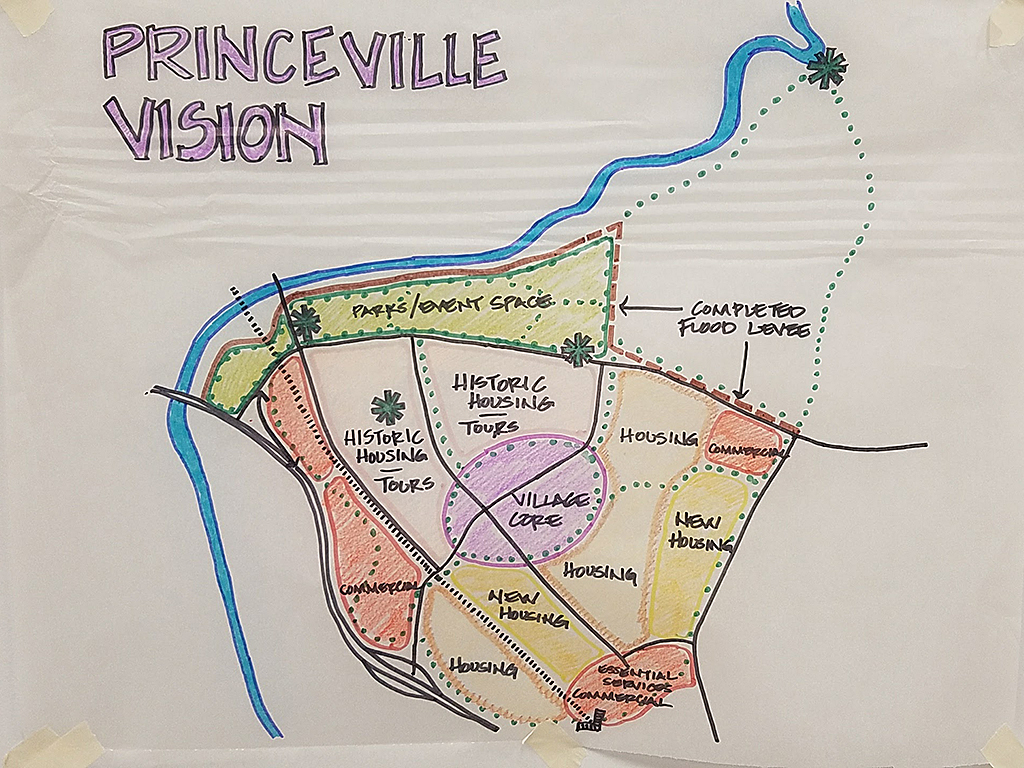
The workshop focused on three broad areas: relocating some residents, businesses and town services to a 52-acre parcel of land outside the floodplain that could be incorporated into the town boundaries; repurposing low-lying land near the river for cultural, historical and recreational uses; and rebuilding some structures in the floodplain to make them more resistant to flooding.

“Essentially, we’re trying to answer the question, ‘How do you take advantage of the opportunity to rebuild the community in a way that doesn’t perpetuate vulnerability but enhances resilience?’” Smith says.

Tourism Opportunities

Kofi Boone, a landscape architecture professor at NC State, sees opportunities to promote tourism by creating a historical trail linking Princeville with Shiloh Landing, a place on the Tar River where enslaved African-Americans were brought by steamboat from Richmond to be offered for sale to Edgecombe County plantation owners. Boone, who developed the pilot project for the African American Music Trails in rural Kinston, North Carolina, says cultural and historical trails often deliver an economic boost to small towns.

“It’s a proven way to allow local people to use what they have in hand — their stories and expert knowledge of a place — to create economic opportunities,” he says.

Joyner, the mayor pro tem, agrees that Princeville’s future is tied to respecting its past.

“Princeville has to stand,” she says, “because of the rich history that it lends to this world. So we need people that believe in us, that believe we can bounce back again, just as our ancestors did, again and again.”

Tagged with:

State of the Town in Blowing Rock Offers Updates on 321, Middle Fork Greenway, Construction & Tourism

By Jesse Wood

The Blowing Rock Chamber of Commerce held its annual State of the Town in the American Legion building on Monday evening. Interested citizens received updates on the U.S. 321 widening project, the Middle Fork Greenway project, chamber activities, tourism and other projects in town.

Blowing Rock Chamber Update

Blowing Rock Chamber Chair Jim Pitts gave an overview of the chamber. Along with noting that the organization was recognized as the chamber of the year in the Carolinas in 2016, he said that the chamber finished the year with more than 500 members, a year-over-year increase of more than 10 percent.

Priorities of the chamber include continued improvements along Laurel Lane, video to promote business growth and fill vacant commercial space in the village, and coming up with a strategy to turn the old firehouse into a performing arts facility.

“It’s not the easiest thing in the world to do. It’s a rather small facility and we all have a little bit of a Hayes Center hangover, but the one thing this town is missing is some sort of cultural, music or performing arts center. It doesn’t have to be big,” Pitts said.

He cited the events the chamber puts on such as the Symphony by the Lake, WinterFest and Savor Blowing Rock (formerly known as the Blue Ridge Wine Food Festival). The chamber changed the latter’s date from April to early May to hopefully increase attendance.

Pitts also gave an overview of the chamber’s Village Foundation, which is a vehicle to raise private funds for projects that enhance the character of the village and spark economic development. This foundation’s work includes Laurel Lane improvements, winter festive lighting and school science and math scholarships.

“There’s no better organization that really nurtures the spirit of this community and nurtures the idea of being really community minded,” Pitts said, adding that the chamber is fortunate to have partners such as the town and TDA and dedicated volunteers.

Update from Town Officials

Mayor J.B. Lawrence and Town Manager Ed Evans gave updates on town activities and developments.

Lawrence highlighted three noteworthy projects. One is the sidewalk project connecting Main Street to Bass Lake. This project is being funded by a $1.2 million federal grant and won’t be completed until likely the end of next summer.

J.B. Lawrence talks about some of the noteworthy projects happening in Blowing Rock at the annual State of the Town sponsored by the Blowing Rock Chamber. Photo by Jesse Wood

The second project is the gateway project for Sunset Drive. He said he’s hopeful this project will progress further than just the planning stages. The last project is in the design stages and currently being worked on by college students through a Virginia Tech Design Grant. This project seeks to beautify the rear of the American Legion building property and the lake area.

“It’s amazing what the students did and the ideas they gave us when they were here. Those things are just in the works. Tourism continues to be our number one industry, probably number 1, 2 and 3,” Lawrence said.

He added, “We got some issues coming up with the trees in the park. Some of them are kind of sick. It’s just some of the issues we got to deal with, and in the for-what-it’s-worth department, I returned to the banking industry today. I am now the client services executive for Highlands Union Bank.”

Town Manager Ed Evans spoke about power lines, construction activity and more during his presentation. He said that through the end of August, construction activity costs and permitting (commercial and residential) are at record levels and exceed $42 million.

“This is $12 million above the highest level ever,” Evans said.

He noted that Ransom Street has received quite a bit of development. “This street is making some amazing changes,” Evans said, noting that among some of the new projects along this road are a couple condos and new single-family homes. 

An artist rendering of the US 321 landscape plan that will be presented to the Blowing Rock Town Council in October. This is not part of the widening project contract.

Evans said that the planning department and McGill Associates, a multi-disciplinary consulting, engineering and landscape architecture firm, is analyzing the town’s roads to see which will be resurfaced in Phase 2 of obligation bond spending pertaining to the transportation category.

Evans said that people have recently asked what happened to the electric power line study. One of the priorities in the town’s 2014 comprehensive plan is removing power lines in downtown Blowing Rock. While acknowledging this is a wonderful idea and would be a great improvement, he noted that this project would cost more than $17 million: $6.5 million on Sunset and $10.75 through Main Street.

Perhaps because of the griping of recent tax increases in Blowing Rock and Watauga County, Evans said he didn’t think taxpayers would want them to increase the tax rate more to pay for burying power lines.

Evans also noted that the NCDOT will present a landscape plan to the Blowing Rock Town Council in October. This project is separate from the U.S. 321 widening project contract. The council will likely sign a memorandum or resolution to begin working on the landscaping along U.S. 321. The presentation will include artist renderings.

Update from Maymead Inc. on U.S. 321 Widening Project.

Kipp Turner of Maymead

Kipp Turner of Maymead Inc., the company contracted to complete the U.S. 321 widening project in Blowing Rock presented at the State of the Town event.

Prior to Turner speaking. J.B. Lawrence complimented Turner’s dedication to this project over the past several years and those in attendance gave a nice applause when it was mentioned that final layer of asphalt had been put down along the town section of U.S. 321, which is basically from Tanger Outlets to South 321 Business.

The entire project spans from Possum Hollow Road across from Tanger Outlets to Blackberry Road.

Turner noted that he expects a subcontractor to come out and put down the final markings next week, hopefully. He mentioned that over the summer, the NCDOT decided to add a traffic signal at U.S. 321 and South Main Street. Permanent signage along the town section of the highway should be complete in October.

He noted that the installation of light poles and landscaping is not part of this contract. Foundation for light poles has begun and the goal is to install those light poles this fall.

Turner said that the final layer of asphalt was placed in the parking lot where the old road into downtown Blowing Rock merged off the highway. This area was striped for parking spaces yesterday and the barricade was removed, so folks can now park there and walk along the sidewalk.

As for the non-town section of the project, Turner said a few more rock walls are being built: “We are real close to all of the retaining walls getting finished on the mountain portion.”

“There will still be fencing and guardrails that will follow after off the mountain, but our goal is to really be in a four-lane pattern by the end of the year even down the mountain,” Turner said. “That’s what we are pushing for.”

He cautioned, though, that the final layer of asphalt on the “mountain” section will likely have to wait until next spring because of temperature requirements and seasonal limitations of asphalt.

TDA Director Tracy Brown on Tourism

TDA Director Tracy Brown

Tracy Brown, the executive director of Blowing Rock’s Tourism Development Authority, gave a presentation on the state of tourism.

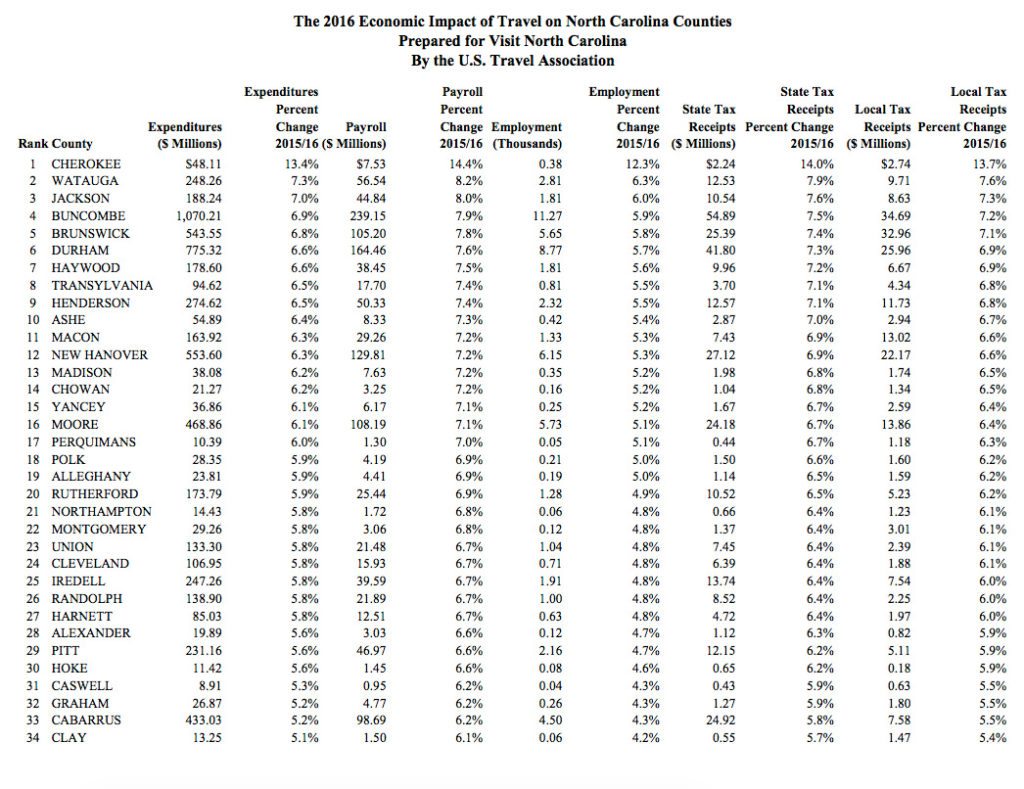
Citing figures from the state, Brown noted that visitors spent $248 million, up 7 percent, in Watauga County in 2016. Tourism-related payroll was $56 million, up 8.2 percent, and 2,800 people are employed because of tourism. State tax receipts were $12.5 million, up nearly 8 percent, and local tax receipts were $9.7 million.

“What that means for us here in this room that own property is that in 2015, each one of us paid $643 dollars less in local taxes because tourists are picking up a lot of that tab,” Brown said, noting that this figure for 2016 isn’t available yet. “We are all benefiting from the tourism dollars that come in here.”

In Blowing Rock, visitors paid nearly $1 million in occupancy tax. Each short-term rental comes with a 6 percent tax that is levied by the Tourism Development Authority to promote the region as a tourist destination and to allocate one-third of those tax proceeds for tourism-related infrastructure, such as the town’s parking decks or digital information kiosks throughout downtown.

He said that leisure-travel tourism had a $50 million impact in Blowing Rock last year.

Brown noted that from January to July (on the calendar year) occupancy tax is down about 12 percent from last year’s January to July in Blowing Rock. He said that part of that was warm weather affecting the ski season and rainy weather in the spring, early summer.

“Thirdly, Chetola went dark. At least about 18 percent of our inventory went dark for about four months. We couldn’t rent them. Those were high dollar units,” Brown said. “We feel like we are going to bounce back with no problems. Let me tell you this, we are fixing to be in the busy season. We are about 2 weeks away from it being wide open.”

Fall leaf color season is arguably the most anticipated season in the High Country and tourists flock to the Blue Ridge Parkway and Grandfather Mountain and the national parks to check out the beautiful autumn colors.

Brown noted that the TDA is continuing to focus on social media and mobile platforms for advertising and promoting content because that’s where the traffic growth is coming from.

Also, the TDA is looking at online booking websites to see if the TDA can recoup or start to collect more occupancy tax revenues that are bypassing the TDA. Apparently, some of these online booking agents are taking their cut off the top – prior to the 6 percent tax being collected.

Middle Fork Greenway Update from Patoprsty

Once complete, the Middle Fork Greenway will be a 6.5-mile multi-use paved trail that connects Boone to Blowing Rock and the Blue Ridge Parkway. So far about one-mile of trail has been built.

In August, the Blue Ridge Conservancy announced that the Town of Blowing Rock was awarded a $2 million federal grant to build a 1.3-mile segment through Section 1 of the Middle Fork Greenway, which is located from Tanger Outlet to the Foley Center at Chestnut Ridge. This section will also feature a pedestrian bridge to access the Blue Ridge Parkway and the Mountains-to-Sea trail funded by a $145,000 grant from the NCDOT.

Blue Ridge Conservancy’s Middle Fork Greenway Project Director Wendy Patoprsty said whenever she is asked when will the entire project be finished, she used to say, “That’s the $12 million question.”

“Today, I can say that’s the $10 million question,” Patoprsty.

Last year, Blue Ridge Conservancy purchased 12 linear acres, representing about a two-third mile of greenway trail, which enables the connection of two existing pocket parks, Sterling Creek Park, across from Mystery Hill and Goldmine Branch Park, which is county land near Niley Cook Road, which is part of Section 4 of the Middle Fork Greenway master plan.

“Right now, we are getting shovel ready in that section. We are getting permits, engineering and all the final designs right now and fundraising the construction of that section as well,” she said.

As for the Boone side, she said the Blue Ridge Conservancy is working with the Town of Boone and Appalachian Regional Healthcare System, which owns Watauga Medical Center and previously gave easements near Foley Center, on the section that would connect the greenway from Niley Cook Road to Fairway Drive, the road that accesses the Boone Golf Course. A $2.5 million grant was recently submitted that would help fund that section.

She also noted that the NCDOT will replace the bridge at Aho Road sometime in the future and that Sen. Deanna Ballard helped the project receive $100,000 in recreation aid money to fund building the bridge wider and taller to accommodate a greenway running underneath.

She said the $1.3 million federal grant requires a 20 percent match. Fundraising efforts are underway, and one idea that they’ve come up with is to ask business in the High Country to encourage customers to round up to the next dollar in July 2018. The goal is to get 200 businesses on board, and so far 56 business have signed up.

“Our goal is to raise the match money for our grant, not only for Blowing Rock section but Section 4. Once we get Section 1 and Tweetsie to Niley Cook towards Boone, we’ll be more than halfway done with the Middle Fork Greenway, which is amazing,” Patoprsty said. “We have lots of money to raise but with the community support and all the grants, I really believe we could do it.”

For more information about the Middle Fork Greenway, click here.

Below are pics of some of the related topics of the State of the Town:

Old Firehouse

Development along or near Ransom Streeet in Downtown Blowing Rock

US 321

Comments

comments

Tagged with:

The Research Triangle Park Selects Clean As Marketing Agency Of Record

In 2014, RTP purchased the 100-acre Park Center along N.C. 54 with the aim of developing a mixed-use central footprint where people also live and socialize outside of working at the corporate campuses. The multiphase project will deliver in-demand amenities such as new retail and restaurants, multifamily residential and hotels, a central marketplace, and public parks. Specifically, this year, RTP will focus on the expansion of 142,000-square-foot startup hub The Frontier into a multi-building campus. The Frontier is home to 85 businesses and has seen more than 300,000 visitors since launching in January 2015. The campus will grow to include additional office towers, open communal spaces, restaurants, and retail.

“In the 1950s, RTP transformed North Carolina’s economy. Today, we’re transforming RTP, adding exciting amenities and opening new buildings at The Frontier,” said Research Triangle Park Vice President of Marketing and Communications Michael Pittman. “As we reimagine the heart of our community, we will benefit greatly from Clean’s strategic vision and expert execution.”

“People move to our region every day because of the Research Triangle Park’s innovation and success,” said Clean CEO Natalie Perkins. “RTP gave rise to our region’s moniker (‘the Triangle’), and we are thrilled to partner on its next-gen identity project to ensure RTP is best positioned to attract and retain employers and talent.”

About Clean
Clean is an integrated branding agency with a diverse client portfolio featuring Lenovo, UNC Kenan-Flagler, Credit Suisse, Raleigh-Durham International Airport, Wilmington Tourism, and Durham Distillery. The agency provides a complete array of services under one roof, including strategy, creative, digital, media, public relations, and social. Launched in 1996, Clean uses a strategy-first approach to develop and execute multichannel marketing programs tailored to each client. A woman-owned business, Clean has been awarded HUB certification by the State of North Carolina. Clean is a member of Worldwide Partners, one of the largest networks of independent advertising and marketing communications agencies in the world.
cleaninc.com

About Research Triangle Park
The Research Triangle Foundation of North Carolina serves the Research Triangle Park, a bellwether institution that was once referred to by Governor Luther Hodges as the “heart and hope of North Carolina.” Situated centrally among Duke University, North Carolina State University and the University of North Carolina at Chapel Hill, RTP contains 7,000 acres, 48,000+ employees, and over 250 companies, including Biogen, Cisco Systems, Credit Suisse, Fidelity Investments, IBM, and RTI International. RTP is also home to The Frontier, a community convening destination at Park Center; and The Lab, an affordable option for wet lab and office space.

Contact: Dan Strickford
919.987.3623
dstrickford@cleaninc.com

Cision View original content:http://www.prnewswire.com/news-releases/the-research-triangle-park-selects-clean-as-marketing-agency-of-record-300621590.html

SOURCE Clean

Related Links

http://cleandesign.com

Tagged with:

High-speed ferries proposed for NC’s Inner Banks | Charlotte Observer

A UNC marketing professor is pitching a plan to put high-speed ferries on North Carolina’s vast Albemarle Sound, which he says is the nation’s largest inland body of water without ferry service.

Nicholas Didow of UNC-Chapel Hill’s Kenan-Flagler Business School presented the Harbor Town Project, as the ferry plan is called, to civic leaders in Elizabeth City on Tuesday. Didow works on economic development projects in rural North Carolina and says ferries could breathe new life into the small towns that tourists often zoom past on their way to the beach.

State ferries have for decades carried passengers and vehicles between North Carolina’s mainland and the Outer Banks, crossing Pamlico Sound to Ocracoke. But no state routes cross the Albemarle Sound on the northeastern coast, a rural region that tourism promoters call the Inner Banks.

Never miss a local story.

Sign up today for a free 30 day free trial of unlimited digital access.

The first phase of Didow’s plan would link five towns, ecotourism sites and historic places on the inland side of the Albemarle Sound, Elizabeth City’s Daily Advance reported.

Didow envisions five catamaran-style ferries running from Elizabeth City to Hertford, Edenton, Plymouth, Columbia, and to Kitty Hawk on the Outer Banks. The state Department of Transportation is building a similar high-speed catamaran ferry that it expects to start serving Hatteras and Ocracoke islands this summer.

Didow estimates the fleet would cost $13.8 million to launch and nearly $2 million a year to operate, the Advance reported.

The money could come from public, private and foundation sources such as the Golden LEAF Foundation, which makes grants from North Carolina’s share of a 1999 settlement between the federal government and cigarette makers. Didow previously helped expand broadband internet service to northeastern North Carolina, using Golden LEAF grants.

The second and third phases of the Harbor Town Project would update the docks and historic downtowns of the five inland towns, and improve ecotourism and historic sites to make them more appealing to tourists.

Conservative estimates are that the ferries could carry 107,000 passengers in the first year, stimulate $14 million in added tourism spending and generate at least 94 full-time jobs, Didow told the Elizabeth City gathering, the Outer Banks Voice reported.

“I’m hoping this can bridge the gap between the Inner Banks and Outer Banks,” he said. “It would be mutually beneficial, bringing tourism growth to both sides.”

Some at the Tuesday meeting questioned a proposed ferry route from Edenton to Kitty Hawk, which they said could benefit Edenton more than the other inland downs. But Plymouth Mayor Brian Roth said he supports the proposal, the Daily Advance reported.

“It’s actually disappointing this didn’t happen 25 years ago,” Roth said. “We could be a quarter of a century ahead of where we are today.”

Didow will present the proposal to Gov. Roy Cooper in late March, the project’s Facebook page said. Cooper has previously voiced support for new ideas to invigorate rural North Carolina.

Tagged with:

Watauga County Ranks 2nd in State for YOY Percentage Increases for Visitor Spending


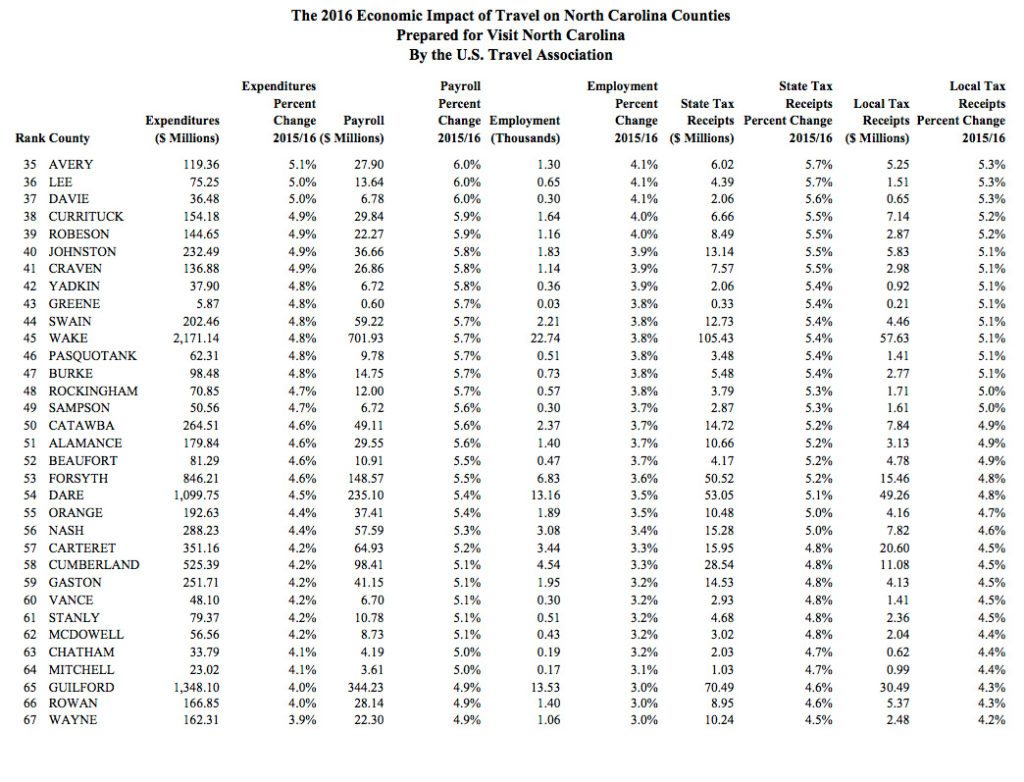
Click on the spreadsheet images to enlarge and see numbers from northwest NC.

While Watauga County doesn’t rank at the top for monetary expenditures because it’s a smaller county than say Mecklenburg or Wake counties, Watauga County did rank second in terms of year-over-year percentage increases in visitor spending and percentage in direct tourism employment.

“We knew that 2016 was a strong year for tourism in Watauga County based on occupancy tax revenue and what we were hearing from our tourism partners in the community.  It was nice to see how well we did compared to other counties in the state,” Wright Tilley, director of Watauga County and Boone Tourism Development Authorities, said in a statement.

“We are extremely pleased to have been second in tourism spending increases and second in increases in direct tourism employment.  Tourism is economic development for Watauga County.”

The largest percent increases in visitor spending were seen in Cherokee (13.4 percent), Watauga (7.3 percent), Jackson (7.0 percent), Buncombe (6.9 percent) and Brunswick (6.8 percent) counties. Durham and Haywood counties followed with a 6.6 percent increase each. Rounding out the top 10 in largest increases were Transylvania (6.5 percent), Henderson (6.5 percent and Ashe (6.4 percent).

These figures come from the Economic Development Partnership of North Carolina, which recently announced that 97 of the state’s 100 counties saw increases in visitor spending in 2016.

Visitor spending topped $5 billion in Mecklenburg, $2 billion in Wake and $1 billion in Guilford, Dare and Buncombe counties. Rounding out the top 10 counties for visitor spending were Forsyth ($846 million), Durham ($775 million), New Hanover ($554 million), Brunswick ($544 million) and Cumberland ($525 million).

Domestic visitors spent a record $22.9 billion statewide in 2016, an increase of 4.4 percent from the previous year. State tax receipts as a result of visitor spending neared $1.2 billion in 2016, and local tax revenues directly resulting from visitor spending totaled more than $693 million. Visitor expenditures directly supported 219,094 jobs and generated nearly $5.6 billion in payroll income across North Carolina. 

“Tourism serves as a specialized economic development engine that fuels North Carolina’s economy,” said Tammy O’Kelley, Chair of the NC Travel Tourism Board, and Executive Director of Randolph County Tourism Development Authority. “A positive tourism economy is critical to our state’s overall economic health, and is made possible by our dedicated tourism partners who work hard every day to make sure that from the mountains, to the Piedmont and the coast, North Carolina remains a destination of choice for travelers from across the globe.”

“North Carolina is an exceptionally beautiful state loved by residents and visitors,” said Wit Tuttell, Executive Director of Visit North Carolina, which is part of the Economic Development Partnership. “North Carolina’s position as the sixth most-visited state in the nation with more than 48 million visitors in 2016 reinforces its status as a premier tourism destination.” 

The visitor spending figures come from an annual study commissioned by Visit North Carolina and conducted by the U.S. Travel Association. The study uses sales and tax revenue data, employment figures and other industry and economic data to determine the overall impact of visitor spending in North Carolina.

Highlights include:

Mecklenburg County received $5.2 billion in domestic travelers’ expenditures to lead all of North Carolina’s 100 counties. Wake County ranked second with $2.2 billion, followed by Guilford County with $1.3 billion, Dare with $1.1 billion and Buncombe with $1.1 billion in visitor spending.

The largest percent increases in visitor spending were seen in Cherokee (13.4 percent), Watauga (7.3 percent), Jackson (7.0 percent), Buncombe (6.9 percent) and Brunswick (6.8 percent) counties. Durham and Haywood counties followed with a 6.6 percent increase each. Rounding out the top 10 in largest increases were Transylvania (6.5 percent), Henderson (6.5 percent and Ashe (6.4 percent).

Positive spending growth was seen throughout the state’s economic development regions. The Western (6.6 percent) and Northwest (5.3 percent) regions experienced the strongest growth, yet all eight regions had spending growth of 3 percent or more from 2015 to 2016.

Mecklenburg County had the largest number of direct tourism employees (50,770) and the largest payroll ($1.8 billion). Four other counties had more than 10,000 direct tourism employees: Wake (22,740), Guilford (13,530), Dare (13,160) and Buncombe (11,270).

96 percent of the state’s counties saw direct tourism employment growth in 2016. Counties with the largest year-over-year increases in direct tourism employment were Cherokee (12.3 percent), Watauga (6.3 percent), Jackson (6.0 percent), Buncombe (5.9 percent), Brunswick (5.8 percent), Durham (5.7 percent) and Haywood (5.6 percent).

Full tables are can be accessed at partners.visitnc.com/economic-impact-studies. For more information about the travel impact numbers, contact Visit North Carolina. See below for figures from all 100 counties. 

Comments

comments

Tagged with:

The Creepiest Place To Visit In Your State That You Probably Haven’t Heard Of

I don’t excel at scary things. My friends have given up on inviting me to see horror movies with them, and I’m not one to hightail it to a ghost tour the minute I touch down in a new city. I even sit Halloween out (I know, I know — it’s controversial, but I’m trying to be honest). I know I’m not necessarily in the majority here, though, and that there are plenty of people out there who actually live for the high-adrenaline experience of being in the presence of pure creepiness. For those of you who fall in this camp, you’ll be psyched to refer to this list of the creepiest place to visit in your state. That’s right — no matter where you live, there’s a creepy destination just waiting to spook you, and it might not even be that far away.

The only thing I ask as you begin to make plans for your in-state horror tour is that you don’t push too hard on the wimps in your circle. As a proud wimp, I know how awkward it can be to feel like the loser in the room simply because I don’t want to tag along on a creepy field trip, when the truth is that the field trip is bound to be way more fun without me. If you’re a fan of the creeps, run wild with this list! And please let the anti-horror stay home with a carton of ice cream.

Alaska

Just looking at this photo of the Igloo City Hotel in Cantwell, AK gives me the creeps. Per Haunted Rooms, this abandoned building is located on an isolated stretch of the Parks Highway, and while it’s common knowledge that construction on it stopped in the 1970s, no one really knows why. Naturally, it’s now believed to be haunted. Why wouldn’t it be?

Arizona

Your first red flag about the Birdcage Theatre should be that it’s located in an Arizona town called Tombstone — but if you need further convincing that it’s a little freaky, look no further than its history. According to the Phoenix New Times, this 19th century theater was home to drinking, gambling, prostitution, and 16 deadly gunfights in its prime. Many have claimed to see ghosts there.

Arkansas

Per Only In Your State, Pea Ridge National Military Park is one of several Arkansas Civil War battlegrounds that are now thought to be haunted. Guests have reported a sense of being followed by something they couldn’t see.

California

The Santa Lucia Mountains that run between Avila Beach and Monterey, CA are an undeniably beautiful sight, but they’re steeped in bone-chilling history. Legend says that there are Dark Watchers — large, quasi-human phantoms — that lurk inside the mountains, according to Culture Trip. If you’re brave enough to try to catch a peek, visit the mountains at twilight and look up!

Colorado

Denver’s Cheesman Park was used as a cemetery in the late 19th century, according to Colorado’s 9News.com. Later, the land was claimed as federal property, and families were given a mere 90 days to remove the bodies — and, in the end, a city contractor had to do most of the dirty work because so few people could afford the removal themselves. As you can imagine, things got weird, and thanks to poor planning on the contractor’s part, there were body parts and bones all over the park. Just try and tell me that the place isn’t haunted.

Connecticut

Per Damned Connecticut, Union Cemetery in Easton, CT has been a hot spot for ghost hunters and thrill seekers for years. It’s a must-see for anyone who claims to be a fan of all things paranormal.

Delaware

Located on Delaware’s Pea Patch Island, Fort Delaware was built by the French to protect Delaware from the Confederacy and other enemies. Today, Haunted Rooms says that the site is one of the state’s most haunted — especially the dungeons, where prisoners would have been held when the fort was functioning. Reports of the sound of rattling chains and disembodied voices are not uncommon.

Florida

St. Augustine, FL is the oldest city in the U.S., so it should come as no surprise that it’s home to one of the eeriest locations in the state. While stunningly beautiful, Castillo de San Marcos is a go-to for ghost tours, thanks to its distinction as our country’s oldest standing masonry fort, per Only In Your State. Legend says that the site is haunted by a Seminole man and a heartbroken woman in white.

Georgia

Don’t be fooled by the many reviews of Moon River Brewing Company‘s great beers. It’s one of the creepiest places in Georgia! Located in Savannah, the 19th century building hosted a variety of violent fights, lynchings, and shootings, according to StyleBlueprint. Contemporary visitors and staff members share stories of bottles flying in midair and being touched by an unseen being.

Hawaii

In 1938, an elderly widow was murdered and left to die by two escaped convicts in her home, which was near the site that’s now known as Morgan’s Corner on the island of Oahu, per Hawaii Magazine. It would be five days before her body would be discovered. Stories are told around Hawaii of other gruesome events that took place at the same spot.

Idaho

Yes, that’s right — there is actually a real Bates Motel, and it’s located in Coeur d’Alene, ID. According to Haunted Rooms, the infamous location was originally an officers barracks, was converted to a Roadway Inn, and was ultimately sold again to Randy Bates, who gave it its well-known moniker. Motel guests and employees have since reported nearly constant paranormal activity at the location.

Illinois

It might look pretty innocent, but the Peoria Public Library is actually known as one of the creepiest places in Illinois, according to Mysterious Heartland. Legend says that it’s built on cursed ground and is therefore haunted by many ghosts. Sounds like the perfect place to check out some scary books if that’s your thing!

Indiana

The Story Inn has tagged itself “One inconvenient location since 1851,” not only because visitors need to travel 20 miles into the wilderness in order to stay there, but also because it’s the only building still standing from a now-defunct mining town, per The Indy Channel. That fact alone is a little eerie, but the documented ghostly hauntings really lock up the creepiness factor for the inn, which is still an operating bread and breakfast.

Iowa

Rumor (well, decades-old legend) has it that anyone who touches the hand of the Black Angel Statue of Fairview Cemetery in Council Bluffs, IA will die, Travel Iowa tells us. Shake hands with her at your own risk.

Kansas

St. Jacob’s Well is a sinkhole formed by centuries of gradually-eroding rock, according to Mysterious Heartland, and while we can now estimate that it’s about 18 feet deep, it was once believed to be a literal bottomless pit. Over the years, many visitors have lowered weighted rope into the depths of the well in search of the bottom! There are plenty of other creepy legends associated with this site too — bodies left at the bottom, sightings of spectral cowboys, haunted houses nearby, and more.

Kentucky

Early Kentucky senator John Brown built Liberty Hall as his family home in 1796, and it became the site of many deaths, according to Kentucky For Kentucky. As a result, there are three spirits thought to haunt the grounds to this day — the “Gray Lady,” a Spanish opera performer, and a soldier.

Louisiana

The New Orleans French Quarter is chock full of buildings laden with all kinds of history, and the Lalaurie House has an especially storied — and haunted — profile, per Vacations Made Easy. The building is a private residence now, but you can walk by it if you’re passing through The Big Easy and get full body chills just looking at it. The Lalaurie House has a sad history of violence toward slaves that’s since been portrayed on American Horror Story.

Maine

Now under consideration as the site for a new veterans facility, the Kennebec Arsenal in Augusta, ME is widely though to be one of the creepiest spots in all of the Pine Tree state, according to Only In Your State. In the early 20th century, the arsenal was a hospital for the severely medically ill, and many say that you can still hear the cries of the building’s former patients.

Maryland

Shortly after John Wilkes Booth assassinated President Lincoln at Ford’s Theatre in Washington, DC, he was taken to the home of Dr. Samuel Mudd in Walford, MD so that his broken leg could be treated. According to Haunted Rooms, Dr. Mudd was tried and convicted as a co-conspirator in the assassination. Today, Dr. Samuel A. Mudd’s House is an important historical site, and some people claim that they’ve seen the doctor’s ghost wandering the property or the impression of a body in the bed where Booth slept and recovered.

Massachusetts

Per Only In Your State, Dogtown started as a respectable 17th century settlement… but went on to have a very bad reputation. Rumors abounded that the dwindling residents of Dogtown practiced witchcraft, a theory that was only confirmed by the mysterious words carved into rocks throughout the area.

Michigan

If sleeping with ghosts is your thing, you can stay at Kalamazoo’s Henderson Castle to this day! Awesome Mitten notes that the building’s original owners, as well as a Spanish-American War veteran, a little girl, and a dog still hang out in their spectral forms around the property. The good news? It sounds like they’re all pretty friendly!

Minnesota

I know that the Greyhound Bus Mueseum doesn’t sound particularly spooky, but previous visitors might disagree! According to Haunted Rooms, there’s a particular bus that happens to be home to a ghost that periodically plays with its windows and doors. Creepy shadows abound!

Mississippi

King’s Tavern is the oldest building in Natchez, MS, according to Visit Mississippi, and it’s also been featured in an episodes of Ghost Adventures, which automatically gives it creepy cred. Legend says that a space was found behind the wall holding three dead bodies. As you might expect, haunted happenings followed, including mysterious sightings in mirrors and the disembodied sound of a crying baby.

Missouri

I can’t say that there are any cemeteries out there that I find decidedly un-creepy, but Lorimier Cemetery sounds especially chill-inducing. Lorimier is the home of the “tapping host,” according to Only In Your State. Visitors report the sensation of being tapped on the shoulder or of having their hair pulled.

Montana

The Montana town of Fort Peck was built in the early 20th century to temporarily house U.S. Army Corps of Engineers workers and their families, and while the town’s theater is still functional today, it’s also said to be haunted by a male spirit, per the Billings Gazette. Visitors have also reported strange sounds and bizarre apparitions in the dressing rooms.

Nebraska

As you can tell from this tweet begging the host of Ghost Adventures to visit Centennial Hall in Valentine, NE, there’s some serious creepiness afoot here. According to Haunted Rooms, a student at this one-time high school building died on campus after her clarinet reed was poisoned, and many have said they believe she still haunts the halls. They report a feeling of being sick when they see her ghost, as well as the sound of music playing from the school’s old music room… even though the building has long since been converted to a museum without a working musical instrument to speak of.

Nevada

Nevada has a reputation for mining communities turned ghost towns, and Goldfield is one of the best-known. Goldfield Hotel and the abandoned Goldfield High School are thought to be particularly creepy, Only In Your State notes, thanks to accounts of ghost sightings.

New Hampshire

Mary is a redheaded, green-eyed ghost who is said to appear in the upstairs window of New Hampshire’s Ocean-Born Mary House, according to Haunted Rooms. She has also been caught standing on the staircase when people enter the building! And since legend says that Mary found the body of her murdered husband when she was alive and buried him under the kitchen’s hearthstone, the whole thing feels extra eerie.

New Jersey

The Devil’s Tree stands alone in a field in Bernards Township, NJ, and many locals believe that it’s cursed, per NJ.com. Legend says that anyone who cuts down the tree will die an early death, largely because, years ago, a farmer is believed to have hanged himself from its branches after murdering his wife and children.

New Mexico

There’s no shortage of creepy sites in New Mexico, but Dawson tops the list from Haunted Rooms. The town was built around a large coal mining operation, but it also became home to two of the most serious mining tragedies in American history! Nearly 400 people were killed in these incidents combined, and ghost stories abound around town. Some have claimed to see miners’ helmet lights and other spectral figures walking through the graveyard.

New York

More than 800 thousand people have been buried in Hart Island since the late 19th century. The land is used for unclaimed bodies or for those whose families cannot afford a proper funeral, according to Untapped Cities.

North Carolina

The legend of Blackbeard the Pirate is well-known, but fewer people know about Teach’s Hole, a cove located in Ocracoke Island, NC and named after Edward Teach — the man better known as Blackbeard. Upon his capture, Blackbeard was beheaded, and his headless body is said to have been seen swimming in the cove or walking the beach, per Thrillist.

North Dakota

Constructed in 1915, Willston, ND’s Old Armory is said to now be the home of freely-moving mannequins and ghostly whispering, according to Haunted Rooms.

Ohio

A Buzzfeed user shares the legend of Lick Road near Cincinnati, OH: “The ghost, Amy, was killed by her boyfriend on the bridge that crosses over the creek. If you sit in your car and wait, Amy will come and write ‘Help Me’ in condensation on your windows. If you park facing the path, turn off your car and flash your headlights three times, Amy’s ghost will appear.” I’m not sure I want to test this one for myself.

Oklahoma

Oh, has the name of this one not sufficiently creeped you out? Let me explain. According to Haunted Rooms, Dead Woman’s Crossing is a bridge on the road around Deer Creek now haunted by the ghost of Katy DeWitt James. James is said to have mysteriously disappeared in 1905 after riding in a buggy with a prostitute friend into a field near said creek. Her baby was dropped off at a local farm wrapped in a bloody dress.

Oregon

In 1906, the crew of the Peter Iredale cargo ship was evacuated during a storm on the way to Portland. Since the ship itself was largely undamaged, according to Oregon Live, the crew planned to save it, but it became gradually buried in the sand and could no longer be moved. Today, the tourist destination is a spooky-looking photo op.

Pennsylvania

As a Pennsylvania native, I can confirm that Eastern State Penitentiary is easily the creepiest place in the Keystone state — so creepy, in fact, that I’ve never ventured to go. Per Thrillist, the century-old prison — once known especially for its focus on solitary confinement — is now a must-see for ghost hunters. Visitors have reported hearing voices and seeing visions of guards and inmates.

Rhode Island

The Seaview Terrace property in Newport, RI is so objectively creepy that it’s been used as part of gothic series Dark Shadows, notes Only In Your State. But it’s not all hype — ghost sightings have also been reported.

South Carolina

According to Haunted Rooms, seven people were once hanged from Seven Devil’s Bridge, and (naturally) the ghosts of those people now haunt the area. It’s said that living people cannot cross the bridge at midnight — and theory that seems to have been confirmed by a number of freaky car crashes for those who attempted it.

South Dakota

Come for a performance, stay for a side of the creeps. The Orpheum Theater of Sioux Falls dates back to 1913 and is rumored to have a resident ghost named Larry, per Haunts.com. He’s been known to mess up concerts and shows by blowing fuses and dropping sandbags onto actors. Legend has it that, in life, Larry committed suicide after failing to land the part of Romeo in an Orpheum production.

Tennessee

The Shiloh National Military Park makes the list of Tennessee’s most creepy. It’s full of natural beauty today, but it was also home to the Battle of Shiloh during the American Civil War, and there are accounts of people seeing a bloodied pond in the area today. Was that the pond where soldiers came to clean their wounds? I guess we’ll never know!

Texas

You can still grab a drink at the La Carafe wine bar in Houston, but given its creepier elements, I’m not sure you would want to. According to Only In Your State, guests of the first floor establishment (which is the oldest still-operating commercial building in the city) have heard heavy footsteps and the sound of a body being dragged upstairs.

Utah

OK, so Rock Canyon is obviously beautiful, but given the fact that it’s really only meant for experienced climbers, it’s also played host to lots of serious injuries and deaths. Haunted Rooms credits this with the negative energy of the area, from which there have been regular reports of a ghostly man who runs down the canyon’s rockier ledges and straight toward the living, vanishing before he can make contact.

Vermont

According to Only in Your State, West Castleton, VT — though once a hot spot for European immigrants and miners — is now largely abandoned. A well-known local story says that a group of West Castleton friends traveling by rowboat to a pub on the other side of Lake Bomoseen… and never returned. Their empty boat, however, was found floating in the lake. Today, it is believed that a spectral rowboat can be seen on Lake Bomoseen.

Virginia

Williamsburg, VA is full of opportunities to tap into some centuries-old spirits, but the Peyton Randolph House is widely known as the most haunted, per Colonial Ghosts. Some even call it the most haunted house in the country! Visitors have heard voices, witness objects moving on their own, and felt hands touch or push them (General Marquis de Lafayette himself reported the latter!).

Washington

Tacoma Old City Hall was once, of course, the HQ for important city matters, but it’s also been the site of many alleged hauntings over the last 40 years. According to Haunted Rooms, police have been called to the scene to check out creepy noises, spontaneous fire alarms, and even burglar alarms. On each occasion, officers found no evidence of an actual human having been inside.

West Virginia

This is the scene that creepy carnival music was made for. Wild, Wonderful West Virginia notes that many believe the land on which Lake Shawnee Amusement Park is built is actually cursed — and for good reason. In the late 18th century, three local children and several Native American warriors were killed on the land before it was even converted to an amusement park, and further deaths were reported later on. The park was abandoned in 1966, and now it’s the home of rusted park remains and ghost sightings (a little girl, of course).

Wisconsin

This dead end road west of the Wisconsin River is said to be named in honor of Boy Scouts who died there many years ago, according to Mysterious Heartland. There’s a lot of mystery around how these deaths occurred on Boy Scout Lane, so if you love an unsolved murder or disappearance, you’ll love the creepy vibes of this spot.

Wyoming

Buffalo Bill himself built Cody’s Irma Hotel, per Haunted Rooms, and some say that he’s stuck around, along with his daughter Irma. Guests have alleged the sound of footsteps, as well as sightings of a ghost missing the bottom half of his body. Irma is said to hang out in a rocking chair in the corner of Room 16, which was her bedroom IRL.

Tagged with:

Don’t get swamped by information, get free | Expert column | Inside … – Virginian

Here is a quiz question: What happens, invariably, when you’re overloaded with too much information on a continual basis? You begin to feel overwhelmed, which leads you to feel overworked.

With shrinking budgets and small staff size, most managers are facing more challenges today than in previous years. And keeping up is made harder by the onslaught of information received on a daily basis, most of which is not vital to your well-being.

Here are some ways you can more efficiently sort through information, and reduce the likelihood of experiencing information overload:

DETECT AND SELECT

You can’t stay on top of everything, but you can determine in advance what is worth your time and attention.

I suggest opening your mail over the wastebasket; it’s much easier to chuck items that way. If you get a magazine or journal, peruse it rapidly and tear out the articles or items that look like they’ll be of interest, and recycle the rest of the issue.

Consider which items you can scan into your computer. The less physical paper you hold on to, the better. Be sure to use an accurate file name and place the scanned document in the best file folder, so you can easily retrieve the document.

Also, collect all the junk mail that comes in for one month and assign someone to call or use a form letter to write back and say, “Please save a tree, delete us from your mailing list!”

TAKE A STAND

Whenever you’re faced with new information, ask yourself:

• What is the driving force behind this item?

• Do I need it, or do I simply fear not retaining it?

• Does it merely repeat what I already know, or what I already believe?

• Is it just an information crutch?

In this era, when information surges forth, you generally don’t need to hang on to as many things as you do.

PRUNE YOUR FILES

Continually pare down and let go of data you’ve been collecting. Muster the mental and emotional strength to let go of information that is only marginally valuable.

What are the best times to pare down? Any time when you’re in the frame of mind that allows you to recognize that paring down, in itself, is a worthwhile activity and an adaptive behavior that helps you in your career and your personal life.

ACKNOWLEDGE THE REALITY

Every workday, for the rest of your life, you’re likely to be besieged by more information, not less, due to the changing nature of information exchange and the internet.

That means you must be smarter about what, and how you take in, information.

Thus far, you perhaps haven’t acknowledged the full extent of the reality you’re facing or drawn upon the resources you have available. Once you do, you’ll be able to withstand the information deluge.

Jeff Davidson is principal of Breathing Space Institute in Raleigh, N.C. He offers keynote presentations and workshops on work-life balance. For more information, visit breathingspace.com or email jeff@breathingspace.com.

Tagged with:

Video shows police officers shooting armed 76-year-old patient at …

March 26–Huntersville police ordered a 76-year-old Hurricane Irma evacuee to drop his gun before and after they shot him in a hospital hallway in September, according to video released Monday by the Huntersville Police Department. The gun is not visible in the video before the shooting.

In December, Mecklenburg County District Attorney Spencer Merriweather ruled two Huntersville police officers were justified in shooting and killing James Charles Cook, who was a patient at Novant Health Huntersville Medical Center.

A nurse came to Cook’s room around 11:30 p.m. on Sept. 10 and saw him pull a gun out of his suitcase, according to investigation records released with the DA’s report. She ran away from the room and was returning with a security guard when she heard a gunshot, the records said.

The security guard, who was unarmed, watched Cook walk out of his room holding a gun, records said.

The Huntersville officers, Michael Joseph and Travis Watts, responded to the hospital after hearing reports that a man had fired shots there.

On the video released Monday, filmed by Joseph’s body camera, Watts can be seen with a black shield and a gun.

The video showed the officers looking for Cook in the hospital and riding an elevator before they found him near a nurses’ station.

“Sir, show me your hands! Show me your hands! Do it now!” one officer said. Another voice said “got a gun” as shots rang out, creating a breeze that turned the pages of a binder on the nurses’ station counter.

In interviews with State Bureau of Investigations officials, Watts and Joseph both said they saw Cook point a gun at Watts before they fired, according to the DA’s report. The officers shot Cook just past the two-minute mark of the video, and Cook is not visible in the video before or during the shooting.

Officers continued to point their guns at Cook after shooting him.

“Sir! Put that gun down! Drop the gun … do not move! Do not move!” an officer said to Cook.

One officer, apparently concerned about the possibility of other attackers, told another to “check our backs and make sure nobody’s gonna shoot us.”

During the rest of the nine-minute video, the officers talked to colleagues about checking the rest of the hospital and keeping an eye on Cook’s gun.

“How in the world did he get a gun in a hospital?” one officer asked near the end of the video.

Jane Wester: 704-358-5128, @janewester

___ (c)2018 The Charlotte Observer (Charlotte, N.C.) Visit The Charlotte Observer (Charlotte, N.C.) at www.charlotteobserver.com Distributed by Tribune Content Agency, LLC.

Tagged with:

Trump’s tariffs could slow Asheville’s flowing craft beer industry | OPINION – Asheville Citizen


Following through on an unfortunate campaign promise, President Donald Trump recently announced his desire for 25 percent and 10 percent tariffs on steel and aluminum imports, respectively. Such a move smacks of crony protectionism, and would unfortunately cost the U.S., and North Carolina, jobs.

One local industry that would be especially harmed is Asheville’s burgeoning craft brewers.

Statewide, the craft brewing industry supports more than 10,000 direct and indirect jobs, with more than $1 billion in economic impact. Asheville is a key driver in this growing industry.

Asheville reportedly boasts more local brewers per capita than any city in the U.S., with more than 60 commercial brewers in the greater mountain area.

Trump’s tariffs, however, would have a significant negative impact on these small businesses. Cans make up 28.5 percent of packaged production for brewers, according to the North Carolina Brewers Association, a percentage even higher for smaller craft brewers. Higher tariffs on imported steel and aluminum would mean fewer affordable options for a key input for brewers. In addition to the aluminum cans, brewers are also major consumers of steel, used for capital goods such as fermentation tanks, pipe fencing, draft equipment and kegs.

“We rely on stainless steel for brewing equipment and kegs, and we rely on aluminum for cans,” said Leah Ashburn, CEO of Highland Brewing in Asheville, in an article posted to the North Carolina Craft Brewers Guild website. “Our investments result in jobs and high-quality beer for the expanding Southeastern U.S. craft beer market. The tariffs on steel and aluminum introduce a level of uncertainty to our supply chain, our equipment needs and our future.” 

In short, Trump’s tariffs would make it far more difficult for local Asheville brewers to launch or expand their business, squelching job creation.

“As Bhramari Brewing continues to explore our expansion opportunities, these proposed tariffs would certainly impact our project scope and payback periods, as well as limit us in terms of future job creation,” said Audra Gaizunas, CEO of Bhramari Brewing in Asheville, also to the NC Craft Brewers Guild.

When confronted with increasing input costs, local brewers will be forced to make adjustments to the increased production costs created by tariffs.

One option is to attempt to pass along the increased cost to the consumer in the form of higher prices. How viable an option this will be depends on how sensitive craft beer consumers are to price hikes. Many consumers will respond by purchasing less craft beer, or seeking alternatives like lower-cost and mass-produced name brand beers from out of state.  

For those consumers willing to pay the higher prices, however, they will have less money to spend on other products – harming those industries. Many of those harmed industries may well be local as well, like restaurants, shops or entertainment venues.

Moreover, if Asheville’s local beer industry diminishes, the city’s vital tourism dollars may be harmed as well.

“Ten years ago our microbreweries were not a factor in motivating a visit to Asheville, but new research shows more than a quarter of visitors to Asheville stop by one of our breweries, and 14 percent say our beer scene was one of the primary reasons for their visit,” Marla Tambellini, vice president of marketing and public relations at the Asheville Convention and Visitors Bureau, told the Citizen Times last year.

Trump’s tariffs are crony protectionism. They will protect a relatively few uncompetitive companies and jobs in the steel and aluminum industries outside of North Carolina, but at great cost to other jobs and industries. One such example is Asheville’s thriving craft brew industry, which would be taxed on its vital inputs, driving up the cost of doing businesses and stunting their ability to create jobs and expand.

If Trump’s tariffs are implemented, Asheville’s flowing craft beer industry may come to a slow drip.  

Brian Balfour is executive vice president of the Civitas Institute in Raleigh.


Tagged with:
Top