This is going to be big. Pyramid big. Ocean big. Donald Trump big.
Bert Hesse, who was unable to get Charlotte to see the light on his fab-ab-ulous plan to plop a movie studio atop the majestic ruins of Eastland Mall, is heading to Rock Hill with his stupendous scheme.
Short-sighted Charlotte leaders didn’t appreciate his project, which would have included a 30-acre studio with eight sound stages, retail and office space, a hotel, a film school, a studio tour and hundreds of jobs. It was big, very big.
But even big, big, bigger is the idea to build the project across the South Carolina border on the Catawba Indian Reservation in York County. You’ll get everything the cinema kingdom at Eastland was offering and a Catawba Cultural Center too.
South Carolina lawmakers can ensure this astonishing project by larding giant tax breaks to producers like other states that are keenly aware of the glorious benefits this single amazing industry brings.
This is not only a huge opportunity for the Catawba tribe and the state of South Carolina, but a potentially transformative windfall for North America, human civilization and the Milky Way galaxy.
Because it’s big.
As every visionary knows, anything this big comes with a few wee problems. You may be wondering, for instance, where the money is going to come from.
This is something that Negative Nellies bring up every time something miraculous is about to drop into their laps. This is the kind of thinking that cost Charlotte the title of Hollywood of the East.
City leaders thought the financing of the deal was a bit vaporous, which just wasn’t true. It was merely invisible, which Hollywood people understand isn’t at all the same thing.
You see, the Eastland complex was estimated at $250 million and the York project is estimated at $350 million. So it’s already made $100 million in invisible money, which ain’t peanuts.
Already millions of dollars are straining against the walls of treasury vaults to get in on the action. Since the Catawba tribe would be involved, the project would qualify for gondolas of federal grants, which as everyone knows, is free money.
Plus, York County has barrels of cash sitting around from its hospitality tax that would be perfect for such a massive tourism magnet.
You may wonder why movie-makers will be so eager to bring their projects to York County when there are already excellent movie studios in California, Wilmington and a dozen other states.
Because it’s going to be big, that’s why. Big, big, big. Hollywood likes it big, and once the vast complex is a-sparkle on the red-clay plains of the Indian reservation, producers will be falling over one another to get there.
South Carolina lawmakers will doubtless ensure the thunderous success of this astonishing project by larding giant tax breaks to the film industry like some other states. Those other states are keenly aware of the glorious benefits that this single amazing industry brings.
They recognize it’s just magical the way movie people make fantasies come true. You just wait and see.
I support Brian Haynes for Council member because he is the only candidate whose message is: “Slow down” and think.
Do we want a city that is of the rich, by the rich and for the rich? A study cited in the Mountain Xpress found Asheville is 50 percent of the way toward total gentrification.
Do want a city that is cluttered with boxlike hotels, boxlike office buildings and boxlike government buildings? Asheville developers seem to have trouble thinking outside the box.
Do we want to continue to have an economy that is heavily dependent on tourism? Tourism revived Asheville in the ’90s, but is the current economic mix the recipe for a healthy, sustainable future?
As George Harrison said, “If you don’t know where you’re going, any road will take you there.”
The Latest: Switzerland to ban sales of some VW group cars
An activist of the environmental protection organization ‘Greenpeace’ holds a protest poster in front of a factory gate of the German car manufacturer Volkswagen in Wolfsburg, Germany, Friday, Sept. 25, 2015, where the supervisory board meet to discuss who to name as CEO after Martin Winterkorn quit the job this week over an emissions-rigging scandal that’s rocking the world’s top-selling automaker. (AP Photo/Michael Sohn)
Michael Sohn
The Latest: Switzerland to ban sales of some VW group cars
Newly appointed Volkswagen CEO Matthias Mueller speaks during a press statement after a meeting of Volkswagen’s supervisory board in Wolfsburg, Germany, Friday, Sept. 25, 2015, after CEO Martin Winterkorn resigned on Wednesday amid an emissions scandal. (AP Photo/Michael Sohn)
Posted: Saturday, September 26, 2015 1:40 pm
|
Updated: 2:00 pm, Sat Sep 26, 2015.
MADRID (AP) — The Spanish government will require the Volkswagen subsidiary SEAT to return subsidies it had received to produce “efficient vehicles,” a top minister said Saturday.
Jose Manuel Soria, the minister of industry, energy and tourism, said he expected SEAT to tell his ministry how many vehicles it had produced and sold containing software that cheats on diesel engine emissions tests. He did not give a figure for the amount of money he expected SEAT to return.
Soria said the Volkswagen Group has given its assurances that it would maintain its investments in Spain and that the emissions scandal would “not affect the activity or employment” there.
In a statement Saturday, SEAT said it was appointing Luca de Meo as its new CEO and that Volkswagen Group’s confidence was shown by its investment of 3.3 billion euros ($3.7 billion) for research-and-development facilities in Spain.
Volkswagen has admitted installing defeat devices on diesel engines that switch on pollution controls when the cars are being tested but turn them off when the cars are back on the road.
The U.S. Environmental Protection Agency said about 500,000 U.S. cars including the Jetta, Golf, Beetle, Passat and Audi A3 have the cheating software. Volkswagen says the Type EA 189 engines that contain the software are in some 11 million vehicles worldwide.
SEAT, which uses Volkswagen engines and has its headquarters in Barcelona, said it exports 80 percent of the vehicles it makes. The company said it brought in almost 7.5 billion euros ($8.4 billion) in 2014 “from worldwide sales of 390,500 units.”
The SEAT Group said it employs 14,000 staff and has three production centers in northeast Spain, where it manufactures Ibiza and Leon models. In addition, SEAT produces the Alhambra in Portugal, the Toledo in the Czech Republic and the Mii in Slovakia.
The reigning family in tiny Belmont, N.C., 15 miles west of Charlotte, are the Stowes. Jasper Stowe opened the county’s first cotton mill in 1863, and after the turn of the century, his family and others opened additional mills, helping develop the town as a textile center nicknamed “City of Diversified Textiles.”
Then the textile industry moved overseas, and most of the mills in the area were torn down or converted. So Daniel J. Stowe, a retired textile executive, decided to craft a very different kind of legacy in his quaint Southern town. He reserved 380 acres of rolling meadows and woodlands abutting Lake Wylie for a first-class botanical complex, and since 1999, the Daniel Stowe Botanical Garden has become an enticing destination for visitors. It’s only a 25-minute drive from Charlotte’s bustling airport, but with its year-round variety of special exhibits, events, classes, and programming, it feels a world away.
Continue reading below
My sister and I spent some of our formative years in Belmont, and our 85-year-old father grew up there, working in the cotton mill for which my grandfather was head electrician most of his adult life. So a trip to the Garden was a homecoming of sorts. For us, the big draw was the Orchid Conservatory, the Carolinas’ only glasshouse dedicated to the display of orchids. Five stories high, the Conservatory’s 8,000 square feet are packed with lush foliage and brilliant blooms. Ever-changing exhibits showcase a collection of roughly 5,000 orchids in an eye-popping array of sizes, shapes, and colors. Even the mini-orchids can stop you in your tracks, exuding the most delectable scents reminiscent of vanilla, cinnamon, and ginger.
Lavish displays also incorporate a wide variety of exotic succulents, bromeliads, and air plants, which sprout improbably from trellises and archways. A relatively short, manageable pathway leads visitors around a central courtyard gazebo with a cascading fountain wall and wishing well, complete with fish swimming and lizards scurrying along stone borders. Throughout, colorful paintings adorn walls and sculptures peek out amid the greenery. For the physically compromised, the Conservatory alone is well worth the visit; Dad’s bum hip was a concern, but he was so enthralled he didn’t mention it once.
Outside, we left him contentedly parked on a bench to explore on our own. The Conservatory opens onto 10 acres of distinctive, beautifully manicured garden oases with flora for every season as well as sculptures, pools, and fountains. The Four Seasons Garden produces colorful blooms and foliage throughout the year. The Cottage Garden showcases heirloom plants popular over a century ago. The Canal Garden features fountains at each end, while the Allee Garden has a tunnel fountain that’s especially popular with kids. Other gardens specialize in azaleas or white flowers or conifers, and the Serpentine Garden includes a long meandering walk around circular pools rimmed with color-themed plantings. If you have the time and energy, you also can take advantage of more than three miles of hiking trails that loop around two ponds and alongside Lake Wylie.
Continue reading it below
Last October, the Garden opened a brand new garden and play area especially for children called Lost Hollow. Centered around a sunken pond, the area is designed to represent a long lost land inviting exploration and discovery. Kids can happily cavort along stone and wood paths, up to a medieval-inspired iron-railed “Balconette” and down to the “Fireplace Cave.” Kids can explore the “Moon Keep,” complete with flying buttresses and a moat, and play inside an “Aviary” that was once in Stowe’s estate garden and is now ringed by plantings designed to attract birds. Over time, Lost Hollow will incorporate more specially chosen flora and additional structures to enhance the Garden’s educational mission.
The Visitor Pavilion, with its vaulting stained glass atrium, is not just where visitors begin their tour, but also an ideal spot to end a visit. The Garden Store inside is well worth a look, offering everything from handmade crafts to live plants. (I couldn’t pass up a tillansia to take home on the plane.) If you want to find a quiet spot in one of the gardens for a picnic, the store also sells light snacks and drinks. But if you’re lucky, you can grab one of the white rockers on the veranda overlooking the gardens and while away the time Southern-style, rocking gently with an iced tea, a glass of wine, or a sparkling mimosa. Indeed, a world away.
Karen Campbell can be reached at karencampbell4@rcn.com.
Tourism officials recently announced that tourism spending in New Hanover County increased in 2014, over 2013.
Kim Hufham, president/CEO of the New Hanover County Tourism Development Authority, said in a statement that the developments come from the “2014 Economic Impact of Travel on North Carolina Counties” annual study, prepared for Visit NC by the U.S. Travel Association. Additionally, its effect on related employment was up.
The study showed that domestic travel spending in the county jumped 6.3 percent in 2014. More specifically, the 2014 expenditures were estimated to be nearly $507.9 million.
“We are pleased to report that tourism spending and direct tourism employment for New Hanover County increased in 2014, setting a new record that breaks the $500 million mark,” Hufham said in a statement. “We are further encouraged that New Hanover County Room Occupancy Tax [ROT] collections for fiscal year 2014/2015 also confirm record growth, breaking the $10 million mark.”
According to the study, travel and tourism in the county provided nearly 5,700 jobs, with a payroll of nearly $113.3 million. Additionally, $43.93 million in state and local tax receipts were generated as a result.
“Travel and tourism is an important economic generator that infuses millions of new dollars into our local economy each year,” Hufham said. “When tourism revenues are up it not only means more jobs and a better quality of life for our local citizens, it also means more money to fund beach re-nourishment, the Wilmington Convention Center and other tourism-related projects.”
Among the state’s 100 counties, New Hanover County remained in eighth place in tourism expenditures, according to the study. Statewide, visitor spending rose in all but three of North Carolina’s counties in 2014.
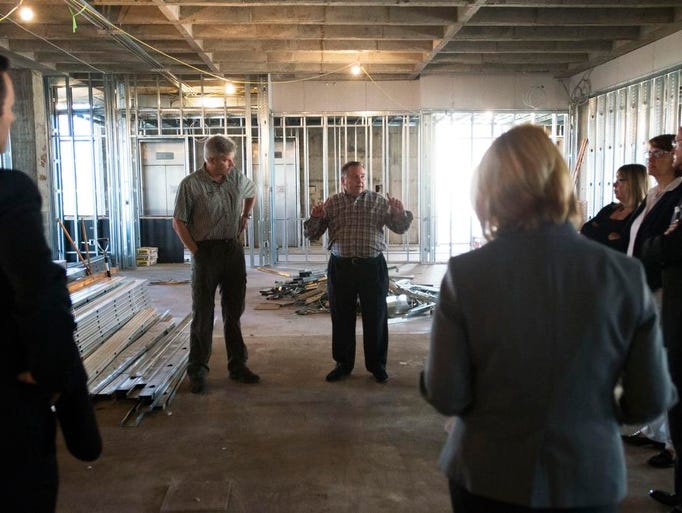
ASHEVILLE — The top floor of the Wells Fargo Building remains largely unfinished, with steel frames and structural bones exposed throughout the fourth floor space.
A pile of metal lies in the center of the room where climate scientists will one day meet. A lone office chair sits in the area that will one day become the lobby. A construction worker sweeps up dust next to a room where architectural drawings have envisioned a coworking space.
It may still be a construction site, but it will soon open as a hub of innovation and expertise.
After years of planning, millions in investment and, now, with new leadership at its helm, The Collider is set to open in January. The site will be a place where business and science can come together to create high-tech ventures in the climate sciences industry that can make sense of how climate change will impact businesses, organizations, cities and the world at large.
“When it comes to technology and innovation, you want to be out in front of it and not riding the tail end of it,” Bill Dean, the newly appointed CEO of The Collider, told members of the Buncombe County Tourism Development Authority during a tour of the space Thursday. “For Asheville, the timing is right and the opportunity is great. No one has what we have.”
Just two blocks away from where The Collider will be is the National Centers for Environmental Information. Previously known as the National Climatic Data Center, the Centers for Environmental Information hosts and provides public access to some of the most significant environmental data archives on Earth.
Along with housing more than 20 petabytes of environmental data, the center also employs some 400 scientists, technologists and analysts, including 16 Nobel Laureates.
The Collider wants that unique community asset to be more than an interesting fact. It wants it to create economic growth.
Bruce Katz, an urban-policy expert at the Brookings Institution in Washington, D.C., thinks it’s not only possible for Asheville to capitalize on the climate science sector but The Collider could be key to making it happen.
“You have something that is truly global. Climate change is a global phenomenon that the marketplace is both concerned about its implications and then also trying to innovate to solve problems and make money at the same time,” he said. “I think you’ve got something the world wants.”
But first it must be built.
Inside The Collider
The Collider has been a project years in the making.
In 2012, the fourth floor of Wells Fargo Building was purchased for $2.8 million by Miami real estate investor Claire Callen. The entire fourth floor, all 26,000 square feet of it, has been named the Callen Center and 6,000 square feet of that space will become The Collider.
“We’re the front door to the whole floor,” said Marilyn McDonald, The Collider’s newly appointed executive director. “We’re making a statement that we are about science and technology from the second you step off the elevator.”
To encourage collaboration, The Collider has been designed with an eye toward open-concept design. The center will include an event space that can accommodate 190 people, 30 coworking desks, six small offices, three conference areas, a 10 gigabit Internet bandwidth connection and a video green room, along with a catering room and a break room.
The project is undergoing a $1.3 million renovation, and has $889,449 budgeted for construction costs. Because construction did not begin until July, it pushed back earlier projections that The Collider would open by fall.
Dean said that isn’t such a bad thing.
“Any type of technology project that you put together is going to be very time-consuming to get it right. It’s not going to be an overnight success story,” Dean said.
But others are still counting on Dean and McDonald to make The Colldier a success.
Leading the charge
In August, Dean was tapped to be CEO of The Collider, in large part, due to the unique skill set he brings to the project.
Dean has been a research park consultant, served as president of the Association of University Research Parks in Washington, D.C., been a research park director in Huntsville, Alabama, and directed the expansion of the Piedmont Triad Research Park in Winston-Salem.
“This is the first time I wasn’t recruited for a job,” Dean said, laughing.
After moving to the mountains, Dean started to get restless about what project he could get involved with next. After attending an Asheville HUB meeting, he said he knew that he wanted to be a part of The Collider.
“It’s all about brain power and bringing that collectively together so that thoughts and ideas can become solutions,” he said. “I see The Collider as an opportunity for us and Asheville to become a part of the next technology revolution, so to speak. It went from defense, to aerospace, to electronics, to biotech — which was the reason why I came to North Carolina from Huntsville. Now I’m seeing all this new technology development, and the concern globally is climate change and what we are going to do about it. Therein lies an opportunity for Asheville and The Collider to do well.”
McDonald is no stranger to innovation.
During her time at the Enka campus of Asheville-Buncombe Technical Community College, McDonald worked closely with entrepreneurs, startups and innovators and the college’s business incubation center.
“I’m really passionate about helping Asheville and our downtown community create opportunities in science and technology,” McDonald said. “I’ve spent so much time working in business incubation, and that gives me a unique toolbox to pull from to help facilitate that kind of opportunity here in The Collider.”
Already, The Collider has been receiving phone calls and emails from companies and entrepreneurs that want to lease office space inside the 6,000-square-foot center.
One group that has already said yes to The Collider is UNC Asheville’s National Environmental Modeling and Analysis Center. An office and conference room has been built specifically for NEMAC, which uses applied research to build tools that help local and regional planners, decision-makers and the public understand how climate can impact them.
Acclimatise North America, a company based in the United Kingdom, will be moving its North American offices to Asheville specifically because of The Collider.
Clark Duncan, director of business development for the Economic Development Coalition for Asheville-Buncombe County, said this is a sign of things to come.
“Having this physical presence is a catalyst for growing this very unique industry in Asheville,” Duncan said.
The potential
Though no economic impact studies have been conducted, Duncan said he is confident that the time is right for The Collider and the high-growth companies it hopes to attract.
“Going back to the ’80s, this community has tried to understand how to leverage that federal investment with NCEI for private industry growth. In 2015, we’re just now at a place where that economic opportunity is really ripe,” he said. “The big data industry is expected to exponentially grow, and this climate data is our big data.”
Amanda Rycerz, a climate risk analyst for Acclimatise North America, said companies like the one she works for see real value in Asheville’s climate assets and the climate cluster that already exists here.
The data and the other climate organizations that already exist here, she explained, go hand-in-hand with the types of consulting work that Acclimatise does.
“We recently did risk assessment of a port in Colombia, and we found that one crucial road that connected where the ships entered the port and unloaded goods and then connected to mainland could be flooded within the next couple years,” she said. “If they can raise that road over time, this will help them avoid losses of $250,000 a day in road closures alone.”
Dean said it’s this kind of thinking that The Collider wants to inspire.
“All of the pieces fit now. The timing is right,” he said.
Katz, at the Brookings Institution, said only one test now remains for The Collider.
“They’re not just big real estate holders or nice buildings you pass on the way to work. They are platforms for growth,” Katz said. “This won’t just happen. There needs to be some purpose present to unlock its potential.”
The Collider by the numbers
10G: High-speed fiber bandwidth, with capacity to expand to 40G 190: Capacity of technology theater 26,000: Total square footage of the Callen Center, where The Collider will be located $504,186: Projected cost of technology $889,449: Estimated construction budget of The Collider $1.3 million: Estimated renovation cost of The Collider
CITIZEN TIMES
Climate organization could bring economic impact to Asheville
NC House rejects Cumberland County’s hotel tax change
By Paul Woolverton Staff writer
An effort by the Cumberland County Commissioners to take control of $5.6 million in local hotel occupancy tax revenue was blocked Thursday afternoon by the state House.
The House voted 103-1 against the bill. The Senate previously approved it.But the measure isn’t dead, said state Rep. John Szoka, a Cumberland County Republican. The bill is being sent to a conference committee of the state House and Senate so that a compromise version can be drafted.
The local hotel tax is 6 percent of the price of a room in Cumberland County. It generates about $5.6 million a year and is used to underwrite the Fayetteville Area Convention and Visitors Bureau, the Crown Coliseum Complex, the Arts Council of Fayetteville/Cumberland County and projects to promote travel and tourism.
As set by law, most of its money is administered by the Cumberland County Tourism Development Authority. The Arts Council share is set by law at 25 percent of the revenue – about $1.4 million – and is not under the control of the Tourism Authority.
The county commissioners have had complaints with how the Fayetteville Visitors Bureau, which gets $2.5 million, has been promoting the community. They want to dissolve the Tourism Authority and take control of the money.
They also would vastly change how the money is spent – they would divert 47 percent of the money to capital projects intended to promote tourism, for example.
The House rejected the commissioners’ request because the proposed changes run afoul of guidelines the state House has set for the administration and use of hotel tax revenue, Szoka said.
The guidelines say the money should be controlled by a Tourism Development Authority with at least half of its members from the local hotel industry. The commissioners’ change would violate that guideline.
The guidelines say at least two-thirds of the hotel tax should be dedicated to advertising and promotion, and no more than one-third can go to other travel and tourism expenses. Cumberland County already violates that guideline and would continue to do so with the law change.
In addition to modifying the administration and spending of Cumberland County’s hotel tax, the bill makes changes to occupancy taxes in Harnett, Moore and Wayne counties and in Sanford.
Sanford’s request, which would direct money to its local civic center, would also violate the guidelines, Szoka said. The Harnett, Moore and Wayne County requests fit the guidelines.
Szoka is hopeful that a compromise bill can be drafted for Cumberland County that is closer to the guidelines but also addresses the community’s needs.
Staff writer Paul Woolverton can be reached at woolvertonp@fayobserver.com, in Raleigh at 919-828-7641 or in Fayetteville at 910-486-3512.
CONCORD, N.H. (AP) — Attention, leaf peepers: New Hampshire has a new foliage tracker aimed at helping visitors plan their ‘peak’ fall adventure.
The interactive, mobile-friendly tracker from Visit New Hampshire offers regional reports of that state’s scenery, lodging and dining suggestions, points of interest and leaf peeper images.
About 8.5 million people are expected to visit New Hampshire this fall, an increase of about 5 percent from last year, travel officials said. Spending from these visitors is anticipated to be up 7 percent, reaching $1.3 billion.
The fall season is historically the second busiest season in the state, attracting more than 25 percent of all visitors to New Hampshire annually.
Most visitors will be from the New England and Mid-Atlantic markets. The state is expected to see an increase this fall in overnight visits from more distant states, including Florida, California, Illinois and Texas. Low gas prices are helping the expected increase.
Visitors are encouraged to share their New Hampshire fall foliage images with New Hampshire’s tourism division on Facebook, Twitter, and Instagram, by using the hashtag #nhfoliage.
FILE – In this Sept. 5, 2015, file photo, North Carolina State’s Matt Dayes (21) finds some running room as Troy’s William Lloyd, left, moves in for the tackle during an NCAA college football game in Raleigh, N.C. For a game Saturday, Sept. 26, at South Alabama, N.C. State once again lists Dayes as the starter at running back with senior Shadrach Thornton as his backup. (AP Photo/Gerry Broome, File)The Associated Press
FILE – In this Sept. 5, 2015, file photo, North Carolina State’s Matt Dayes (21) finds some running room as Troy’s William Lloyd, left, moves in for the tackle during an NCAA college football game in Raleigh, N.C. For a game Saturday, Sept. 26, at South Alabama, N.C. State once again lists Dayes as the starter at running back with senior Shadrach Thornton as his backup. (AP Photo/Gerry Broome, File)
Share Photo
MOBILE, Ala. (AP) — North Carolina State seems to have learned how to win on the road. Now, the Wolfpack will try to keep that success going in an unfamiliar venue.
They visit South Alabama Saturday night at Ladd-Peebles Stadium as 17-point favorites to win a fifth straight game away from home for the first time since 1973-74. Coach Dave Doeren said understanding how to prepare is the biggest factor.
“When you’re a team that lets outside things bother you, the road is really difficult,” Doeren said. “We’ve learned through trial and error that sometimes you have to get beat enough to understand, ‘Hey, you just have to do what he’s saying.'”
North Carolina State (3-0) ranks second in FBS in total defense, giving up just 188.3 yards a game, and eighth in scoring defense (11.7 points per game). South Alabama (2-1) has struggled to score at times, averaging 25.3 points.
The Jaguars have already played one team from a power five conference this season, and it didn’t go well. They lost 48-9 at Nebraska, but bounced back with what coach Joey Jones called the program’s biggest win.
South Alabama topped San Diego State in overtime on the road.
Now, the Jaguars are big home underdogs.
“I don’t worry about those things, but we are playing an ACC opponent who is very good and off to great start this year,” Jones said. “We’ve had two long trips to Nebraska and California, so to come home is exciting. The fact that we are playing N.C. State is exciting. I think our crowd is going to be into it like they always are.”
___
Here are some things to watch in the game:
RUNNING STRONG: N.C. State once again lists junior Matt Dayes as the starter at running back with senior Shadrach Thornton as his backup. Thornton, the team’s leading rusher last season, missed the first two games while serving a suspension for an offseason violation of athletic department rules. In his first game back last week, Thornton rushed for 92 yards and a touchdown behind Dayes, who had 108 yards and a score in a 38-14 win at Old Dominion.
FROM BIRMINGHAM TO MOBILE: Doeren says he’s watched some film from UAB last season to prepare for the Jaguars, who brought in a dozen former Blazers players and two assistants — including offensive coordinator Bryant Vincent and quarterback Cody Clements — who left when that program was shut down. “They’ve really benefited from another program’s demise,” Doeren said.
NO APOLOGIES: Doeren is defending N.C. State’s nonconference schedule, which includes one FCS team (Eastern Kentucky), two teams that recently were at that level before moving up (Old Dominion and South Alabama), plus another Sun Belt school (Troy). He points to the large number of freshmen on the depth chart who are getting their first taste of college football and says “I’m not going to apologize for being 3-0.”
THEY MEET AGAIN: South Alabama’s program has matured since the last time these teams met. The Jaguars made their first bowl appearance last season. North Carolina State won the first two meetings 35-13 and 31-7 in 2011 and 2012.
KEEPAWAY: South Alabama may have a hard time getting the ball back. The Wolfpack lead the nation in time of possession (40 minutes, 36 seconds per game) while the Jaguars are 107th, at less than 27 minutes a game.
A look at things to watch in the Atlantic Coast Conference for Week 4:
GAME OF THE WEEK: No. 20 Georgia Tech’s visit to Duke figures to once again have significant ramifications in the Coastal Division race. Both teams are coming off close losses to ranked nonconference teams, with the Yellow Jackets falling at No. 6 Notre Dame and the Blue Devils out-mistaking No. 17 Northwestern. Duke knocked off Georgia Tech last year in Atlanta, and a defense that ranks 15th nationally against the run should provide a good test for Tech’s triple-option. Coach Paul Johnson says that because this is a divisional game, it “counts like two.”
BEST MATCHUP: Syracuse’s run defense vs. LSU RB Leonard Fournette. The Orange’s best chance to shock the eighth-ranked Tigers rides with their run-stoppers. Syracuse ranks third nationally against the run, allowing an average of 46.7 yards. Fournette leads the nation in rushing, averaging 193.5 yards, and rolled up 228 in a rout of formerly ranked Auburn. Syracuse coach Scott Shafer calls Fournette the “best running back I’ve seen in my 26 years” in coaching.
INSIDE THE NUMBERS: North Carolina has made significant progress in its first year with defensive coordinator Gene Chizik. The Tar Heels in 2014 played 52 quarters and allowed points in all but four of them. This year North Carolina already has posted six scoreless quarters through just three games. Coach Larry Fedora says his players “are feeling much more comfortable in the techniques that they’re having to play in this style of defense, and so they’re gaining confidence.”
LONG SHOT: Perhaps North Carolina State should be wary of its trip to Mobile to face 16-point underdog South Alabama. The Jaguars are coming off a win at San Diego State that they’ve called the biggest in their program’s brief history. So they should be amped for just their second visit from a major-conference program ? they lost at home to Mississippi State last year. The Wolfpack have cruised to three straight double-figure wins against one of the country’s weaker schedules.
PLAYER TO WATCH: Keep an eye on Wake Forest freshman QB Kendall Hinton, who may make his first start against unbeaten Indiana. Hinton replaced injured starter John Wolford last week at Army and threw for 159 yards while rushing for 114 yards and both of the Demon Deacons’ touchdowns in a 17-14 victory.
___
Compiled by AP Sports Writer Joedy McCreary in Raleigh, North Carolina.



 ‘Modern-day pirate’ Kim Dotcom’s words now used against him
 The Latest: Moment grows for female UN chief
 The Latest: Moment grows for female UN chief
 Tracing China’s long, convoluted relationship with the UN
 Spain: A look at Catalonia’s secession drive, Sunday’s vote
 Spain: A look at Catalonia’s secession drive, Sunday’s vote