

Since then, the state’s wine scene has expanded dramatically. For example, Biltmore Wines launched in 1985, producing European-style Vitis vinifera grapes like merlot, chardonnay and cabernet sauvignon, instead of the indigenous Vitis rotundifolia vines of muscadine and scuppernong. Biltmore’s massive investment spurred major entrepreneurs to start turning former tobacco farms into wineries. In the last 20 years, the state has seen a winery boom: Now, 129 vineyards and wine producers are registered with the North Carolina Department of Agriculture.
But the wine business has proved, for many, to be an arduous and uncertain one. It’s costly, labor-intensive and fickle. Of all the common alcoholic beverages, wine is the most difficult to produce, given the intricacies of the necessary agricultural and fermentation conditions. Corn and grains are durable crops, and hops can endure a rough season, but grapes are a persnickety product, with each varietal requiring different planting and harvesting times, and all being susceptible to frostbite.
Add to that the meager yields of juice, the ludicrous cost of crushers, wine presses and fermentation tanks, the $1,000 barrels that can only be used a couple of times and the fragile fermentation process — all in a field where one can’t even begin to compete with the cost effectiveness of a year-round producer like those in California — and it seems a pursuit that only those cut out for a serious challenge can tackle.
Building a legacy
Just outside Tryon, in Mill Spring, sits Parker-Binns Vineyard and Winery. Wind down the gravel driveway lined with picturesque Yoshino cherry trees on any given summer day, and you are bound to see blossoming white flowers framing a landscape of acres and acres of rolling hills filled with plump grapes. Lulu, the winery’s dog, might be lying in the sunlight just under the stone arches of the tasting room’s garden, which might well be bursting with colorful bloomage. But right now, it’s January, and the trees are naked hands with spindly bare fingers. The vines hang on their braces like scarecrows, with arms outstretched, as chickens cluck in the distance.
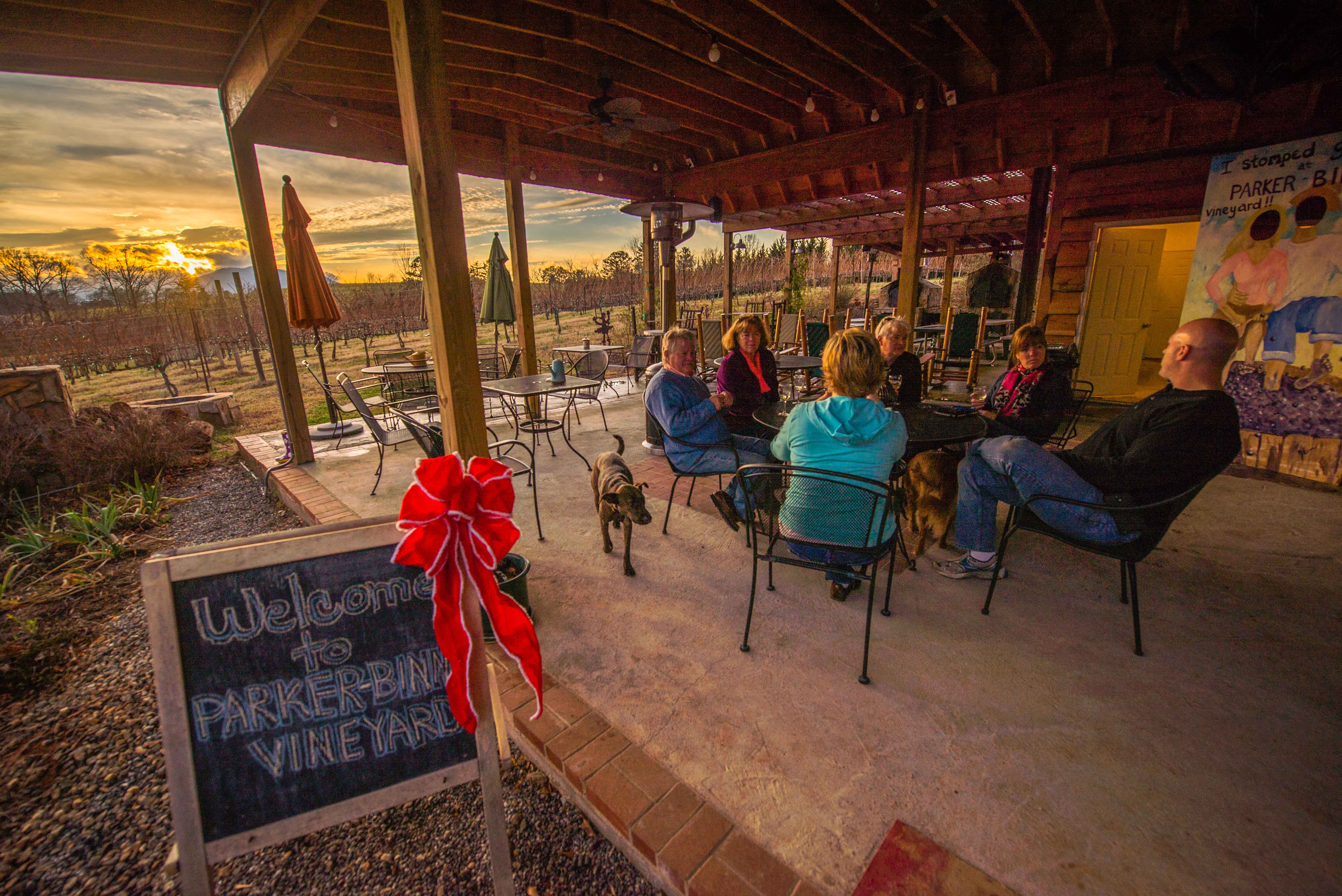
“I think North Carolina wines are improving,” says Bob Binns. He and his wife, Karen Parker-Binns, moved here from Florida to open Parker-Binns seven years ago. “Since we came here in 2008, I can see a vast difference in the quality of the wine.”
“All we really intended to do was grow grapes in the summer and go back to Florida in the winter,” says Karen. Initially they were negotiating to sell grapes to the Biltmore Estate, but when the recession hit in 2008, Biltmore stopped buying grapes from outside sources, and the couple decided that rather than take a loss on the harvest, they could make the wine themselves.
“When I called the Biltmore, they said, ‘We’re not taking on anymore new growers now.’” Bob adds: “And I thought, holy geez, what are we going to do with all these grapes? And that’s when we started making our own wine.”
As has been the trend in the area since the ’90s, Parker-Binns focuses on traditional, European Vitis vinifera grapes, a direct retreat from the sugar-laced wines that have come to dominate the state. The winery grows chardonnay, merlot, cabernet sauvignon, cabernet franc, muscat, petit manseng and chambourcin.
“I’m very particular about the grapes I grow,” says Karen. “Some people think I’m anal, but I think that wine is made in the vineyard. And you’ve got to grow the cleanest, best fruit that you can grow, because that is what your wine is going to be. I’m very much a minimalist in the winery. I try to do the minimum of tampering with the grapes. I add the yeast, I get out of the way and I let the wine make itself.” In fact, Parker-Binns’ blackberry wine is the only one they make that contains any added sugars.
The wines reflect Karen’s dedication. The rosé is made of cabernet sauvignon and is a rich pink color, tasting of fresh strawberries and lemon zest. It is crisp, ripe and complex, more so than any other local rosé I’ve tried.
The cabernet has a rusty red coloration with a thick watermark for such a young age. There is a distinct note of chocolate in the nose, and its palate is slick and viscous, like a classic Bordeaux and not weighty like a lot of California reds. It’s high in acid, but softened by a light sizzle of tannins across the sides of your tongue. At under $20, it’s a pretty remarkable wine. There is, however, an unmistakable flavor found in most North Carolina wines: a mineral quality with a slight sour at the tail, the telltale flavor of the foothills terroir.
“We were in the bar and restaurant business for a long time, and then we went into the tree-farming business,” Karen recounts. “I’ve been into wine for a long time,” Bob adds, “so it wasn’t much of a stretch to go from farming to making wine.”
Well into his 80s, and despite what appears to be boundless energy, Bob finds himself keenly aware of his growing limitations. “We’re getting older and we realize we need new blood,” he says. “So now our daughter and son-in-law have come into the business.” They never planned on it, but both Bob and Karen seem to think it is inevitable that the addition of such young energy is bound to cause the small-production winery to expand its operations.
A trend in North Carolina wine is that it is usually made by people who really like to work. If it isn’t someone who already has another successful business opening a winery, it is often someone who was bored with corporate life. Or, more commonly, someone who has retired and can’t stand the thought of not working.
“The beauty of being in a business, particularly when you get older, is that it makes you feel alive,” says Bob. “Most people, when they retire, they get out of the flow of life. The flow of life is that you have to get up every morning and go make a living. … Making wine is a simple life with hard work, but it’s very enjoyable.”
Out with the old
The hardest fight facing the state’s wine surge seems to stem from the roots, from the environment itself. “I think North Carolina is still struggling to find the grape that we absolutely should be growing,” Karen says. “You can make that same bottle of wine year after year in California, because they don’t have the kind of weather we do. We get a box of chocolates here — we never know what we’re going to get until it hits us.”
“It’s really hard to grow the vinifera grapes around here,” says Samantha Biggers. She and her husband, Matt, have just planted their first vines for their new venture, Morning Star Vineyards, in the Dutch Cove community just outside Canton. “They just aren’t very cold-hardy, and if it gets down to negative-5 degrees, you’re going to lose them. You may not see that happen very often, but even if it happens every five years, you lose your grape vines and you have to start all over.”
The Biggerses are young, in their 30s. After inheriting a significant swath of land from her grandfather, a former bootlegger, Samantha decided to follow in his steps and use the land to produce local hooch, with the intent of giving her dry county its first local winery. But unlike most regional winemakers, the Biggerses intend to use local varietals like Catawba and Concord grapes to make rustic, dry wines. Having just planted their first vines in 2013, they are still years away from their first real crush. But that hasn’t stopped them from aggressively pursuing a distinct vision for their winery.
“Part of the problem is that we don’t have a sense of place here,” Samantha says. “People go to Italy or they go to France, and they see the wineries, and they want to do that. But we’re not Italy or France. People come here because they want to see Appalachia, they want to see our history and our people.”
A family affair
“There is nothing about this that is easy, but it has certainly been something that has been enjoyable,” says Jeff Frisbee. He and his wife ventured into viticulture after Jeff was laid off for the second time from a technology-sales position. “I was tired of being a line-item expense that could be taken out that easily,” he says.
So he rooted down in a business of his own, turning his family’s struggling cattle and tobacco farm into Addison Farms Vineyard in Leicester. “We wanted to do something that would preserve the family farm,” he says, “and we were looking for something that had the potential to make a living. Now, we are not there yet, but we’re getting closer.”
Addison Farms Vineyard’s first vines were planted in 2009 by Frisbee and his father, who set just an acre of grapes. He spent his time on unemployment laboring in the vineyard, preparing himself for his entrepreneurial future while taking viticulture classes at Surry Community College. In 2010, they did their first crush, with fruit bought from other growers within the area. By 2011, they were pressing their own grapes and expanding the winery. The vineyard currently encompasses 7 acres, yielding 50-60 percent of the needed harvest.
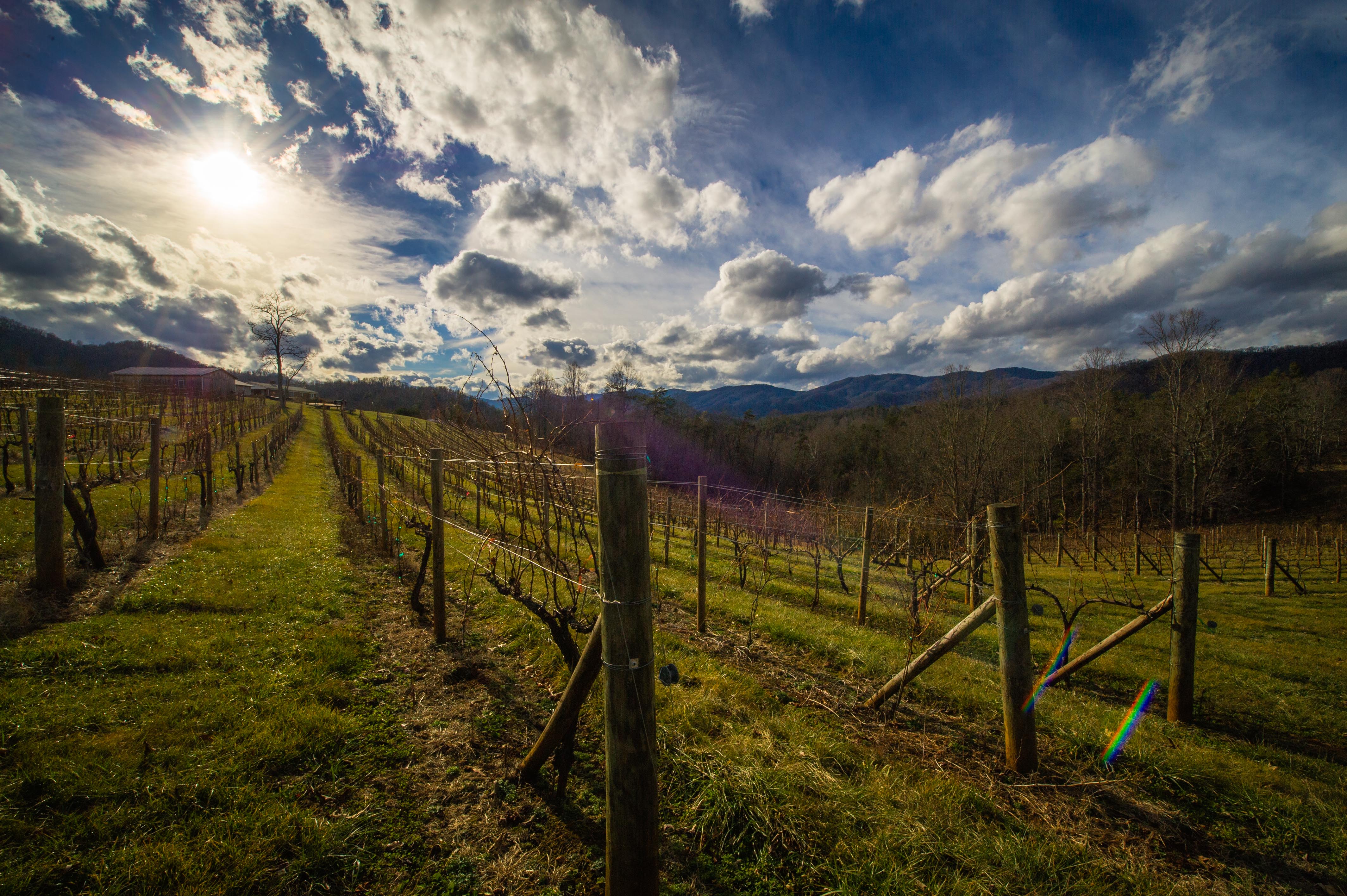
“I expect that it will go on like that forever,” Frisbee says. “We’ll always grow some of our fruit and we’ll buy some of it.”
Buying grapes is not uncommon in the wine world. For hundreds of years in France, négociants have been farming and selling grapes to winemakers. For many operations, that is both a good thing and a bad one. A négociant will never grow the grapes the way you would, however, it does free some time for the winemaker to focus on making the wine and tending to other aspects of the brand, or in the Frisbees’ case, work their day jobs. Jeff still works in technology sales and enterprise communications, and his wife is an art director for a motion-graphics business in Atlanta.
“We’re finally home,” says Jeff, “I’m working a project with my folks, and I’ve spent more time with them in the last four years than I had in the 20 years prior to that. It’s just nice to be home.”
For many consumers, the main critique of North Carolina wines is that they aren’t up to par with the wines of Italy, Spain or France. For others, it is a matter of price disparity. Yet those same people will pay upward of $20 for a six-pack of locally made craft beer that features mail-ordered hops without batting an eye.
True, North Carolina wine might never compare to the sour grapes of the black-slated Priorate, and we will never hold a candle to the white rocks and extinct river bed of the Châteauneuf-du-Pape, but then again, nobody here seems to be trying to do that. For winemakers here, it is about making a living they can feel proud of. It’s about continuing a legacy of farming in their family and on their family’s land, or seeing the sun set on their lives while working a job that makes them feel dignified and honorable. And it’s about welcoming guests from all over to lean back on the patio and sip a glass of wine, made by the hands of your host and from the land on which you sit.
“I am happy that we are a small boutique winery, because I like every step of the process now,” says Karen Parker-Binns. “I can really appreciate a bottle of wine so much better now because I know every single step that went into it. From clearing the land to planting the grapes to harvesting, pulling the leaves off, all the way to the crush. Everything. Every bottle of wine has a story.”
Leave a Reply