Today’s batch of burning questions, my smart-aleck answers and the real deal:
Question: I was riding on Smoky Park Highway and saw a sign next to the budget truck rental store, which said, “Future entrance to the Enka Center” (pointing toward the old clock tower). Is this toward where the ball fields will be located, or toward the reinvention of the shopping center that had plans shelved when the economy was bad several years ago? Also the rumor of a Costco is popping up again. Any thoughts?
My answer: Yes. Now I can get “Costco” in a headline, allowing me to outpace my colleague Carol Motsinger in web traffic today.
Real answer: Martin Lewis, one of the principals in Fletcher Partners, which owns the former BASF site, said the sign is indeed new and the company plans to get the project moving again. The bridge leading to the land took awhile to “come to fruition,” but the company has settled on a five-lane design that will accommodate traffic heading into the New Belgium distribution center, a new school going up nearby and planned retail and industrial developments.
“That bridge should start moving forward this month,” Lewis said.
Fletcher partners bought about 200 acres in 2008, and in 2010 the city of Asheville approved plans. But in the sour economy, the businessmen decided to hold off.
Now, they hope to move ahead again, including plans for retail on 60 acres.
“Anybody that sells anything, we’ve talked to them,” Lewis said. “At this point we don’t have anything to announce. We’ve got our fingers crossed and we’re hoping.”
The property could accommodate big box stores like Target, Lowe’s, and yes, Costco, Lewis said, adding, “We’re not limiting anything.”
“I’m a big Costco fan,” Lewis said. “I drive to Spartanburg for them regularly.”
A Costco official said the company never comments on future developments until all the permitting is complete.
Shannon Tuch, development services director for the city of Asheville, said the city has received no requests for a Costco on this site, or any other in the city.
Matt Stone, director of Buncombe County’s Permits Inspections office, said the office has gotten no permit requests from Costco, either.
Lewis said the ball fields project is moving along nicely. Enka Youth Sports will be the entity that manages the facility, which will include seven baseball and softball fields, mostly for players up to age 14.
So far the project has garnered $750,000 from six private donors, $1.3 million from Buncombe County, $2 million from the Buncombe County Tourism Development Authority grant program, and an agreement for a $1 million loan. The total cost of the ball fields project will be $5.5 million, Lewis said.
Question: In the recent heavy rains, my driveway was covered with hundreds, if not thousands, of worms and night crawlers. Why are they out there on the pavement and not underground? Why do they do this?
My answer: The worms I interviewed offered little insight. Mostly, it went like this: “Gurrrrgggle, gurrrrrrgle, gasp!”
Real answer: First of all, worms need air to breathe, just like we do, so when their worm holes get swamped, they’ve got to get out and away from the water. Sidewalks and streets look like a good solution — at first.
“When a worm gets washed onto a sidewalk, it can’t find its way back,” said Chris Gentile, director of the WNC Nature Center. “Their first impulse is to dig straight down, and they’re not able to do that. As soon as they’re washed out of their burrow and move out onto a sidewalk, they don’t know what to do. Then they dry out.”
This is the opinion of John Boyle. To submit a question, contact him at 232-5847 or jboyle@citizen-times.com
–>
and imageUrl: http://visit-nc.com/wp-content/plugins/RSSPoster_PRO/cache/694ae_CL78154LOGO –>
TripAdvisor Logo. (PRNewsFoto/TripAdvisor)
Bulk TV Internet provides free-to-guest television services to businesses nationwide. Facebook Twitter Pinterest
left
0
Bulk TV Internet provides free-to-guest television services to businesses nationwide.
http://visit-nc.com/wp-content/plugins/RSSPoster_PRO/cache/db556_CL78154LOGO
http://photos.prnewswire.com/prn/20120328/CL78154LOGO
http://photos.prnewswire.com/prnthumb/20120328/CL78154LOGO
http://photos.prnewswire.com/prnh/20120328/CL78154LOGO
http://photos.prnewswire.com/prnvar/20120328/CL78154LOGO
and http://visit-nc.com/wp-content/plugins/RSSPoster_PRO/cache/db556_CL78154LOGO –>
RALEIGH, N.C., Jan. 13, 2015 /PRNewswire/ — Bulk TV Internet (Bulk TV), a leading provider of television solutions to hotels nationwide announces their television partnership with the Hilton Americas-Houston, the largest convention hotel in Houston, Texas. Bulk TV is providing a full residential lineup and interactive channel guide throughout the property’s 1200 guestrooms.
“The DIRECTV Residential Experience (DRE) is an outstanding amenity we are now able to provide to our guests,” said Jacques D’Rovencourt, hotel manager for the Hilton Americas-Houston. “DRE offers the familiar comfort of the same entertainment experience guests receive in their own home, which is in alignment with our goal of making our guests feel like they are at home when staying with us. Additionally, the extensive HD channel selection allows us to differentiate ourselves from other brands.”
Located in the heart of downtown, the 24-story Hilton Americas-Houston is known for providing leading edge technological amenities in order to give guests an unparalleled experience. As a complement to the hotel’s offerings, DRE offers a robust HD lineup with over 100 channels, a faster interactive programming guide and an anti-microbial, simplified remote. DRE is one of the recent advancements the property has made to enhance the overall guest experience. The hotel is also adding a Starbucks in the east lobby that will be close to 5,000 square feet as well as an onsite UPS Store.
D’Rovencourt adds, “It is imperative for us to select credible partners that offer extensive experience. Partnering with a respected name in the industry such as Bulk TV Internet was critical to ensure quality and customer satisfaction.”
Bulk TV has installed the DIRECTV Residential Experience (DRE) in hundreds of hotels and is the leader in DRE installations nationwide. Based on the company’s demonstrated abilities and following an extensive review process, Bulk TV was recently selected by Hilton Worldwide as a Strategic Partner to provide HD services to all Hilton brands at pre-negotiated terms and exclusive rates.
“Hilton Worldwide is known for transforming the guest experience with forward thinking, customized offerings,” said James Jessel, vice president of sales, Bulk TV Internet. “The DIRECTV Residential Experience gives guests the television services they expect at a hotel that is as impressive as Hilton Americas-Houston.”
Bulk TV provides DIRECTV programming services to over 4,000 properties in every state and across every hotel brand. Each customized TV solution receives thorough quality assurance throughout every step of the process, which includes engineering, project management, professional installation and 24/7 technical support.
In addition to DRE, Bulk TV also provides centralized headend solutions that enable hotels to provide a customized channel lineup without equipment in the guest rooms. For more information on both solutions, please visit www.BulkTV.comor call 877-285-5881.
About Bulk TV Internet Bulk TV Internet is a leading provider of DIRECTV services designed to meet the unique needs of the hospitality industry. Bulk TV Internet provides service to upwards of 300,000 rooms nationwide including free-to-guest television programming and digital satellite TV systems. In addition to award-winning television services, Bulk TV also offers high-speed Internet access services and Mitel phone systems. For more information, please visit www.BulkTV.com.
About Hilton Americas-Houston Directly connected to the George R. Brown Convention Center, the Hilton Americas-Houston contains the city’s largest number of guestrooms, ballrooms, hotel meeting space, and the most technologically advanced services available under one roof. Conveniently situated between Toyota Center and Minute Maid Park, this AAA Four Diamond rated hotel boasts 1,200 luxuriously appointed guestrooms, 91,500 square feet of flexible meeting space, two restaurants, lobby bar, coffee emporium, and full service spa and health club. For more information about the company, please visit www.americashouston.hilton.com.
left
0
LendingTree Logo
http://visit-nc.com/wp-content/plugins/RSSPoster_PRO/cache/c27da_MM04455LOGO
http://photos.prnewswire.com/prn/20110518/MM04455LOGO
http://photos.prnewswire.com/prnthumb/20110518/MM04455LOGO
http://photos.prnewswire.com/prnh/20110518/MM04455LOGO
http://photos.prnewswire.com/prnvar/20110518/MM04455LOGO
and http://visit-nc.com/wp-content/plugins/RSSPoster_PRO/cache/c27da_MM04455LOGO –>
CHARLOTTE, N.C., Jan. 12, 2015 /PRNewswire/ — LendingTree, Inc. (NASDAQ: TREE) today announced that it is introducing guidance for the full year 2015. Additionally, the company expects to exceed its previously provided revenue guidance for fourth quarter and full-year 2014 and meet or exceed its guidance on adjusted EBITDA.
Fourth Quarter and Full-Year 2014
LendingTree’s previously provided guidance for fourth quarter and full-year 2014 was as follows:
Fourth quarter revenue of $40.5 – $42.5 million and $164.0 – $166.0 million for full-year 2014
Fourth quarter variable marketing margin of $15.3 – $17.3 million and $63.0 – $65.0 million for full year 2014
Fourth quarter Adjusted EBITDA of $4.7 – $5.7 million and $20.5 – $21.5 million for full-year 2014 Adjusted EBITDA
“In Q4, we saw continued positive momentum from our results in Q3. Our Mortgage Marketplace was able to manage well through a significant surge in consumer volume while our non-mortgage products saw continued growth,” said Doug Lebda, Chairman CEO.
Full-Year 2015
For full-year 2015, LendingTree is providing revenue, variable marketing margin, and adjusted EBITDA guidance, as follows:
LendingTree anticipates revenue between $185 – $190 million for 2015, an increase of 12% to 15% over the mid-point of full-year 2014 guidance
Variable marketing margin is anticipated to be in the range of $73.0 – $77.0 million, implying growth of 14% – 20% over the mid-point of full-year 2014 guidance
Adjusted EBITDA is anticipated to be in the range of $25.5 – $26.5 million, implying growth of 21% – 26% over the mid-point of full-year 2014 guidance
“Our approach in 2015 will be similar to prior years. We expect to produce significant top-line revenue growth that places us at the top-end of peer companies, to show significant profits, and to reinvest in product and marketing for the future. The online lending industry is undergoing a significant transformation, and LendingTree is well-positioned not only to capitalize on current trends but also to accelerate and shape them.”
Definitions of Certain Financial Measures
Adjusted EBITDA is a non-GAAP measure defined as EBITDA excluding (1) non-cash compensation expense, (2) non-cash intangible asset impairment charges, (3) gain/loss on disposal of assets, (4) restructuring and severance expenses, (5) litigation settlements and contingencies, (6) pro forma adjustments for significant acquisitions or dispositions, and (7) one-time items. EBITDA is a non-GAAP measure defined as operating income or loss (which excludes interest expense and taxes) excluding amortization of intangibles and depreciation.
LendingTree is not able to provide a reconciliation of projected adjusted EBITDA to expected reported results due to the unknown effect, timing and potential significance of the effects of the wind-down of discontinued operations and tax considerations.
Non-GAAP measures should be considered in addition to results prepared in accordance with GAAP, but should not be considered a substitute for or superior to GAAP results. For further information on LendingTree’s non-GAAP measures, see LendingTree’s press release dated November 6, 2014, including as Exhibit 99.1 to Form 8-K filed with the Securities and Exchange Commission on November 6, 2014.
Variable marketing margin is defined as revenue minus the portion of selling and marketing expense attributable to variable costs paid for advertising, direct marketing and related expenses, which excludes overhead, fixed costs and personnel-related expenses, and is considered an operating metric.
Safe Harbor Statement Under the Private Securities Litigation Reform Act of 1995
The matters contained in the discussion above may be considered to be “forward-looking statements” within the meaning of the Securities Act of 1933 and the Securities Exchange Act of 1934, as amended by the Private Securities Litigation Reform Act of 1995. Those statements include statements regarding the intent, belief or current expectations or anticipations of LendingTree and members of our management team. Factors currently known to management that could cause actual results to differ materially from those in forward-looking statements include the following: adverse conditions in the primary and secondary mortgage markets and in the economy, particularly interest rates; seasonality of results; potential liabilities to secondary market purchasers; changes in the Company’s relationships with network lenders; breaches of network security or the misappropriation or misuse of personal consumer information; failure to provide competitive service; failure to maintain brand recognition; ability to attract and retain customers in a cost-effective manner; ability to develop new products and services and enhance existing ones; competition; allegations of failure to comply with existing or changing laws, rules or regulations, or to obtain and maintain required licenses; failure of network lenders or other affiliated parties to comply with regulatory requirements; failure to maintain the integrity of systems and infrastructure; liabilities as a result of privacy regulations; failure to adequately protect intellectual property rights or allegations of infringement of intellectual property rights; and changes in management. These and additional factors to be considered are set forth under “Risk Factors” in our Annual Report on Form 10-K for the period ended December 31, 2013 and our Quarterly Report on Form 10-Q for the period ended September 30, 2014, and in our other filings with the Securities and Exchange Commission. We undertake no obligation to update or revise forward-looking statements to reflect changed assumptions, the occurrence of unanticipated events or changes to future operating results or expectations.
About LendingTree, Inc. LendingTree, Inc. (NASDAQ: TREE) operates the nation’s leading online loan marketplace and provides consumers with an array of online tools and information to help them find the best loan for their needs. LendingTree’s online marketplace connects consumers with multiple lenders that compete for their business, empowering consumers as they comparison-shop across a full suite of loans and credit-based offerings. Since inception, LendingTree has facilitated more than 32 million loan requests. LendingTree provides access to lenders offering home loans, home equity loans/lines of credit, personal loans, business loans, auto loans and more.
LendingTree, Inc. is headquartered in Charlotte, N.C. and maintains operations solely in the United States. For more information, please visit www.lendingtree.com.
1. Basnight’s Lone Cedar Cafe: This beachside restaurant in Nags Head is “legendary” in the area, according to GUYOT.com. Naturally, seafood is a top menu item (they’ll even cook your catch), but you also can get beef, chicken, and pasta. You can’t ignore the 2,000-bottle wine cellar or 55 beers, either.
2. The Fuji Japanese Steakhouse and Sushi Bar made the cut for GUYOT’s top 10 list. With a traditional hibachi grill, customers can sample food prepared “by a knife-wielding, egg-throwing, wise-cracking chef,” GUYOT said. The sushi bar is a little quieter than the energetic steakhouse, but just as good.
3. Spend a day in Duck, North Carolina, visiting the boardwalk and sampling fare from numerous great restaurants along the way. The Seafood-Pots-to-Go from Cravings Steaks Seafood were highlighted on the TV show “Diners, Dives and Drive-ins.” To end your day, consider Sanderling Resort and Spa for a fine dining experience in one of several restaurants.
4. Colington Cafe tops user reviews on TripAdvisor as the best restaurant in the Outer Banks. This 24-year-old restaurant specializes in local food with a gourmet twist at reasonable prices, according to its website. Nestled in a converted Victorian home, it’s suggested you make reservations.
5. Outer Bean Juice Java follows Colington on the TripAdvisor list, with customers raving on the website. “I am traveling with my vegetarian friend so finding a restaurant they makes us both happy cd be a challenge! I had the kale-spinach soup … so spicy and good. The smoked salmon salad was fabulous and the bread pudding ( made with no bread!) was superb,” one person wrote.
6. Check out the crab cakes at the Kill Devil Cafe, and stick around for a great dining experience. Chicken and dumplings or meatloaf and mashed potatoes will make you feel right at home while you’re on away on vacation.
ASHEVILLE – Plans for an ice skating rink in the city have been on thin ice for years but have now completely fallen through the cracks.
Asheville has not had a public ice rink for figure skating or hockey since the winter of 2008-09, when the city voted not to continue funding the ice rink at the Civic Center downtown, now called the U.S. Cellular Center. Those wanting to play in a hockey league, take figure skating lessons or just try their best to glide on ice have had to travel to the closest rinks in Greenville, South Carolina, about an hour and 15 minutes away.
That trend will continue.
In a deal to bring back the recreational sport, the city sold the ice rink and equipment in 2011 to the nonprofit Asheville Hockey League, which planned to build and operate a skating venue. That deal is now defunct, according to Chris Corl, general manager of the U.S. Cellular Center.
The city sold the rink and equipment for $15,000.
The ice rink equipment, including a Zamboni machine, dashers and glass, a chiller unit and ice cover, was valued at about $100,000 at the time. It has been in storage since, while the club sought a venue, sponsors and funding. Under the deal with the city, the Asheville Hockey League was to have a rink operational by May 2014.
CITIZEN-TIMES
Looking to ice skate, Asheville? Head south
The city acquired the rink as part of its deal with the former professional hockey team, Asheville Smoke, which played at the Civic Center from 1998-2002. Another professional team, the Asheville Aces, played at the center briefly, from 2004-05.
A deal had been proposed between the Asheville Hockey League and Crowne Plaza Resort in West Asheville. It was to open in a new, 28,000-square-foot building next to the Asheville Raquet Club. Crowne Plaza general manager Regina Cash said the plans for the rink have been scrapped, but she did not elaborate on the reasons.
“We found lots of interest and energy, with not only ice hockey but with figure skating, and we thought Asheville needed to have a rink,” Hockey League president Hutch Kerns said.
“We had the opportunity to purchase an ice rink, but we just couldn’t find the funding. The city is invoking their reversion clause to take it back.”
Under the agreement with Crowne Plaza, the league was to raise an additional $350,000 to cover operational costs and other expenses for the project.
The league had applied for money from the Buncombe County Tourism Development Authority but was not selected for a grant.
Kerns said the hockey league, which numbers about 200 members, is now an inline hockey league, but many members do travel to Greenville to play in leagues there or to practice on the ice.
“We’re not giving up. Our plan is to take the long view. We think Asheville needs a rink, so we’re going to do our part to get one here and promote the sport of hockey and ice skating. It’s a good thing to expose kids to, and hockey is a good team sport, not unlike soccer.”
Corl said the city is in the process of retrieving the equipment.
“We still have no future plans for an ice rink at the U.S. Cellular Center,” Corl said. “We do intend to resell the equipment. We’ve put out some feelers to companies that build ice rinks but haven’t had any responses yet.”
A new partnership that will research and create lighter and stronger manufacturing materials will be a boost to Michigan’s economy and the auto industry, officials said Tuesday.
President Barack Obama last week announced that the $259 million Institute for Advanced Composites Manufacturing Innovation, which will be anchored by the University of Tennessee-Knoxville and include 122 public and private partners, including some from Michigan. They’ll team to make lighter and stronger manufacturing materials for things like fuel-efficient cars or wind turbine blades.
The effort is backed in part by a $70 million grant from the U.S. Department of Energy and Michigan has made a $15 million commitment to support the hub’s activities in Michigan over the next five years. Other partners are providing the rest of the funding.
“This award has huge implications on the future of the industry and will help smaller companies who need access technology or a place to test innovative ideas,” Calley told reporters at the North American International Auto Show in Detroit.
As part of the effort, lab space is expected to be used in Detroit. Michigan State University, the University of Michigan, Midland-based Dow Chemical Co. and Dearborn-based Ford Motor Co. are among those involved in the Advanced Composites hub.
It joins other manufacturing hubs designated for Detroit; Youngstown, Ohio; Raleigh, N.C., and Chicago.
On Thursday, a ribbon-cutting is planned at the earlier announced $148 million American Lightweight Materials Manufacturing Innovation Institute in Detroit. The research program is expected to help move cutting-edge metals from research into vehicles, planes and ships used commercially and by the U.S. military.
Meanwhile, Calley on Tuesday also joined officials in announcing the creation of theMichigan Design Council, which is intended to help grow Michigan’s pool of design professionals.
Details are in the works, but plans call for the creation of an annual statewide product design prize and a district in Detroit where design work would be encouraged. A similar design enterprise zone could be organized in Grand Rapids to promote the design industry.
and http://visit-nc.com/wp-content/plugins/RSSPoster_PRO/cache/bfb04_168715LOGO –>
CLEVELAND, Jan. 13, 2015 /PRNewswire/ — Penton‘s IndustryWeek, the leading publication that serves operations and executive decision-makers in the manufacturing industry, has announced the winners of the 2014 IndustryWeek Best Plants Awards.
In its 25th anniversary year, the IndustryWeek Best Plants Awards recognizes manufacturing facilities in North America on the forefront of efforts to create rewarding work environments, enhance customer satisfaction, and increase competiveness in the marketplace.
The 2014 IndustryWeek Best Plants, which will be profiled in the January/February issue, are (in alphabetical order):
L.B. Foster Rail Technologies Corp. – (Vancouver, British Columbia, Canada)
General Cable Corp. – Marion Plant – (Marion, IN)
The Raymond Corp.- (Greene, NY)
TS Brass and Bronze Works- (Travelers Rest, SC)
“The 2014 IndustryWeek Best Plants winners are high achievers among North American manufacturing facilities, and we salute their accomplishments today — knowing that tomorrow they will be working even harder to excel,” said Patricia Panchak, IndustryWeek’s editor-in-chief. “They demonstrate that operational excellence continues to thrive in manufacturing. It is our great pleasure to share their success stories.”
The IndustryWeek Best Plants Awards program, which began twenty-five years ago, is itself an institution in manufacturing. It recognizes companies that are on the leading edge of efforts to increase competitiveness enhance customer satisfaction and create stimulating and rewarding work environments. Entrants are evaluated on a comprehensive set of criteria that includes: manufacturing plant-floor operations, customer and supplier relations, management practices, level of employee involvement, safety, as well as an evidence of competitiveness and other quantifiable performance indicators.
The 2014 winners will be honored during an awards ceremony at the 2015 IndustryWeek Best Plants conference (www.iwbestplants.com), where they also will share their stories of continuous improvement and other business-critical insight. The conference is May 4-6 in Charlotte, NC.
The individual winning plant profiles will appear in the January/February issue of IndustryWeek and will be posted at www.industryweek.com on February 3, 2015. Follow news about the winners and conference on Twitter at @IndustryWeek, #IWBestPlants.
About IndustryWeek IndustryWeek covers what matters most in leading a successful manufacturing business, identifying and sharing the trends, strategies, technologies and best practices that help manufacturers become more innovative, competitive and profitable. The only media brand with intensive, dedicated coverage of the nearly $2 trillion U.S. manufacturing industry and the supply chains around the globe that feed it, IW has an over 100-year history of honoring leaders in manufacturing operations through distinguished programs such as the IW Best Plants, the IW 50 Best U.S. Manufacturers, the IW US 500, the IW 1000, and the IW Manufacturing Technology Leader of the Year. For more information, please visit www.industryweek.com, or follow at Twitter and Facebook.
About Penton Penton drives performance for more than sixteen million professionals each and every day. They rely on us to deliver: Insights, information workflow tools to inform critical business decisions; networking community to engage them with industry peers partners; and data marketing services to advance their business performance deliver ROI.
Penton is a growth company with a track-record of strong performance and success and is backed by its co-owners: MidOcean Partners and U.S. Equity Partners II, an investment fund sponsored by Wasserstein Co., LP.
For additional information on the company and its businesses, visit www.penton.com.
Since then, the state’s wine scene has expanded dramatically. For example, Biltmore Wines launched in 1985, producing European-style Vitis vinifera grapes like merlot, chardonnay and cabernet sauvignon, instead of the indigenous Vitis rotundifolia vines of muscadine and scuppernong. Biltmore’s massive investment spurred major entrepreneurs to start turning former tobacco farms into wineries. In the last 20 years, the state has seen a winery boom: Now, 129 vineyards and wine producers are registered with the North Carolina Department of Agriculture.
But the wine business has proved, for many, to be an arduous and uncertain one. It’s costly, labor-intensive and fickle. Of all the common alcoholic beverages, wine is the most difficult to produce, given the intricacies of the necessary agricultural and fermentation conditions. Corn and grains are durable crops, and hops can endure a rough season, but grapes are a persnickety product, with each varietal requiring different planting and harvesting times, and all being susceptible to frostbite.
Add to that the meager yields of juice, the ludicrous cost of crushers, wine presses and fermentation tanks, the $1,000 barrels that can only be used a couple of times and the fragile fermentation process — all in a field where one can’t even begin to compete with the cost effectiveness of a year-round producer like those in California — and it seems a pursuit that only those cut out for a serious challenge can tackle.
Building a legacy
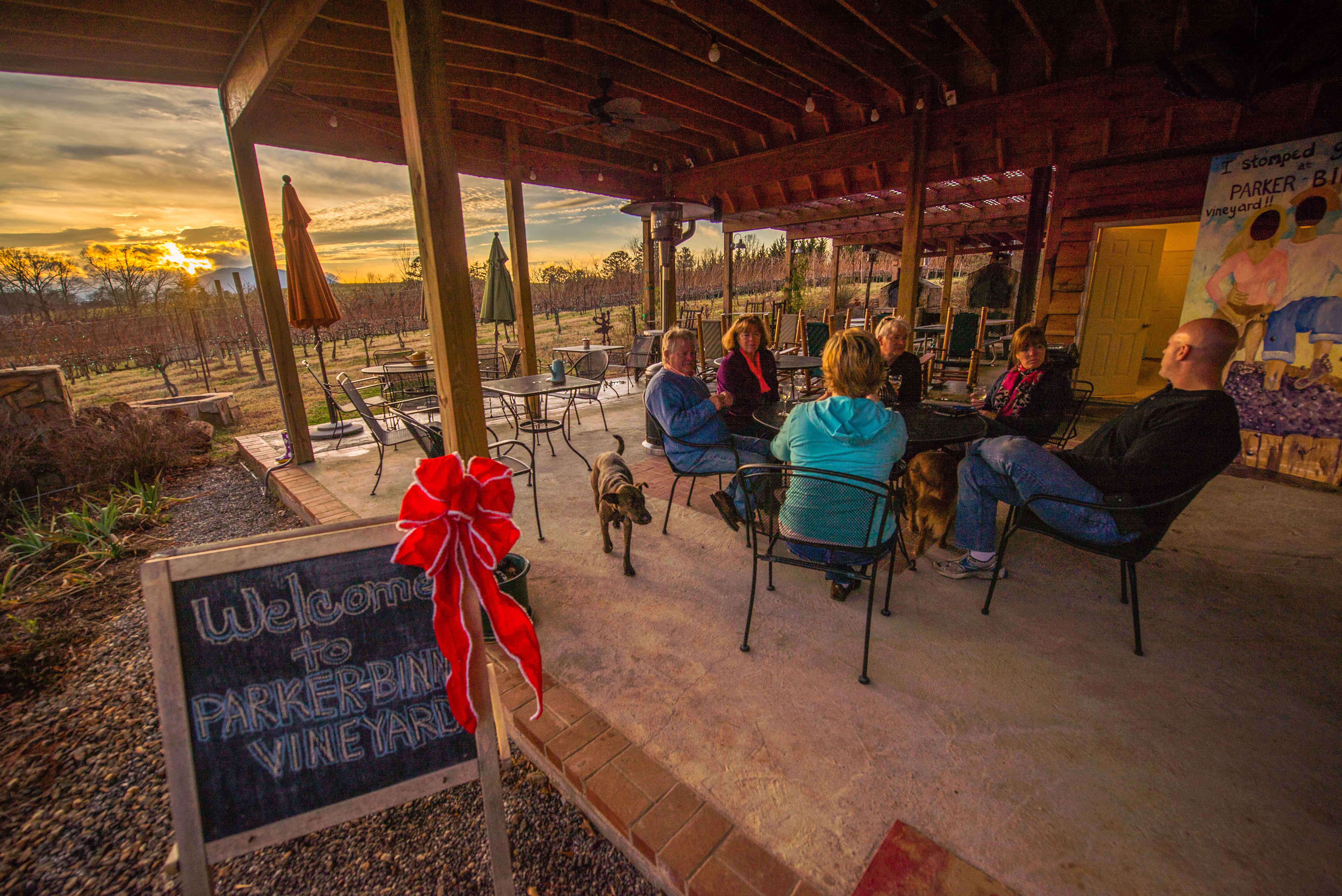
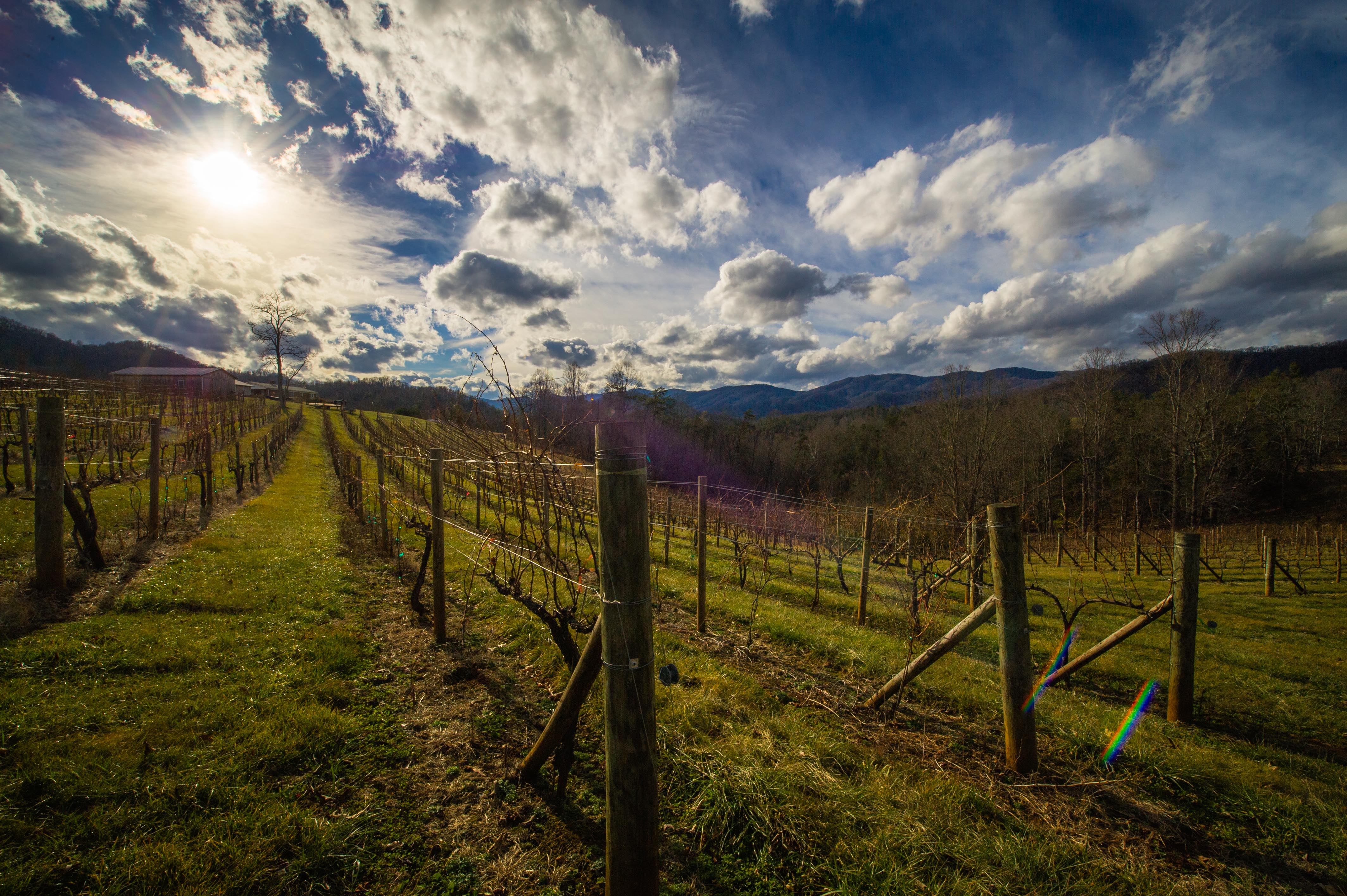
Just outside Tryon, in Mill Spring, sits Parker-Binns Vineyard and Winery. Wind down the gravel driveway lined with picturesque Yoshino cherry trees on any given summer day, and you are bound to see blossoming white flowers framing a landscape of acres and acres of rolling hills filled with plump grapes. Lulu, the winery’s dog, might be lying in the sunlight just under the stone arches of the tasting room’s garden, which might well be bursting with colorful bloomage. But right now, it’s January, and the trees are naked hands with spindly bare fingers. The vines hang on their braces like scarecrows, with arms outstretched, as chickens cluck in the distance.
THE GOOD LIFE: “The beauty of being in a business, particularly when you get older, is that it makes you feel alive. … Making wine is a simple life with hard work, but it’s very enjoyable,” says Bob Binns. Photo by Pat Barcas
“I think North Carolina wines are improving,” says Bob Binns. He and his wife, Karen Parker-Binns, moved here from Florida to open Parker-Binns seven years ago. “Since we came here in 2008, I can see a vast difference in the quality of the wine.”
“All we really intended to do was grow grapes in the summer and go back to Florida in the winter,” says Karen. Initially they were negotiating to sell grapes to the Biltmore Estate, but when the recession hit in 2008, Biltmore stopped buying grapes from outside sources, and the couple decided that rather than take a loss on the harvest, they could make the wine themselves.
“When I called the Biltmore, they said, ‘We’re not taking on anymore new growers now.’” Bob adds: “And I thought, holy geez, what are we going to do with all these grapes? And that’s when we started making our own wine.”
As has been the trend in the area since the ’90s, Parker-Binns focuses on traditional, European Vitis vinifera grapes, a direct retreat from the sugar-laced wines that have come to dominate the state. The winery grows chardonnay, merlot, cabernet sauvignon, cabernet franc, muscat, petit manseng and chambourcin.
“I’m very particular about the grapes I grow,” says Karen. “Some people think I’m anal, but I think that wine is made in the vineyard. And you’ve got to grow the cleanest, best fruit that you can grow, because that is what your wine is going to be. I’m very much a minimalist in the winery. I try to do the minimum of tampering with the grapes. I add the yeast, I get out of the way and I let the wine make itself.” In fact, Parker-Binns’ blackberry wine is the only one they make that contains any added sugars.
The wines reflect Karen’s dedication. The rosé is made of cabernet sauvignon and is a rich pink color, tasting of fresh strawberries and lemon zest. It is crisp, ripe and complex, more so than any other local rosé I’ve tried.
The cabernet has a rusty red coloration with a thick watermark for such a young age. There is a distinct note of chocolate in the nose, and its palate is slick and viscous, like a classic Bordeaux and not weighty like a lot of California reds. It’s high in acid, but softened by a light sizzle of tannins across the sides of your tongue. At under $20, it’s a pretty remarkable wine. There is, however, an unmistakable flavor found in most North Carolina wines: a mineral quality with a slight sour at the tail, the telltale flavor of the foothills terroir.
“We were in the bar and restaurant business for a long time, and then we went into the tree-farming business,” Karen recounts. “I’ve been into wine for a long time,” Bob adds, “so it wasn’t much of a stretch to go from farming to making wine.”
Well into his 80s, and despite what appears to be boundless energy, Bob finds himself keenly aware of his growing limitations. “We’re getting older and we realize we need new blood,” he says. “So now our daughter and son-in-law have come into the business.” They never planned on it, but both Bob and Karen seem to think it is inevitable that the addition of such young energy is bound to cause the small-production winery to expand its operations.
A trend in North Carolina wine is that it is usually made by people who really like to work. If it isn’t someone who already has another successful business opening a winery, it is often someone who was bored with corporate life. Or, more commonly, someone who has retired and can’t stand the thought of not working.
“The beauty of being in a business, particularly when you get older, is that it makes you feel alive,” says Bob. “Most people, when they retire, they get out of the flow of life. The flow of life is that you have to get up every morning and go make a living. … Making wine is a simple life with hard work, but it’s very enjoyable.”
Out with the old
The hardest fight facing the state’s wine surge seems to stem from the roots, from the environment itself. “I think North Carolina is still struggling to find the grape that we absolutely should be growing,” Karen says. “You can make that same bottle of wine year after year in California, because they don’t have the kind of weather we do. We get a box of chocolates here — we never know what we’re going to get until it hits us.”
“It’s really hard to grow the vinifera grapes around here,” says Samantha Biggers. She and her husband, Matt, have just planted their first vines for their new venture, Morning Star Vineyards, in the Dutch Cove community just outside Canton. “They just aren’t very cold-hardy, and if it gets down to negative-5 degrees, you’re going to lose them. You may not see that happen very often, but even if it happens every five years, you lose your grape vines and you have to start all over.”
The Biggerses are young, in their 30s. After inheriting a significant swath of land from her grandfather, a former bootlegger, Samantha decided to follow in his steps and use the land to produce local hooch, with the intent of giving her dry county its first local winery. But unlike most regional winemakers, the Biggerses intend to use local varietals like Catawba and Concord grapes to make rustic, dry wines. Having just planted their first vines in 2013, they are still years away from their first real crush. But that hasn’t stopped them from aggressively pursuing a distinct vision for their winery.
“Part of the problem is that we don’t have a sense of place here,” Samantha says. “People go to Italy or they go to France, and they see the wineries, and they want to do that. But we’re not Italy or France. People come here because they want to see Appalachia, they want to see our history and our people.”
A family affair
“There is nothing about this that is easy, but it has certainly been something that has been enjoyable,” says Jeff Frisbee. He and his wife ventured into viticulture after Jeff was laid off for the second time from a technology-sales position. “I was tired of being a line-item expense that could be taken out that easily,” he says.
So he rooted down in a business of his own, turning his family’s struggling cattle and tobacco farm into Addison Farms Vineyard in Leicester. “We wanted to do something that would preserve the family farm,” he says, “and we were looking for something that had the potential to make a living. Now, we are not there yet, but we’re getting closer.”
Addison Farms Vineyard’s first vines were planted in 2009 by Frisbee and his father, who set just an acre of grapes. He spent his time on unemployment laboring in the vineyard, preparing himself for his entrepreneurial future while taking viticulture classes at Surry Community College. In 2010, they did their first crush, with fruit bought from other growers within the area. By 2011, they were pressing their own grapes and expanding the winery. The vineyard currently encompasses 7 acres, yielding 50-60 percent of the needed harvest.
ROOTING DOWN: Jeff Frisbee turned his family’s struggling cattle and tobacco farm in Leicester into Addison Farms Vineyard in 2009 after being laid off for a second time from his technology-sales job. Photo by Pat Barcas
“I expect that it will go on like that forever,” Frisbee says. “We’ll always grow some of our fruit and we’ll buy some of it.”
Buying grapes is not uncommon in the wine world. For hundreds of years in France, négociants have been farming and selling grapes to winemakers. For many operations, that is both a good thing and a bad one. A négociant will never grow the grapes the way you would, however, it does free some time for the winemaker to focus on making the wine and tending to other aspects of the brand, or in the Frisbees’ case, work their day jobs. Jeff still works in technology sales and enterprise communications, and his wife is an art director for a motion-graphics business in Atlanta.
“We’re finally home,” says Jeff, “I’m working a project with my folks, and I’ve spent more time with them in the last four years than I had in the 20 years prior to that. It’s just nice to be home.”
For many consumers, the main critique of North Carolina wines is that they aren’t up to par with the wines of Italy, Spain or France. For others, it is a matter of price disparity. Yet those same people will pay upward of $20 for a six-pack of locally made craft beer that features mail-ordered hops without batting an eye.
True, North Carolina wine might never compare to the sour grapes of the black-slated Priorate, and we will never hold a candle to the white rocks and extinct river bed of the Châteauneuf-du-Pape, but then again, nobody here seems to be trying to do that. For winemakers here, it is about making a living they can feel proud of. It’s about continuing a legacy of farming in their family and on their family’s land, or seeing the sun set on their lives while working a job that makes them feel dignified and honorable. And it’s about welcoming guests from all over to lean back on the patio and sip a glass of wine, made by the hands of your host and from the land on which you sit.
“I am happy that we are a small boutique winery, because I like every step of the process now,” says Karen Parker-Binns. “I can really appreciate a bottle of wine so much better now because I know every single step that went into it. From clearing the land to planting the grapes to harvesting, pulling the leaves off, all the way to the crush. Everything. Every bottle of wine has a story.”



 Facebook
 Twitter
 Pinterest


 Facebook
 Twitter
 Pinterest


 Facebook
 Twitter
 Pinterest